U.S. Department of Transportation
Federal Highway Administration
1200 New Jersey Avenue, SE
Washington, DC 20590
202-366-4000
MAP-21 - Moving Ahead for Progress in the 21st Century
Note: This document was canceled on 05/13/2016 by: Transportation Alternatives (TA) Set-Aside Implementation Guidance
FINAL: June 10, 2013, Updated March 6, 2014
This guidance supersedes all previous guidance, including questions and answers, regarding the Transportation Alternatives Program.
The Transportation Alternatives Program (TAP) was authorized under Section 1122 of Moving Ahead for Progress in the 21st Century Act (MAP-21) and is codified at 23 U.S.C. sections 213(b), and 101(a)(29). Section 1122 provides for the reservation of funds apportioned to a State under section 104(b) of title 23 to carry out the TAP. The national total reserved for the TAP is equal to 2 percent of the total amount authorized from the Highway Account of the Highway Trust Fund for Federal-aid highways each fiscal year. (23 U.S.C. 213(a))
The TAP provides funding for programs and projects defined as transportation alternatives, including on- and off-road pedestrian and bicycle facilities, infrastructure projects for improving non-driver access to public transportation and enhanced mobility, community improvement activities, and environmental mitigation; recreational trail program projects; safe routes to school projects; and projects for planning, designing, or constructing boulevards and other roadways largely in the right-of-way of former Interstate System routes or other divided highways.
Section 1122 of the Moving Ahead for Progress in the 21st Century Act (MAP-21) established TAP in 23 U.S.C. 213. Section 1105 of MAP-21 provides for the apportionment of funds in 23 U.S.C. 104(b), from which TAP funding is set aside.
Projects funded under TAP must comply with all applicable Federal requirements. The following sections of title 23 are among the requirements that most often need to be considered:Activities eligible under the following section of Safe, Accountable, Flexible, Efficient Transportation Equity Act: A Legacy for Users (Public Law 109-59) are eligible under TAP:
The following section of MAP-21 is also applicable to TAP:
Each State's TAP funding is determined by dividing the national total among the States based on each State's proportionate share of FY 2009 Transportation Enhancements funding. Within each State, the amount for TAP is set aside proportionately from the State's National Highway Performance Program (NHPP), Surface Transportation Program (STP), Highway Safety Improvement Program (HSIP), Congestion Mitigation and Air Quality Improvement Program (CMAQ), and Metropolitan Planning apportionments. (23 U.S.C. 213(a))
The following table shows the national total for TAP under MAP-21:
| Fiscal Year | Transportation Alternatives Program Funds |
|---|---|
| FY 2013 | $808,760,000 |
| FY 2014 | $819,900,000 |
| TOTAL | $1,628,660,000 |
The Fiscal Management Information System (FMIS) program codes were provided to the FHWA Division Offices and States:
| FHWA Program Code | Program Description |
|---|---|
| M300 | Transportation Alternatives Program (TAP) Flex |
| M301 | TAP - Urbanized Areas With Population Over 200K |
| M302 | TAP - Areas with Population Over 5K to 200K |
| M303 | TAP - Areas with Population 5K and Under |
| M940 | Recreational Trails Program (RTP) |
| M941 | Return of 1% for RTP Administration |
| MR10 | State RTP Administration |
| MR20 | RTP Educational Programs |
Period of Availability: TAP funds are available for obligation for a period of 3 years after the last day of the fiscal year for which the funds are authorized. This includes funds set aside for the Recreational Trails Program (RTP). (23 U.S.C. 118)
Funds apportioned for Transportation Enhancement (TE) activities and the RTP prior to MAP-21 are available for a period of 3 years after the last day of the fiscal year for which the funds were authorized. (23 U.S.C. 118)
Funds apportioned for the Safe Routes to School (SRTS) Program prior to MAP-21 are available until expended. (SAFETEA-LU §1404(i))
Contract Authority and Obligation Limitation: TAP is funded by contract authority from the Highway Account of the Highway Trust Fund. The TAP funds are subject to the annual obligation limitation imposed on the Federal-aid highway program.
The Federal share for TAP projects is as follows:
As provided in 49 CFR 18.24 "Matching or cost sharing", the following requirements are emphasized:
18.24(b) Qualifications and exceptions-(1) Costs borne by other Federal grant agreements. Except as provided by Federal statute, a cost sharing or matching requirement may not be met by costs borne by another Federal grant. This prohibition does not apply to income earned by a grantee or subgrantee from a contract awarded under another Federal grant.
(3) Cost or contributions counted towards other Federal costs-sharing requirements. Neither costs nor the values of third party in-kind contributions may count towards satisfying a cost sharing or matching requirement of a grant agreement if they have been or will be counted towards satisfying a cost sharing or matching requirement of another Federal grant agreement, a Federal procurement contract, or any other award of Federal funds.
Innovative Financing and Programmatic Match: MAP-21 eliminated the provision for innovative financing and programmatic match that was available for TE funds in 23 U.S.C. 133(e)(5)(C) (authorized in the Transportation Equity Act for the 21st Century). Therefore:
Donations: 23 U.S.C. 323: Title 23 Section 323 allows the fair market value of donated land that is acquired for a Federal-aid project, and allows credit for donations of funds, materials, or services. At the option of the State, these donations may be used to reduce State or local cash contributions required to meet the State or local matching share. For additional information on donations, see Federal-Aid Guidance Non-Federal Matching Requirements.
Advance Payment Option: MAP-21 eliminated the provision for an Advance Payment Option that was available for TE funds under 23 U.S.C. 133(e)(3)(B) (originally authorized in the National Highway System Designation Act of 1995, and amended in the Transportation Equity Act for the 21st Century).
B. ALLOCATIONS, SUBALLOCATIONS, AND TRANSFERS OF FUNDSSuballocation: Fifty percent of a State's TAP apportionment (after deducting the set-aside for the Recreational Trails Program, if applicable) is suballocated to areas based on their relative share of the total State population with the remaining 50 percent available for use in any area of the State. MAP-21 uses the same suballocation structure as STP funds (see 23 U.S.C. 213(c), 23 U.S.C 133(d)).
Suballocations are made available through FHWA's Fiscal Management Information System (FMIS). Figure 1 shows the TAP suballocation:
Figure 1: Transportation Alternatives Program Suballocation
Source: https://www.fhwa.dot.gov/map21/qandas/qasuballocation.cfm
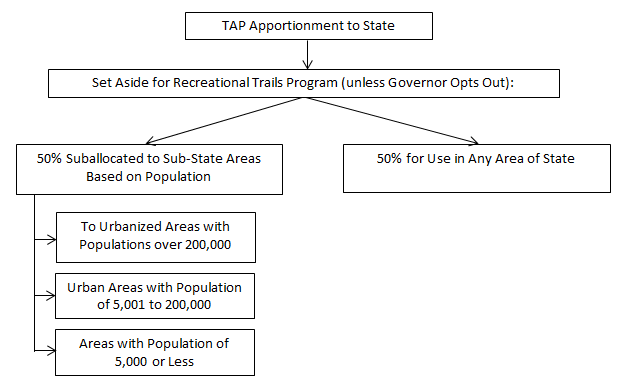
MAP-21 Text:
23 U.S.C. 213(c) Allocations of Funds.--Distribution among urbanized areas with populations over 200,000: States are required to obligate funds in urbanized areas with populations over 200,000 (which are referred to in this discussion as "large urbanized areas") based on their relative share of population, unless the Secretary approves a joint request from the State and relevant Metropolitan Planning Organization(s) (MPO) to use other factors in determining obligation (see 23 U.S.C. 213(c)(3)). Eligible entities within any large urbanized area also may apply to the State for "any area" funds. For large urbanized areas that cross State lines, each large urbanized area will receive an amount of suballocated funds. Eligible entities within these areas also may apply to their respective States for "any area" funds.
There may be MPOs with multiple urbanized areas, including one or more with populations above 200,000, and one or more with populations below 200,000. To be consistent with policies that govern the suballocation of STP funds, the large urbanized area's suballocated TAP funds may be used anywhere within the MPO planning boundaries that cover the large urbanized area. In addition, eligible entities within an urbanized area that is not a large urbanized area, but is still within the larger MPO planning boundaries, may also compete for TAP funds suballocated to areas between 5,001 and 200,000 population and for "any area" TAP funds. Any proposed projects within an MPO's planning area must be consistent with the relevant metropolitan transportation planning process.
Distribution among Small Urban Areas: MAP-21 does not require suballocation to individual local government entities, to individual MPOs with populations less than 200,000, or to other individual small urban areas. MAP-21 requires the State to have a competitive process to allow eligible entities to submit projects for funding; therefore, the State may not suballocate the small urban area funds by population to individual counties, cities, or other local government entities (23 U.S.C. 213(c)(4)(A)). The State's competitive process may include selection criteria to ensure a distribution of projects among small MPOs and other small urban areas across the State.
TAP funds suballocated for use in areas with a population between 5,001 and 200,000 may be used anywhere in those areas, including within the metropolitan planning area boundaries of an MPO serving an urbanized area with a population less than or equal to 200,000 (23 U.S.C. 213(c)(4)(A)). Eligible entities within any small urban area also may apply to the State for "any area" funds.
Distribution among Nonurban Areas: MAP-21 does not require suballocation to individual entities within areas of populations less than 5,000. MAP-21 requires the State to have a competitive process to allow eligible entities to submit projects for funding; therefore, the State may not suballocate the nonurban area funds by population to individual counties, cities, or other local government entities (23 U.S.C. 213(c)(4)(A)). The State's competitive process may include selection criteria to ensure a distribution of projects across the State. Eligible entities within any nonurban area also may apply to the State for "any area" funds.
Distribution of Any Area Funds: MAP-21 does not require suballocation of "any area" funds. The State's competitive process may include selection criteria to ensure a distribution of projects across the State; therefore, the State may not suballocate the "any area" funds by population to individual counties, cities, or other local government entities. MAP-21 requires the State to have a competitive process to allow eligible entities to submit projects for funding (23 U.S.C. 213(c)(4)(A)). The "any area" funds are available for projects in any area within a State, including within large urbanized areas, small urban areas, or nonurban areas.
A State may transfer up to 50 percent of TAP funds to NHPP, STP, HSIP, and CMAQ from the portion of TAP funds available for use anywhere in the State (no transfers of suballocated TAP funds or funds set aside for the RTP, which are discussed below). (MAP-21 §1509; 23 U.S.C. 126)
Funds may be transferred to the Federal Transit Administration (FTA) for TAP-eligible projects. If a transit project eligible under TAP is selected, funds for the project may be transferred to FTA to administer the project in accordance with chapter 53 of title 49. Funds may be transferred in the same manner as other Federal-aid highway program procedures. (23 U.S.C. 104(f))
Projects eligible under TAP are generally eligible for STP funds and STP funds may be used for TAP projects without making a transfer. (23 U.S.C. 133(b)(11)). If a State funds a TAP-eligible project under STP, then STP provisions and requirements apply. TAP provisions and requirements would not apply.
Section 126 of title 23 provides the States with flexibility to shift program funds from one Federal-aid apportioned program category to another subject to certain limitations (see Funding Transfer Guidance to be issued). Upon transfer, the funds transferred are eligible to be obligated for the same purposes and under the same requirements that apply to the funding category to which funds are transferred.
Section 213(d) allows:
The effective date of MAP-21 was October 1, 2012; therefore, §213(d) refers to August 1, 2014. (MAP-21 §3).
The term "exceeds 100 percent" applies to the ratio of the unobligated balance of available funds compared to total apportioned amount within a fiscal year.
In Section 213(d)(2), Section 149 refers to the Congestion Mitigation and Air Quality Improvement Program (CMAQ). States with nonattainment or maintenance areas may use TAP funds transferred under this Flexibility provision for any TAP or CMAQ project.
Selection of Projects: Consistent with other Federal-aid highway programs, TAP funds are administered by the State Department of Transportation (State DOT). TAP funds must be used for eligible projects that are submitted by eligible entities (listed below in Section D) and chosen through a competitive process (23 U.S.C. 213(c)(4)(A)). TAP does not establish minimum standards or procedures for competitive processes.
The statute requires the following with respect to the selection of projects:
In a large urbanized area, an MPO representing the large urbanized area may allow the State to run its competitive process. However, the final project selection decision must be retained by the MPO and the State cannot require an MPO to turn over the selection process to the State. (23 U.S.C. §§ 134(k)(4)(A) & 213(c)(5)). States and MPOs have discretion about how to establish project priorities, or whether to fund (or not fund) particular categories. There is no requirement to consider all eligible TAP activities equally.
Under 23 U.S.C. 213(c)(4)(B), the Eligible Entities to receive TAP funds are:
State DOTs and MPOs are not eligible entities as defined under 213(c)(4)(B) and therefore are not eligible project sponsors for TAP funds. However, State DOTs and MPOs may partner with an eligible entity project sponsor to carry out a project.
Nonprofit organizations are not eligible as direct grant recipients for TAP funds unless they qualify through one of the eligible entity categories (e.g., where a nonprofit organization is a designated transit agency or a school). Nonprofits are eligible to partner with any eligible entity on a TAP project, if State or local requirements permit.
Local government entities include any unit of local government below a State government agency, except for a Metropolitan Planning Organization. Examples include city, town, township, village, borough, parish, or county agencies.
Regional transportation authorities are considered the same as the Regional Transportation Planning Organizations defined in the statewide planning section (23 U.S.C. 135(m)).
Transit agencies include any agency responsible for public transportation that is eligible for funds under the Federal Transit Administration.
Natural resource or public land agencies include any Federal, Tribal, State, or local agency responsible for natural resources or public land administration. Examples include:
School districts, local education agencies, or schools may include any public or nonprofit private school. Projects should benefit the general public, and not only a private entity.
The Recreational Trails Program (RTP) set-aside funds retain the RTP eligible project sponsor provisions under 23 U.S.C. 206. (23 U.S.C. 213(f)(3))
The project selection process and the eligible project sponsor requirements apply for all TAP eligibility. TAP projects are not required to be located along Federal-aid highways. Activities eligible under TAP are eligible for STP funds (23 U.S.C. 133(b)(11)). Some aspects of activities eligible under TAP also may be eligible under other Federal-aid highway programs.
Under 23 U.S.C. 133(c)(2), TAP-eligible projects funded with STP funds are exempt from the location restriction in 23 U.S.C. 133(c). See Section C of the Surface Transportation Program Implementation Guidance for more information.
For SRTS noninfrastructure projects, traffic education and enforcement activities must take place within approximately two miles of a primary or middle school (grades K - 8). Other eligible noninfrastructure activities do not have a location restriction. SRTS infrastructure projects are eligible for TAP funds regardless of their ability to serve school populations, and SRTS infrastructure projects are broadly eligible under other TAP eligibilities, which do not have any location restrictions.
Under 23 U.S.C. 213(b), eligible activities under the TAP program consist of:
TAP funds cannot be used for:
Careful consideration should be given to whether an activity falls within the eligibilities created under TAP. Section 1103 of MAP-21 eliminated the definition of transportation enhancement activities in section 101 of title 23 and inserted in its place a definition of transportation alternatives. The transportation alternatives definition contained in 23 U.S.C. 101(a)(29) created different categories of activities than those included under the previous transportation enhancement definition. As a result, some activities that were previously eligible as independent transportation enhancement projects are no longer eligible; some categories of eligibility remain, but for a different range of activities. In some cases, activities that are no longer eligible for funding as independent TAP projects may be eligible for FHWA participation under other title 23 provisions, such as project mitigation measures when determined necessary to mitigate project impacts (including the impacts of a TAP project). Transportation enhancement categories that are no longer expressly described as eligible activities under the definition of transportation alternatives are:
TE funds apportioned in prior years will continue to be available for their specified period of availability under the same terms and conditions in effect prior to the effective date of MAP-21.
If there are insufficient TE funds to cover all previously selected TE projects, then a State may use old TE funds on projects that were eligible under TE, but are no longer eligible under TAP, and use TAP funds for previously selected TE projects that remain eligible. Note that TAP projects must be selected through a competitive process.
Section 213(e) requires:
The "treatment of projects" requirement (23 U.S.C. 213(e)) means that all projects carried out using TAP funds (except for recreational trails projects carried out under the RTP set-aside) must comply with applicable provisions in title 23, such as project agreements, authorization to proceed prior to incurring costs, prevailing wage rates (Davis-Bacon), Buy America, competitive bidding, and other contracting requirements, regardless of whether the projects are located within the right-of-way of a Federal-aid highway.
Some eligible subgrantees may include partners at the community level who may not be familiar with title 23 requirements. It is important that the State fully inform potential subgrantees of these Federal requirements ahead of time. Some subgrantees may wish to seek a lead sponsor such as a public works department that has experience with Federal construction contracts in general, and title 23 in particular.
Additional treatment of projects notes:
MAP-21 Section 1524 requires the US DOT/FHWA to "...encourage the States and regional transportation planning agencies to enter into contracts and cooperative agreements with qualified youth service or conservation corps...to perform appropriate projects eligible under sections 162, 206, 213, and 217 of title 23, United States Code, and under section 1404 of the SAFETEA-LU."
To the extent the requirements of 23 U.S.C. 213(e) relating to Treatment of Projects conflicts with the express provisions in section 1524, the provisions in section 1524 prevail. There are differences between MAP-21 Section 1524 and the newly established 23 U.S.C. 213(e) under TAP regarding compliance with Federal-aid highway requirements. MAP-21 Section 1524 provides exceptions to certain requirements regarding pay rates and contracting requirements for projects using contracts and cooperative agreements with qualified youth service or conservation corps for certain projects.
Section 1524(b)(1) requires the Secretary to establish a living allowance or rate of pay for youth service and conservation corps as required under State law or at an amount not to exceed the maximum living allowance authorized by 42 U.S.C. 12594 (as implemented by Part 4 -- Corporation for National and Community Service of OMB Circular A-133 Compliance Supplement 2012, available at www.whitehouse.gov/omb/circulars/a133_compliance_supplement_2012).
Section 1524(b)(2) exempts contracts and cooperative agreements with youth service and conservation corps from Federal-aid highway program contracting requirements under 23 U.S.C. 112. A State or regional transportation planning agency may sole-source contracts and cooperative agreements to qualified youth service and conservation corps for work undertaken for byway, recreational trail, transportation alternatives, bicycle and pedestrian, or SRTS projects.
MAP-21 section 1122 amended the RTP to make the funding a set-aside from the TAP. Unless the Governor opts out in advance, an amount equal to the State's FY 2009 RTP apportionment is to be set aside from the State's TAP funds for recreational trails projects. (23 U.S.C. 213(f)-(g)). All RTP provisions and requirements continue under section 206 of title 23. (23 U.S.C. 213(f)(3).
Under 23 U.S.C. 213(f), if continuing the RTP:
If opting out of the RTP:





