




| << Previous | Contents | Next >> |
Construction Program Management and Inspection Guide
3. Construction Program Management (continued)
Objectives of Inspection
Inspections, either at the project or program level, are the primary method used by FHWA for fulfilling its construction program oversight responsibilities. Oversight represents the compliance or verification component of FHWA's stewardship activities.
Project oversight requirements may be different depending upon the stewardship agreements, but the general objectives of construction inspections are the same. Although STAs may be delegated the authority to administer the program within the scope of 23 USC and related Federal laws, FHWA retains the responsibility to assure that projects are being administered in full compliance. Specific objectives are as follows:
- Obtain assurance that the project has been completed in reasonably close conformity with plans and specifications including authorized changes and extra work. Provide a basis for acceptance of the project and reimbursement of project costs with Federal-aid funds.
- Acquire information on problems and construction changes. Provide an opportunity for timely remedial action where applicable. Provide documentation of solutions to problems or commitments. Encourage other STA units' involvement and awareness of problems to avoid future reoccurrence.
- Assess the State's abilities and effectiveness in managing and controlling Federal-aid construction projects with respect to items such as these:
- Qualifications-training, certification, written guidance
- Staffing, equipment, and facilities
- Performance
- Project documentation, including inspection diaries, test reports, etc.
- Promote the development and implementation of quality management programs.
- Offer technical and procedural advice. Recommend improved construction techniques and engineering supervision.
- Report on special or innovative construction materials, methods, procedures, new equipment, and other technological innovations.
- Professional development of FHWA and State review personnel.
- Other items, such as these:
- Establish contact and communications with project staff.
- Become familiar with project.
- Attend partnering workshops and project progress meetings.
- Monitor and evaluate progress of work.
- Provide support and encouragement for project personnel.
- Focus division resources on critical construction features and practices.
- Follow up on previous inspection findings.
- Lessons learned.
Purposes of Construction Inspection Reports
Document Project History and Compliance
Construction inspection reports fulfill four basic requirements:
- Provide permanent file evidence that inspections are being made as required by Federal regulations.
- Provide a basis for acceptance of completed work.
- Document field conditions, contractor performance, and the State's project management.
- Document FHWA's role, observations, findings, resolution of identified problems, claims, and any other topics of interest.
FHWA project files are generally maintained through formal final acceptance before being stripped and sent to the Federal Record Center; however, FHWA reports are generally maintained in STA records for several years longer. Field inspection reports should be considered historical project records.
To establish timeframes for record maintenance, consult the Office of Management and Budget policy contained in Circular No. A-130, Revised (Transmittal Memorandum No. 4) and available at https://www.whitehouse.gov/omb/circulars/a130/print/a130trans4.html#1. The FHWA Files Management and Records Disposition schedules are available on the FHWA Web site at https://www.fhwa.dot.gov/legsregs/directives/orders/m13241.htm.
The inspecting engineer should be aware that FHWA inspection reports are subject to Freedom of Information Act requirements, as described in Circular No. A-130. Potential readers can be from the general public, and inspection reports can be used in litigation. These possibilities underscore the importance of reporting only facts, observations, and professional recommendations, and not unnecessary personal opinion. More information is available at https://www.fhwa.dot.gov/foia/.
Convey Information to the Reader
The report writer should take into consideration a variety of potential readers. To be comprehensive and coherent, the report should cover these areas:
- Activities taking place on the project during the inspection.
- Observations and actions taken regarding quality and progress of work.
- Comments on the adequacy of the project administration by the contracting agency's representatives (staffing, supervision, documentation, measurement and payment of contract items, material issues, etc.).
- Adequacy of addressing traffic control, safety, and environmental issues.
- The STA's handling of change or extra work including proper justification for the work and adequacy of supporting documentation.
- Information on special or unusual technical topics.
- Followups from previous reports.
All reports should be clear, concise with facts, and free of unnecessary personal opinions, and should include positive and constructive observations. Above all, reports should be accurate and specific since the content may be used in evaluating or refuting contract claims.
The original report should be filed in the division's project file, a copy sent to the STA, and a copy circulated to the program technical specialist and appropriate management in the division office. Reports should be made available to headquarters and the FHWA Resource Center as appropriate.
Inspections: Types and Scope
This Guide suggests the use of specific types of construction inspections. The type of inspection will vary depending on the time at which it is conducted, the objective of the inspection, and the FHWA-STA stewardship agreement criteria. Various types of inspections may be combined depending on the circumstances. The following descriptions of construction inspection classifications have been developed to provide guidance for FHWA offices on construction monitoring activities.
The FHWA Construction and Maintenance Web page (https://www.fhwa.dot.gov/construction/) provides generic construction review guidelines to provide the FHWA division offices and STAs with examples of process and indepth reviews that have been undertaken by various field offices. These generic "samples" should be modified as appropriate to meet specific State program needs.
Process Review/Product Evaluation
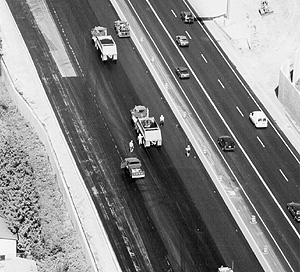 Process review/product evaluations (PR/PEs) are comprehensive reviews that have three primary objectives:
- Assure that State processes, procedures, and controls are in substantial conformance with Federal requirements.
- Assure that projects are constructed in substantial conformance with State processes, procedures, and controls.
- Identify opportunities and implementation plans to advance existing processes, procedures, controls, and technology to the state of the practice or state of the art.
PR/PEs are oriented toward reviewing the STA's method of doing business with enough product verification to assure that the process is working satisfactorily. Process reviews are generally undertaken on a statewide or areawide basis and should include a review of the process at key decision points. As appropriate, State Oversight projects should be included in the sample of projects inspected as part of the PR/PE; refer to supplemental information in Appendix C, Sample Guidelines for Process Review/Product Evaluation Programs.
Inspections-in-Depth
Inspections-in-depth (IIDs) may be made on individual projects or may be part of a statewide review effort. IIDs are product oriented but involve the tracking of processes necessary to correct deficiencies or to identify and promote processes that produce high quality products on either a project or statewide basis. They are a detailed type of inspection involving the review of specifications, procedural manuals, and specific contract requirements.
IIDs, as well as PR/PEs, of a subject area will require a considerable degree of review effort (Appendix D, Guide for Making Inspections-in-Depth on Federal-Aid Highway Construction Projects). Considerable preliminary work is required to develop the appropriate review criteria. IIDs are useful to follow up on recommendations or implementation of changes defined by process reviews. A blending of both IID and PR/PE has proven to be most effective when balanced with other routine project reviews.
The team review concept with the STA's central office is recommended for both PR/PEs and IIDs in coordination to make the reviews more efficient and effective.
Project Inspection
Project inspection is an on-site review to evaluate project activities, the quality and progress of the work, and, if appropriate, to follow up on findings from previous inspections.These reviews are generally more limited in scope than a PR/PE, IID, or phased inspection.
Final Inspection
A final inspection is a review to determine the extent to which the project has been completed in reasonably close conformance with the plans, specifications, and authorized changes. The division administrator should develop and include, as a part of the construction management program, a process to determine the final inspection requirements for construction projects. This determination should consider the type, size, and complexity of the project, the degree to which the project has been previously inspected by FHWA personnel, the adequacy of the STA's internal controls, and the extent of independent inspections and evaluations that have been provided by the State. The final inspections are conducted in accordance with the FHWA/STA stewardship agreement.
A final inspection may be accomplished by any of the following methods:
- An on-site review conducted at or near the completion of work.
- A review of project records that are provided by the State at the completion of work if prior on-site inspections have been conducted.
- If previous PR/PE or IID reviews of the STA's internal control programs for inspection of completed projects have indicated the STA has satisfactory procedures, the final inspection may be based on the finding that the STA is properly exercising its internal controls, and no additional review will be required.
- When similar types of work are included in an areawide project or projects using the same contractor, an inspection of a sample of contract work locations may fulfill the requirement for a final inspection.
Specialty Reviews
Sometimes division offices develop other types of review activities patterned after the basic inspection types in an effort to better meet their needs and the management style of the STA. Special emphasis reviews have been used successfully to focus attention on high priority/high visibility topics; as fact-finding tools for preliminary investigations; for evaluating project staffing levels; for making state-of-the-art evaluations; for determining the extent of suspected problem areas; or for concentrated problem solving efforts.
Emphasis area reviews will typically be less detailed than major phase reviews but will be more detailed than a project inspection. This type of review envisions that a concentrated effort will be expended over a number of projects to direct added emphasis to a particular item or phase for a short period of time.
Phase reviews will typically target a major phase of work where all parts, such as paving, will be reviewed. Minor phases or portions of major phases, such as crushing or plant operations, may occasionally be reviewed. Reviews will typically be comprehensive but may be in less detail than an IID.
Contact reviews are useful for monitoring the status of changing situations, change orders, and construction operations. They are also useful in maintaining effective rapport and working relationships with State counterparts and local officials, and they can facilitate the scheduling of more detailed inspections. They typically should not replace the more indepth reviews. However, they can be effective when properly controlled. While inspections should be on site, contacts by telephone or when passing through a project help to keep FHWA aware of project status and conditions.
Factors to Consider
In planning inspection activities, a number of factors need to be considered. Of prime importance is the objective of the inspection. Is it for fact-finding, program emphasis, problem identification, problem solving, verification, or another purpose? Identification of the objective may assist in determining the inspection technique to be used. Sometimes a broad-based review is desired, and at other times it may be appropriate to review only selected elements in some depth on a few typical or individually chosen projects.
Timing of the inspection in relation to construction activities can dictate or limit the type of inspection to be made. The time available for the inspection will help to determine if one of the more intensive types of inspections can be used. Sometimes it will be necessary to evaluate the potential benefits of making a greater number versus more indepth inspections.
Inspection selection decision should be based on program insight and knowledge of the STA's staffing and performance. This is an area of risk management where feedback from the field engineer is necessary to optimize not only review efforts but also construction program direction. It should be recognized that these post-award activities are a logical progression of pre-award actions (planning, environment, design, etc.) in which various standards, commitments, and conditions have been agreed to for compliance with a variety of Federal/State/Local requirements.
| << Previous | Contents | Next >> |