




| << Previous | Contents | Next >> |
Performance Specifications Strategic Roadmap: A Vision for the Future
[Archived] Chapter 4. Organization and Management
Management Structure
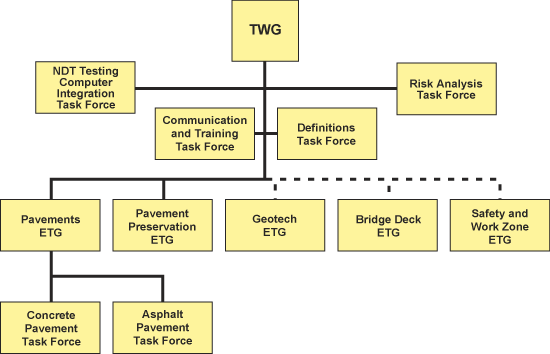
An organization or a movement? The Performance Specification Program is a combination of both elements. The program has established a Technical Working Group to establish and oversee the road map and its execution. Fundamental to the road map is the identification and formation of expert task groups that will do the bulk of the technical work specific to that discipline. In the diagram below, boxes connected with solid lines represent structure in place, while those with dotted lines are anticipated.
Working Group and Task Group Membership
The Technical Working Group will consist of representatives from FHWA, State DOTs, industry, and academia with background, expertise, and interest in promoting the performance specification concept. Each expert task group will have one representative on the Technical Working Group. Membership will be flexible. As emphasis on various goals and tasks changes, Technical Working Group membership will change appropriately. It is expected that the Technical Working Group will average 14 representatives.
Current members include five representatives from State DOTs, five from FHWA, four from the pavement industry, and one from academia. Among the DOT members are representatives from the AASHTO Subcommittees on Materials and Construction, and the Joint Task Force on Pavements. Included in the FHWA membership are representatives from the Offices of Pavement, Bridge Technology, Infrastructure, and Research and Development. Finally, members should represent disciplines with active expert task groups. With disciplines such as geotechnology, safety, bridges, etc., it is expected that the membership will be adjusted to reflect the diversity of the mission and the particulars of each group.
The Technical Working Group will assemble task forces as required to help guide the program. A Definitions Task Force would build on work done by the Transportation Research Board Committee on Management of Quality Assurance, which manages the Glossary of Highway Quality Assurance Terms. The task force would review the definitions in the glossary and recommend updates to reflect PRS and warranty developments. A Communications and Training Task Force would develop a broad outreach program that covers the full spectrum of PS activities and work with the TCCC. A Non-Destructive Testing and Computer Integration Task Force would look at innovations in both of these areas and recommend ways to incorporate them into the various PS activities. Finally, a Risk Analysis Task Force would look at the transfer of roles and responsibilities between transportation agencies and contractors as a result of PS developments. This task force would organize risk management through a quantitative approach that includes a manual and guidelines.
Administrative Support
It is important for at least one organization to take responsibility for the overall program, but in the process allow for the many disciplines involved to participate and cooperate. The FHWA Office of Asset Management will serve as the program's administrative arm. In accepting this role, it will maintain the road map, prepare status reports, and support the activities of the Technical Working Group. The Office of Asset Management also will provide in-house and consultant services, as necessary, to support the effort.
Roles and Responsibilities
The Technical Working Group will guide the program and provide technical support and make recommendations to the FHWA, the states, and industry on how best to accomplish the goals and tasks presented in Chapter 3. The expert task groups will do the same within their specific program areas. The TWG will have the added responsibility of determining if performance principles, definitions, training, and outreach efforts initiated by the expert task groups are reasonably consistent and in harmony with the overall definition of the program. The TWG will also make final recommendations to FHWA and other stakeholders implementing PRS.
Timeline
How long will this performance specification development effort go on? In reality, it is a long-term process. The road map covers the next five years. Table 1 shows the major activities that will be integrated into the goals and tasks presented in Chapter 3. Table 2 outlines the significant accomplishments expected over the same time period.
It should be recognized that the entire program is based on volunteerism by the DOTs and industry and that dependencies abound. It is up to the major national organizations to support the key activities.
Table 1. Activities Timeline
| Pre-2003 | 2003 | 2004 | 2005 | 2006 | 2007 | 2008 | |
|---|---|---|---|---|---|---|---|
| National and International Outreach Efforts | FL DOT PRS Workshop | National Workshop | International Performance Symposium | National Workshop | International Performance Symposium | ||
| TWG Meetings | 2 | 2 | 2 | 2 | 2 | 2 | 2 |
| ETG Meetings | 2 | 4 | 6-10 | 6-10 | 6-10 | 6-10 | 6-10 |
| National Research Initiatives | F-SHRP (anticipated) | ||||||
| FHWA (anticipated) | |||||||
| NCHRP AC | |||||||
| Outreach Activities | PRS Database Newsletter, Articles, Flyers | ||||||
| Construction Projects | Experimental and Demonstration Projects | ||||||
| Specification Database | National Specification Database Performance Specification Section | ||||||
Table 2. Accomplishment Timeline
| By the end of: | The program should: |
|---|---|
| 2004 | Establish a formal Technical Working Group management, structure, and financial support system within FHWA. Establish four to eight permanent technical expert task groups with strategic plans in operation. Implement a quarterly newsletter program. Complete and distribute a management brochure. Implement a fully operational performance specification database. |
| 2005 | Connect to a nationally funded research effort through FHWA's R&D and/or AASHTO's F-SHRP. Develop a detailed, comprehensive research plan for each expert task group. Develop and implement expert task group outreach plans. Draft performance specifications for select technical items in each expert task group area. Initiate experimental and demonstration projects. |
| 2006 | Conduct the first International Specification Symposium. Identify and evaluate risk methodology. Evaluate additional modeling, performance data, and construction relationships. |
| 2007 | Implement major research and deployment efforts. |
| 2008 | Complete draft performance specification book. Complete draft warranty manual. Complete draft risk manual. AASHTO Adoption of Performance Guide Specifications. |
| 2009-2020 | A viable contract option |
| << Previous | Contents | Next >> |