




Technical Advisory T 5040.31 Open Graded Friction Courses
December 26, 1990
Par.
- Purpose
- Cancellation
- Background
- Recommendations
- PURPOSE. To provide technical guidance on the use of open graded friction courses (OGFC), also known as plant mix seal courses, to develop good friction characteristics for pavement surfaces.
- CANCELLATION. Technical Advisory T 5040.13, Open-Graded Asphalt Friction Courses, dated January 11, 1980, is canceled.
- BACKGROUND
- Open graded friction courses constructed with high quality, polish resistant aggregates have an outstanding capacity for providing and maintaining good frictional characteristics over the operating range of speeds onhigh speed highways. Their macrotexture facilitates drainage of water from the tire/pavement interface, improving tire contact with the pavement and reducing the potential for hydroplaning.
- Open graded friction courses have generally provided good performance for 7 to 10 years under a range of traffic conditions. When failures have occurred, many were resolved by making minor refinements to the mix design and construction procedures to adjust for local conditions.
- When compared to other high type surfaces, open graded friction courses have demonstrated the following advantages:
- (1) provide and maintain good high speed, frictional qualities (the frictional characteristics are rela tively constant over the normal ranHx of operating speeds);
- (2) reduce the potential for hydroplaning;
- (3) reduce the amount of splash and spray;
- (4) are generally quieter, often providing a 3 to 5 decibel reduction in tire noise;
- (5) improve the wet weather, night visibility of painted pavement markings; and
- (6) conserve high quality, polish resistant aggregates, which may be scarce in some areas, because they are placed only as a surface layer, up to 3/4 inch thick.
- Open graded friction courses exhibit the following limitations:
- (1) increase the potential for stripping of the surface and underlying pavement (they do not seal the underlying pavement against moisture intrusion);
- (2) require special snow and ice control methods and generally remain icy longer;
- (3) require special patching and rehabilitation techniques;
- (4) do not add structural value to the pavement (theirperformance is governed by the condition of underlying pavement) ; and
- (5) may ravel and shove when used at intersections, locations with heavy turning movements, ramp terminals, curbed sections and other adverse geometric locations.
- RECOMMENDATIONS. In selecting an OGFC, a number of factors should be considered, such as the environmental conditions, alignment, accident rates and the frictional properties of the State's standard surface mixes. Some locations or pavements may not be appropriate for an OGFC and therefore proper project selection must be considered. For an OGFC to perform as intended, it must be properly designed, constructed, and maintained.
- An OGFC should only be placed on structurally sound pavements that have minimal cracks, ruts, bleeding and depressions. Pavement cracks are as likely to reflect through an OGFC as with any other thin asphalt course. The high air voids content in an OGFC will allow water to drain into it and attempt to flow laterally. Ruts in the underlying pavement may inhibit lateral flow and cause water to pond in the ruts, promoting separation of the OGFC from the underlying pavement. An OGFC placed on a bleeding pavement may lose its drainage characteristics (close up) due to the migration of the free asphalt from the underlying pavement.
- The underlying pavement should be sealed with a 50 percent diluted asphalt emulsion, applied at a rate of 0.05 to 0.10 gallons per square yard. An OGFC willincrease the amount of time that the underlying pavement will be wet. If the underlying pavement has a high air voids content, stripping potential is increased.
- Specifications should require the coarse aggregate to be polish resistant and 100 percent crushed material. Carbonate aggregates should not be used. Certain slags and light weight aggregates have demonstrated satisfactory performance. The frictional qualities of an OGFC are affected by the microtexture of the coarse aggregate. It is poor practice to construct a premium friction course and then have its effectiveness lost due to polishing.
- An OGFC should be designed in accordance with the mix design procedures included as the Attachment to this Technical Advisory. A copy of this Attachment is available online in .PDF format. The basic steps in this procedure determine asphalt content, mixing temperature, air voids, and moisture damage susceptibility.
- (1) An OGFC generally has a higher asphalt content than a dense graded mix and uses an equal or harder grade of asphalt. A very heavy asphalt film on the aggregate is essential for longevity. The film helps to resist stripping and oxidation of the asphalt cement. Typical dense graded mixes achieve a 4-6 micron average film thickness, where as an OGFC requires a 8-11 micron average film thickness. The OGFC has a black shiny appearance and appears to have excessive asphalt when compared to a dense graded mix. It is critical that no reduction in asphalt content be made based on the appearance of the OGFC. Excessive drain down of asphalt in the haul trucks can usually be corrected by lowering the mixing temperature or correcting deficiencies in the mixing and handling procedures. The combined handling and hauling of the mix should be limited to 40 miles or 1 hour.
- (2) To ensure that a heavy asphalt cement film is actually obtained, the mixing temperature should correspond to the asphalt viscosity in the range of 700 to 900 centistokes from the temperature- viscosity curve for the asphalt cement. Higher mixing temperatures can cause the asphalt cement to flow off the aggregate. This may result in some areas of the mat having excessive asphalt, others not enough. A range of 2 to 5 percent minus 200 material in the mix will help achieve a thickasphalt cement film. A number of State and local agencies have successfully used latex modified asphalt and other additives to improve OGFC performance.
- (3) The air voids analysis is not necessarily required for each project. However, it should be conducted when developing master gradation bands for open graded mixes or when considering new aggregate sources.
- (4) An OGFC should be tested for moisture susceptibility because its high air voids content increases the potential for stripping. The mix should be tested for retained coating (AASHTO T 182) and retained strength (modified AASHTO T 165 and T 167). If stripping is observed, the mix design must be re vised. The aggregates may be changed or an asphalt cement additive selected. Additional tests should be performed using the revised mix design.
- One ounce of silicone should be added to every 5000 gallons of asphalt cement. This additive will improve mix workability and reduce the potential of tearing the mat under the paver screed. It also improves mix discharge from the truck beds.
- An OGFC is placed as a thin lift and loses heat quickly. An OGFC should only be placed when the underlying pavement surface and ambient temperature have reached 600° F,otherwise raveling may result. Late season placement of an OGFC may prevent adequate curing of the asphalt cement and should be discouraged
- An OGFC should be placed full width, from outside edge to outside edge of the shoulders, to provide a cross-section with uniform frictional properties. As a minimum, it should extend 3 feet onto the shoulder. Do not place dense graded mix or curb and gutter adjacent to an OGFC. This will obstruct the lateral flow of water.
- Handwork during placement should be minimized to avoid roughening of the surface. Rolling of an OGFC should be limited to one or two passes of an 8 to 10 ton static steel wheel roller to seat the mix. Longitudinal and transverse joints should be kept to a minimum. Joints should be butted rather than lapped.
- Maintenance on roadways surfaced with an OGFC should avoid any activities which may obstruct the lateral flow of water through the OGFC.
- (1) Traffic striping may inhibit lateral water flow if the stripe material is applied at a heavy rate or an excessive amount of reflective beads are used.
- (2) Snow and ice control should be limited to plowing and chemical deicers. The use of sand or other abrasive to improve traction must be avoided.
- (3) All crack and joint sealing should be performed prior to placing OGFC. When sealing is required on reflective cracks through an OGFC, only transverse joints should be sealed.
- (4) Only small dense graded patches which allow for lateral flow of water through the OGFC should be considered. When larger areas of patching are involved OGFC should be replaced with OGFC.
- (5) A fog coat can be applied to an OGFC to extend the life of the asphalt binder. The fog coat is a 50 percent dilution of asphalt emulsion applied in two passes at a rate of 0.05 gallons per square yard for each pass. The use of rejuvenating agents should be avoided.
- (6) When any additional overlay is required on the pavement, the existing OGFC surface must be re moved.
/S/
Anthony R. Kane
Associate Administrator for
Program Development
Attachment
OPEN GRADED FRICTION COURSE (OGFC) FHWA MIX DESIGN PROCEDURE
This document combines and updates the design procedure found in Federal Highway Administration Report No. FHWA-RD-74-2, Appendix A and B and Supplements 1 & 2 to the report which were distributed by FHWA Bulletin, dated July 11, 1975. The procedure has been expanded to consider alternative equipment. A suggested laboratory report form is included at the end of the design procedure.
1.0 Material Requirements
- Definitions. The grading terminology used in this design procedure is defined as follows:
- Coarse Aggregate Fraction - the aggregate from each source or combined job mix formula (JMF), which ever is specified, that is retained on a No.8 sieve.
- Fine Aggregate Fraction - the aggregate from each source or combined JMF, which ever is specified, that passes a No.8 sieve.
- Predominant Aggregate Fraction - the aggregate from the combined JMF that passes a 3/8" sieve and is retained on a No.4 sieve.
1.1 Aggregate. Use high quality, polish resistant aggregate with a capacity to provide and maintain good frictional characteristics. It is recommended that relatively pure carbonate aggregates or any aggregates known to polish be excluded from the coarse aggregate fraction. The coarse aggregate fraction should have at least 75 percent by weight of particles with at least two fractured faces and 90 percent with one or more fractured faces The abrasion loss (AASHTO T 96) should not exceed 40 percent.
1.2 Mineral Filler. Mineral filler as specified in AASHTO M 17 or as specified in the State's Standard Material Specifications is suitable for OGFC design.
1.3 Gradation. The recommended gradation for OGFC is as follows:
| U. S. Sieve Size | Percent Passing (by weight) |
|---|---|
| 1/2" | 100 |
| 3/8" | 95-100 |
| #4 | 30-50 |
| #8 | 5-15 |
| #200 | 2-5 |
1.4 Asphalt Cement. The recommended grade of asphalt cement is AC-20, AASHTO M 226 Table 2. Other grades of asphalt should be considered when local conditions indicate a necessity or when an improved performance can be achieved.
1.5 Asphalt Additives. Additives may be required to improve the properties of the asphalt binder to resist stripping, retard oxidation (aging) or improve temperature susceptibility. Additives routinely used by the highway agency should be acceptable for OGFC mixes. Additives which have not been previously used should be considered experimental features and examined accordingly. In either situation, all additives required for the mix must be incorporated in the mix design.
2.0 Preliminary Data
2.1 Gradation. Test the aggregate from each source, as received for the project, for gradation. If mineral filler is submitted as a separate item, it should also be tested for specification compliance. Analyze the gradation results to determine the JMF that will meet the specification limits of Section 1.3.
2.2 Specific Gravity. Separate the coarse and fine aggregate for each aggregate source and determine the bulk and apparent specific gravity of the coarse and fine aggregate fractions for each source of material submitted. Utilizing the information verified in Section 2. 1, mathematically compute the bulk specific gravity (SGb) for the coarse and fine aggregate fractions for the proposed JMF gradation. If the bulk specific gravities of the aggregate sources are significantly different, a gradation analysis based on aggregate weight will not reflect the actual particle size distribution. Re-examine the gradation of the aggregate blend on a volume basis for compliance with Section 1.3.
Compute the apparent specific gravity (SGa) of the predominant aggregate fraction based on the proportion of predominant aggregate from each source and utilizing the specific gravity information obtained above.
2.3 Viscosity. Test the asphalt cement to be used for specification compliance with AASHTO M 226. The asphalt cement binder used for the temperature-viscosity data should include all additives proposed for the mix.
3.0 Asphalt Content
3.1 Surface Capacity. Determine the surface capacity of the predominant aggregate fraction in accordance with the following procedure (AASHTO T 270):
- 3.1.1 Quarter out a 105 gram sample of the predominant aggregate. Dry the sample on a hot plate or in an oven (230 ± 9°F) to a constant weight and allow the sample to cool to room temperature.
- 3.1.2 Reduce the sample to approximately 100.0 grams (measured to 0.1 gram) and place the sample in a metal funnel with a piece of screen (No.10 sieve) fastened above the orifice. The suggested funnel size is top diameter 3-1/2 inches, height 4-1/2 inches, orifice 1/2 inch.
- 3.1.3 Completely immerse the specimen in S. A. E. No.10 lubricating oil for 5 minutes at room temperature. [IF HIGHLY ABSORPTIVE AGGREGATE IS BEING USED, IMMERSE THE SPECIMEN FOR 30 MINUTES. ]
- 3.1.4 Drain the sample in the funnel for 2 minutes. Place the funnel containing the sample in an oven (140 ± 5°F) for 15 minutes of additional drainage.
- 3.1.5 Pour the sample from the funnel into a tared pan, cool to room temperature, and reweigh the sample to the nearest 0.1 gram.
- 3.1.6 Compute the percent oil retained (POR) using the following equation:
POR = SG a
2.65x (B-A)
Ax 100 where SGa =apparent specific gravity of the predominant aggregate
A = oven dry weight of the sample (Step 3.1.2)
B = coated weight of the sample (Step 3.1.5)
- 3.1.7 WHEN USING THE PROCEDURE FOR HIGHLY ABSORPTIVE AGGREGATE, AFTER DETERMINING THE POR, POUR THE SAMPLE ONTO A CLEAN DRY ABSORPTIVE CLOTH AND OBTAIN A SATURATED SURFACE DRY CONDITION.
- 3.1.8 POUR THE SAMPLE FROM THE CLOTH INTO A TARED PAN AND REWEIGH THE SAMPLE TO THE NEAREST 0.1 GRAM.
- 3.1.9 COMPUTE THE PERCENT OIL ABSORBED (POA) USING THE FOLLOWING EQUATION):
POA = (C-A)
Ax 100 WHERE A = DRY WEIGHT OF THE SAMPLE (STEP 3.1.2)
C = SATURATED SURFACE DRY WEIGHT OF THE SAMPLE (STEP 3.1.8)
DETERMINE THE PERCENT (FREE) OIL RETAINED (PORA) USING THE FOLLOWING EQUATION:
PORA = POR - POA
- 3.1.10 Compute the surface constant value (Kc) for the predominant aggregate using the following equation or use Figure 1 below:
Kc = 0.1 + 0.4(POR)
WHEN USING THE PROCEDURE FOR HIGHLY ABSORPTIVE AGGREGATE, THE EQUATION FOR THE KCA. VALUE IS:
KCA = 0.1 + 0.4(PORA)
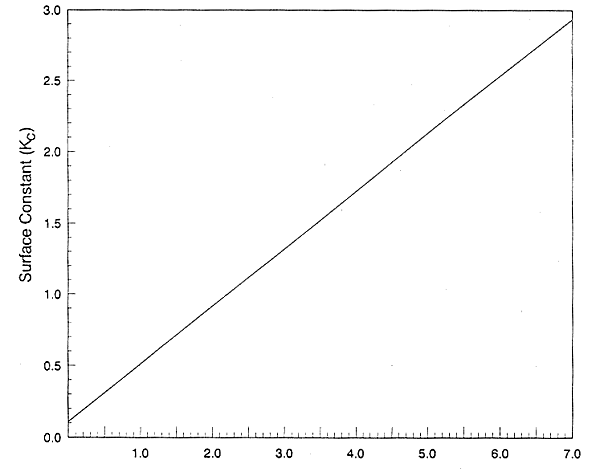
Percent oil Retained (POR)
Figure 1: SURFACE CAPACITY (Kc) GRAPH
3.2 Asphalt Content. Compute the required JMF asphalt content (ACJMF) which is based on the weight of aggregate from the following equation. The asphalt content computed from this formula is the same regardless of the asphalt grade or viscosity.
| ACJMF | = | (2(Kc) + 4.0) | x | 2.65 SGa |
WHEN USING THE PROCEDURE FOR HIGHLY ABSORPTIVE AGGREGATE, DETERMINE THE REQUIRED ASPHALT CONTENT (ACJMF) AS FOLLOWS :
COMPUTE THE EFFECTIVE ASPHALT CONTENT (ACEFF) FROM THE FOLLOWING EQUATION:
| ACEFF | = | (2(KCA) + 4.0) | x | 2.65 SGa |
COMPLETE SECTION 4.0 AND 5.0, THEN CONTINUE WITH THE DETER MINATION OF THE ASPHALT CONTENT AS FOLLOWS:
PREPARE A TRIAL MIXTURE USING AN ASPHALT CONTENT EQUAL OR SOMEWHAT GREATER (ESTIMATE AMOUNT THAT WILL BE ABSORBED) THAN THE EFFECTIVE ASPHALT CONTENT (ACEFF) DETERMINED ABOVE AND USING THE AGGREGATE GRADATION AS DETERMINED IN SECTION 5.2.
USING A SUITABLE TECHNIQUE, SUCH AS THE TEST FOR MAXIMUM SPECIFIC GRAVITY OF ASPHALT MIXTURES (AASHTO T 209), DETERMINE THE ACTUAL QUANTITY OF ASPHALT ABSORBED (IN PERCENT, BASED ON TOTAL WEIGHT OF AGGREGATE).
DETERMINE THE JMF ASPHALT CONTENT (ACJMF) OF THE ABSORPTIVE MIXTURE USING THE FOLLOWING EQUATION:
ACJMF = ACEFF + actual asphalt absorbed
4.0 Void Capacity of Coarse Aggregate
4.1 Unit Weight. Determine the unit weight of the coarse aggregate fraction of the proposed JMF by either of the following procedures (FHWA-RD-72-43 or ASTM D 4253 modified).
- 4.1.1 Apparatus
Compaction Mold. - A 6 inch nominal diameter solid-wall metal cylinder with a detachable metal base plate. A detachable metal guide-reference bar as shown in Figure 2 is required for Method 1.
Vibratory Compactor
Method 1 Rammer. - A portable electromagnetic vibrating rammer as shown in Figure 3, having a frequency of 3,600 cycles a minute, suitable for use with 115-volt alternating current. The rammer shall have a tamper foot and extension as shown in Figure 4.
Wooden Base. - A plywood disc 15 inches in diameter, 2 inches thick, with a cushion (rubber hose) attached to the bottom. The disc shall be constructed so it can be firmly attached to the base plate of the compaction mold.
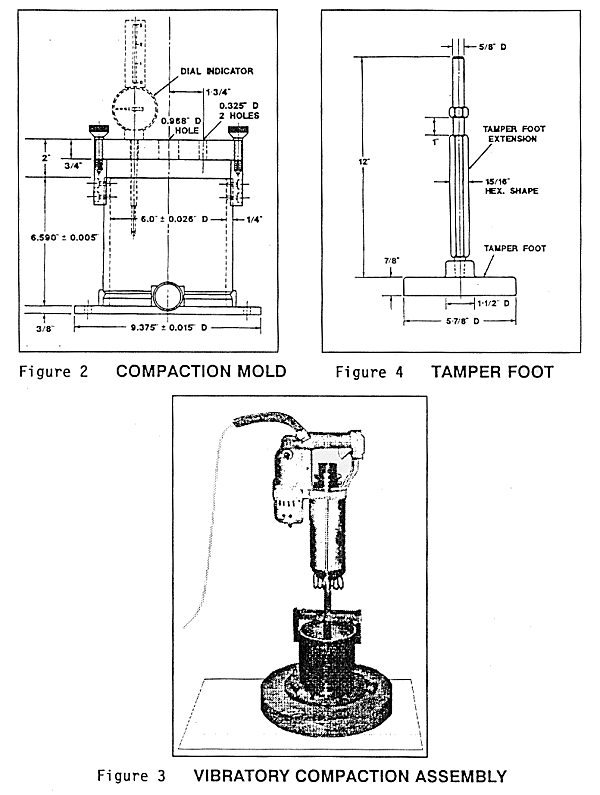
Method 2 (experimental) Vibrating Table. - A vibrating table capable of inducing a vibratory force to the sample at 3,600 cycles a minute and at an amplitude of (0.013 + 0.002 inch) . (Soiltest CN-166 or equivalent)
Confining Load. - A circular steel disc weighing 50 pounds with a diameter of 5 7/8 inches. (Soil test CN-167 or equivalent)
Timer. - A stopwatch or other timing device graduated in divisions Of 1.0-second and accurate to 1.0-second, and capable of timing the unit for up to 2 minutes. An electric timing device or electrical circuits to start and stop the vibratory compactor may be used.
Dial Indicator - A dial indicator graduated in 0.001-inch with a travel range of 3.0 inches.
- 4.1.2 Sample. Select a sample of the coarse aggregate fraction (approx.5 lb. ) from the proposed JMF as verified in Section 2.1. If the bulk specific gravity of the coarse aggregate is less than 2.0, reduce the size of the sample to approximately 3.5-lb. Weigh the sample to the nearest 0.1 pound.
- 4.1.3 Procedure
Method 1. Pour the selected sample into the compaction mold and place the tamper foot on the sample. Place the guide-reference bar over the shaft of the tamper foot and secure the bar to the mold with the thumb screws.
Place the vibratory rammer on the shaft of the tamper foot and vibrate for 15 seconds. During the vibration period, the operator must exert just enough pressure on the hammer to main tain contact between the sample and the tamper foot.
Remove the vibratory rammer from the shaft of the tamper foot and brush any fines from the top of the tamper foot. Measure the thickness (t) of the compacted material to the nearest 0.01 inch.
Method 2. (experimental) Pour the selected sample into the compaction mold and place the surcharge base plate on the sample.
Lower the surcharge weight onto the surcharge base plate and vibrate the assembly for 2 minutes.
Remove the surcharge weight and brush any fines from the top of the surcharge base plate. Measure the thickness (t) of the compacted material to the nearest 0.01 inch.
- 4.1.4 Calculation. Calculate the vibrated unit weight (X) (in pounds per cubic feet) as follows:
X = 6912 w
pi d2tWhere
w = weight of coarse aggregate fraction (pounds)
d = diameter of compaction mold (inches)
t = thickness of compacted specimen (inches)
4.2 Void Capacity. Determine the void capacity of the coarse aggregate (VCA) as percent of total volume using the following equation:
| VCA | = | (1 - | X Uc) |
x 100 |
Where
X = vibrated unit weight from step 4.1.4
Uc = bulk dry solid unit weight of the coarse aggregate fraction (pcf) .
5.0 Optimum Content of Fine Aggregate
5.1 Compute the optimum fine aggregate content with the following relationship:
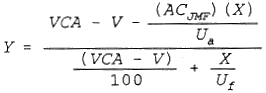
Where
Y = percent of fine aggregate by weight of total aggregate
VCA = voids in the coarse aggregate (percent)
V = design percent air voids = 15.0 percent
ACJMF = asphalt content for the JMF (percent by weight of aggregate) [WHEN USING THE PROCEDURE FOR HIGHLY ABSORPTIVE AGGREGATE, USE ACEFF FROM SECTION 3.2, NOT ACJMF]
X = vibrated unit weight of coarse aggregate (pcf)
Ua = unit weight of asphalt cement (pcf)
Uf = bulk dry solid unit weight of fine aggregate (pcf)
5.2 Compare the optimum fine aggregate content (Y) determined in Section 5.1 to the amount passing the No.8 sieve of the proposed JMF. If these values differ by more than 1 percentage point, revise the JMF using the value determined for optimum fine aggregate content. Recompute the proportions of coarse and fine aggregates (as received) to meet the revised JMF. If the proposed and revised JMF gradations are significantly different, it may be necessary to rerun portions of this procedure
6.0 Optimum Mixing Temperature
Prepare a sample of aggregate (approximately 1000 grams in the proportions determined under Section 5. Mix this sample with the proposed asphalt cement at the asphalt content (ACJMF) determined under Section 3.2 at a mix temperature corresponding to an asphalt viscosity of 800 centistokes determined under Section 2.3. When the aggregate is completely coated, transfer the mixture to a pyrex glass plate (8-9 in. diameter) and spread the mixture with a minimum of manipulation. Place the plate with the sample in the oven at the mixing temperature. Observe the bottom of the plate after 60 minutes. A slight puddle of asphalt cement at the points of contact between the aggregate and the glass plate, as shown in Figure 5, is suitable and desirable after the 60 minute period. Otherwise, repeat the test at a higher or lower mixing temperature to achieve the desired contact area. If asphalt drainage occurs at a mixing temperature which is too low to provide for adequate drying of the aggregate (typically not lower than 225°F), an asphalt of a higher viscosity should be used.
An intermediate observation of the plate can be made at 15 minutes. If there is excessive drain down at the contact points, the sample can be discarded and the test repeated at a lower temperature.
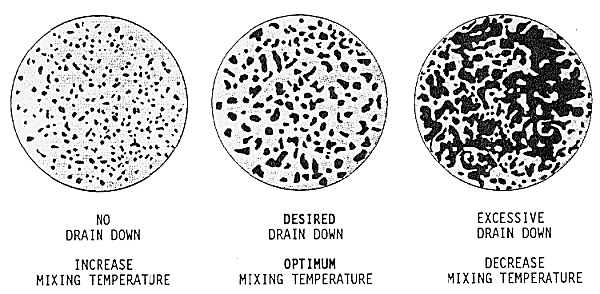 Figure 5: DRAIN DOWN CHARACTERISTICS
7.0 Resistance to Effects of Water
Conduct the Immersion-Compression Test (AASHTO T 165 and T 167) on the designed mixture. Prepare samples at the optimum mixing temperature determined in Section 6.0. Use a molding pressure of 2000 psi rather than the specified value of 3000 psi. Determination of the Bulk Specific Gravity is not required for this design procedure.
After 4-day immersion at 120°F, the Index of Retained Strength shall not be less than 50 percent unless otherwise permitted. Additives to promote adhesion that will provide adequate retained strength may be used when necessary.