




Technical Advisory T 5080.14 Continuously Reinforced Concrete Pavement
Superseded in August, 2016 by Continuously Reinforced Concrete Pavement Manual: Guidelines for Design, Construction, Maintenance, and Rehabilitation
June 5, 1990
- PURPOSE. To outline recommended practices for the design, construction, and repair of continuously reinforced concrete pavement (CRCP).
- CANCELLATION. Technical Advisory T 5080. 5, Continuously Reinforced Pavement, dated October 14, 1981, is cancelled.
- BACKGROUND
- Continuously Reinforced Concrete Pavement is a Portland cement concrete (PCC) pavement that has continuous longitudinal steel reinforcement and no intermediate transverse expansion or contraction joints. The pavement is allowed to crack in a random transversecracking pattern and the cracks are held tightly together by the continuous steel reinforcement.
- During the 1970's and early 1980's, CRCP design thickness was approximately 80 percent of the thickness of conventional jointed concrete pavement. A substantial number of the thinner pavements developed distress sooner than anticipated.
- Attention to design and construction quality control of CRCP is critical. A lack of attention to design and construction details has caused premature failures in some CRCPs. The causes of early distress have usually been traced to: (1) construction practices which resulted in pavements which did not meet design requirements; (2) designs which resulted in excessive deflections under heavy loads; (3) bases of inferior quality, or; (4) combinations of these or other undesirable factors.
- DESIGN RECOMMENDATIONS
- Concrete Thickness. Generally the slab thickness is the same as the thickness of a jointed concrete pavement unless local performance has shown thinner pavements designed with an accepted design process to be satisfactory.
- Reinforcing Steel
- (1) Longitudinal Steel
- (a) A minimum of 0. 6 percent (based on the pavement cross sectional area) is recommended to aid transverse crack development in the range of 8 feet, maximum, and 3. 5 feet, minimum, between cracks. Exceptions should be made only where experience has shown that a lower percentage of steel has performed satisfactorily. In areas where periods of extreme low temperature (average minimum monthly temperatures of 10° F or less) occur, the use of a minimum of 0. 7 percent steel is recommended.
- (b) Deformed steel bars that meet the requirements set out in AASHTO Specifications, Part I,AASHTO M31, M42, or M53 are recommended. The tensile requirements should conform to the American Society for Testing and Materials (ASTM) Grade 60. Recommended spacing of the longitudinal steel is not less than 4 inches or 2 1/2 times the maximum sized aggregate, whichever is greater, and not greater than 9 inches. A minimum ratio of 0. 03 square inches of steel bond area per cubic inch of concrete is recommended. See Attachment 1 for an example problem for determining the minimum longitudinal steel spacing and the minimum bond ratio. Table 1 shows the minimum and maximum bar sizes for given pavement thicknesses and reinforcement percentages. These bar sizes meet the minimum bond ratio and the minimum bar spacing criteria stated above.
- (c) The recommended position of the longitudinal steel is between 1/3 and 1/2 of the depth of the pavement as measured from the surface. The minimum concrete cover should be 2-1/2 inches with 3 inches preferable. For pavements thicker than 11 inches, several States have begun to experiment with the use of two layers of longitudinal steel. Pavements constructed with two layers of steel have not been in service long enough to evaluate performance; therefore, this technique should be considered experimental.
Table 1
Recommended Longitudinal Reinforcement Sizes
Minimum and Maximum Bar Size % Steel Pavement Thickness 8" 9" 10" 11" 12" 13" 0.60 4,5 5,6 5,6 5,6 5,6 6 0.62 5,6 5,6 5,6 5,6 5,6 6 0.64 5,6 5,6 5,7 5,7 6,7 6,7 0.66 5,6 5,7 5,7 5,7 6,7 6,7 0.68 5,6 5,7 5,7 6,7 6,7 6,7 Note: Bars are uncoated deformed bars.
- (d) The use of epoxy coated reinforcing steel is generally not necessary for CRCP. However, in areas where corrosion is a problem because of heavy applications of deicing salts or severe salt exposure, epoxy coating of the steel may be warranted. The bond area should be increased 15 percent to increase the bond strength between the concrete and reinforcement if epoxy-coated steel reinforcement is used.
- (e) When splicing longitudinal steel, the recommended minimum lap is 25 bar diameters with the splice pattern being either staggered or skewed. If a staggered splice pattern is used, not more than one-third of the bars should terminate in the same transverse plane and the minimum distance between staggers should be 4 feet. If a skewed splice pattern is used, the skew should be at least 30 degrees from perpendicular to the centerline. When using epoxy-coated steel, the lap should be increased a minimum of 15 percent to ensure sufficient bond strength.
- (f) Plan details or specifications are needed to insure sufficient reinforcing at points of discontinuity as described in paragraphs 4e(3) and 4f(1) .
- (2) Transverse Reinforcing and Tiebars
- (a) If transverse reinforcement is included, it should be #4, #5, or #6 grade 60 deformed bars meeting the same specifications as mentioned for the longitudinal reinforcement.
- (b) Although it can be omitted, transverse reinforcing reduces the risk of random longitudinal cracks opening up and thus reduces the potential of punch-outs. If transverse reinforcement is included, the following equation can be used to determine the amount of reinforcement required (see number 5 of Attachment 2):
Pt = Ws F x 100 2 fs
Where:
Pt = transverse steel, %
Ws = total pavement width, (ft)
F = subbase friction factor
fs = allowable working stress in steel, psi, (0. 75 yield strength) - (c) The spacing between transverse reinforcing bars can be calculated using the following equation (see numbers 1 and 5 of Attachment 2):
Y = As x 100 Pt D
Where:
Y = transverse steel spacing (in)
As = cross-sectional area of steel, (in2) per bar (#4, #5, or #6 bar)
Pt = percent transverse steel
D = slab thickness (in)Note: The transverse bar spacing should be no closer than 36 inches and no further than 60 inches.
- (d) In cases where transverse steel is omitted, tiebars should be placed in longitudinal joints in accordance with the FHWA Technical Advisory, Concrete Pavement Joints.
- (1) Longitudinal Steel
- Bases
- (1) The base design should provide a stable foundation, which is critical for CRCP construction operations and should not trap free moisture beneath the pavement. Positive drainage is recommended. Free moisture in a base or subgrade can lead to slab edge-pumping, which has been identified as one of the major contributors to causing or accelerating pavement distress. Bases that will resist erosion from high water pressures induced from pavement deflections under traffic loads, or that are free draining to prevent free moisture beneath the pavement will act to prevent pumping. Stabilized permeable bases should be considered for heavily traveled routes. Pavements constructed over stabilized or crushed stone bases have generally resulted in better performing pavements than those constructed on unstabilized gravel.
- (2) The friction between the pavement and base plays a role in the development of crack spacing in CRCP. Most design methods for CRCP assume a moderate level of pavement/base friction. Polyethylene sheeting should not be used as a bond breaker unless the low pavement/base friction is considered in design. Also, States have reported rideability and construction problems when PCC was constructed on polyethylene sheeting.
- Subgrades. Continuously Reinforced Concrete Pavement is not recommended in areas where subgrade distortion is expected because of known expansive soils, frost heave, or settlement areas. Emphasis should be placed on obtaining uniform and adequately compacted subgrades. Subgrade treatment may be warranted for poor soil conditions.
- Joints
- (1) Longitudinal Joints. Longitudinal joints are necessary to relieve stresses caused by concrete shrinkage and temperature differentials in a controlled manner and should be included when pavement widths are greater than 14 feet. Pavements greater than 14 feet wide are susceptible to longitudinal cracking. The joint should be constructed by sawing to a depth of one-third the pavement thickness. Adjacent slabs should be tied together by tiebars or transverse steel to prevent lane separation. Tiebar design is discussed in the FHWA Technical Advisory entitled "Concrete Pavement Joints. "
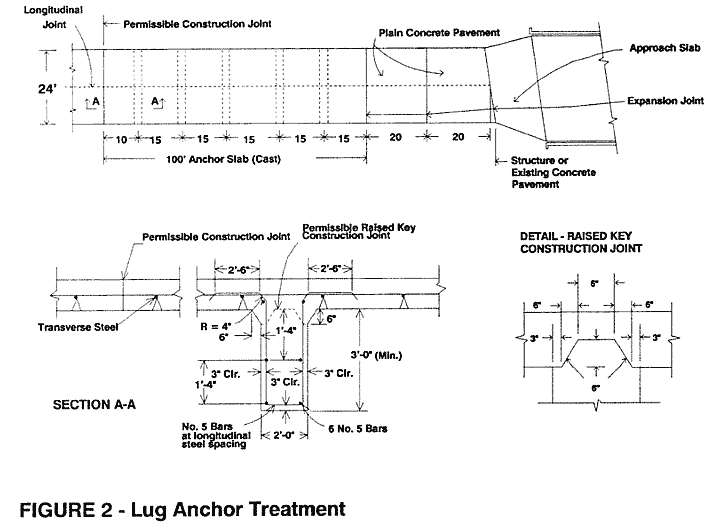
- (2) Terminal Joints. The most commonly used terminal treatments are the wide-flange (WF) steel beam which accommodates movement, and the lug anchor which restricts movement.
- (a) The WF beam joint consists of a WF beam partially set into a reinforced concrete sleeper slab approximately 10 feet long and 10 inches thick. The top flange of the beam is flush with the pavement surface. Expansion material, sized to accommodate end movements, is placed on one side of the beam along with a bond-breaker between the pavement and the sleeper slab. In highly corrosive areas the beam should be treated with a corrosion inhibitor. Several States have reported premature failures of WF beams where the top flange separated from the beam web. Stud connectors should be welded to the top flange, as shown in Figure 1 (below), to prevent this type of failure. Table 2 and Figure 1 contain recommended design features.
Figure 1: Recommended WF Steel Beam Terminal Joint Design
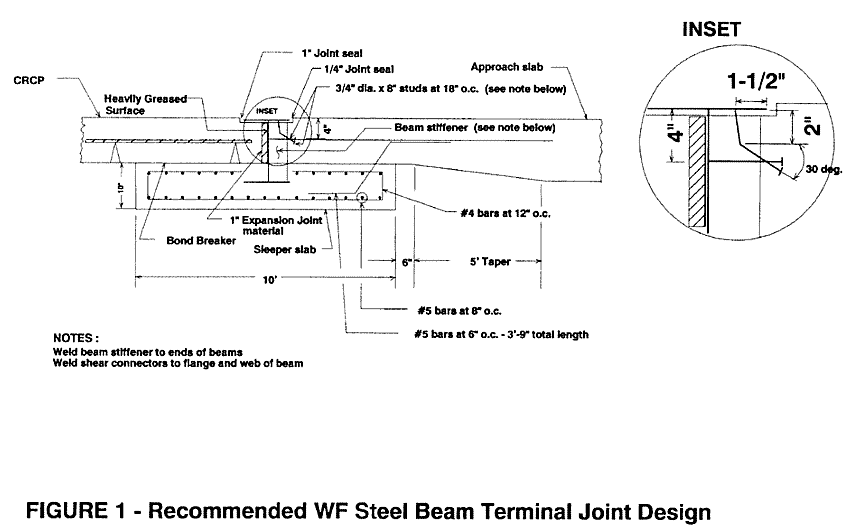
Table 2 Recommended WF Beam Dimensions WF Beam (weight and dimensions) CRCP thickness (in. ) Embedment in "Sleeper" slab - in. WF Beam Size Flange Web Thickness (in. ) Width Thickness 8 6 14 x 61 10 5/8 3/8 9 5 10 6 16 x 58 8-1/2 5/8 7/16 11 5 - (b) The lug anchor terminal treatment generally consists of three to five heavily reinforced rectangularly shaped transverse concrete lugs placedin the subgrade to a depth below frost penetration prior to the placement of the pavement. They are tied to the pavement with reinforcing steel. Since lug anchors restrict approximately 50 percent of the end movement of the pavement an expansion joint is usually needed at a bridge approach. A slight undulation of the pavement surface is sometimes induced by the torsional forces at the lug. Since this treatment relies on the passive resistance of the soil, it is not effective where cohesionless soils are encountered. Figure 2 shows a typical lug anchor terminal treatment.
Figure 2: Lug Anchor Treatment
- (a) The WF beam joint consists of a WF beam partially set into a reinforced concrete sleeper slab approximately 10 feet long and 10 inches thick. The top flange of the beam is flush with the pavement surface. Expansion material, sized to accommodate end movements, is placed on one side of the beam along with a bond-breaker between the pavement and the sleeper slab. In highly corrosive areas the beam should be treated with a corrosion inhibitor. Several States have reported premature failures of WF beams where the top flange separated from the beam web. Stud connectors should be welded to the top flange, as shown in Figure 1 (below), to prevent this type of failure. Table 2 and Figure 1 contain recommended design features.
- (3) Transverse Construction Joints
- (a) A construction joint is formed by placing a slotted headerboard across the pavement to allow the longitudinal steel to pass through the joint. The longitudinal steel through the construction joint is increased a minimum of one-third by placing 3-foot long shear bars of the same nominal size between every other pair of longitudinal bars. No longitudinal steel splice should fall within 3 feet of the stopping side nor closer than 8 feet from the starting side of a construction joint. Refer to paragraph 4b(1) (e) for recommended splicing patterns. If it becomes necessary to splice within the above limits, each splice should be reinforced with a 6-foot bar of equal size. Extra care is needed to ensure both concrete quality and consolidation at these joints. If more than 5 days elapse between concrete pours, theadjacent pavement temperature should be stabilized by placing insulation material on it for a distance of 200 feet from the free end at least 72 hours prior to placing new concrete. This procedure should reduce potentially high tensile stresses in the longitudinal steel.
- (b) Special provisions for the protection of the headerboard and adjacent rebar during construction may be necessary.
- Leave-Outs. Temporary gaps in CRCPs should be avoided. The necessity for leave-outs is minimized by giving proper consideration to the paving schedule during project design. The following precautions can be specified to reduce distress in the leave-out portion of the slab in the event a leave-out does become necessary.
- (1) Leave-outs require 50 percent more longitudinal deformed bars of the same nominal size as the regular reinforcement. The additional reinforcement should be spaced evenly between every other normal pavement reinforcing bar and should be bonded at least 3 feet into the pavement ends adjacent to the leave-outs. All regular longitudinal reinforcement should extend into the leave-out a minimum of 8 feet. Required slices should be made the same as those in normal construction.
Figure 2. Lug Anchor Treatment (please refer to source document)
- (2) Leave-outs should be paved during stable weather conditions when the daily temperature cycle is small. Because of the closeness of the steel extreme care should be exercised in placing and consolidating the concrete to prevent honeycombing or voids under the reinforcement.
- (3) If it becomes necessary to pave a leave-out in hot weather, the temperature of the concrete in the free ends should be stabilized by placing an adequate layer of insulating material on the surface of the pavement as described in paragraph 4e(3) (a) . The curing compound should be applied to the new concrete in a timely manner. The insulation material should remain on the adjacent pavement until the design modulus of rupture of the leave out concrete is attained.
- (1) Leave-outs require 50 percent more longitudinal deformed bars of the same nominal size as the regular reinforcement. The additional reinforcement should be spaced evenly between every other normal pavement reinforcing bar and should be bonded at least 3 feet into the pavement ends adjacent to the leave-outs. All regular longitudinal reinforcement should extend into the leave-out a minimum of 8 feet. Required slices should be made the same as those in normal construction.
- Ramps Auxiliary Lanes, and Shoulders. PCC pavement for ramps, auxiliary lanes, and shoulders adjacent to CRCP is recommended because of the possible reduction in pavement edge deflections and the tighter longitudinal joints adjacent to the mainline pavement. Ramps should be constructed using jointed concrete pavement. The use of jointed pavement in the ramps will accommodate movement and reduce the potential for distress in the CRCP at the ramp terminal. When PCC pavement is used for ramps, auxiliary lanes, or shoulders, the joint should be designed as any other longitudinal joint. Refer to the FHWA Technical Advisory T 5040. 29, Paved Shoulders, for further information on proper joint design.
- Widened Lanes. Widened right lane slabs should be considered to reduce or eliminate pavement edge loadings. This is discussed in the FHWA Technical Advisory T 5040. 29, Paved Shoulders.
- CONSTRUCTION CONSIDERATIONS
- Many CRCP performance problems have been traced to construction practices which resulted in a pavement that did not meet the previously described design recommendations. Because CRCP is less forgiving and more difficult to rehabilitate than jointed pavements, greater care during construction is extremely important. Both the contractor and the inspectors should be made aware of this need and the supervision of CRCP construction should be more stringent.
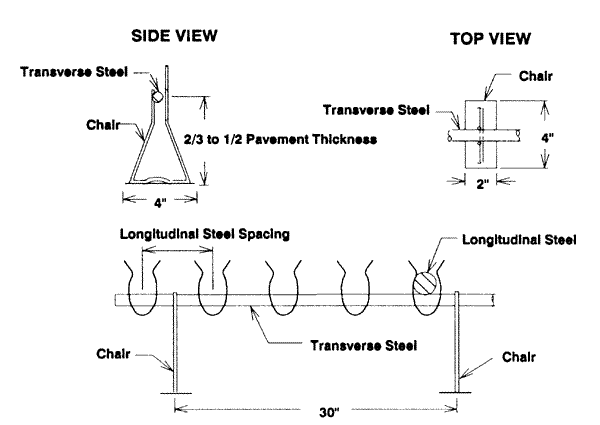
- Steel placement has a direct effect on the performance of CRCP. A number of States have found longitudinal steel placement deviations of ±3 inches in the vertical plane when tube feeders were used to position the steel. The use of chairs is recommended to hold the steel in its proper location. The chairs should be spaced such that the steel will not permanently deflect or displace to a depth of more than 1/2 the slab thickness. An example chair device is shown in Figure 3, Combination Chair and Transverse Steel Detail.
Figure 3: Combination Chair and Transverse Steel Detail
- Procedures should be implemented to ensure a uniform base and subgrade. Soft spots or gradeline variations should be repaired and corrected prior to concrete placement. Emphasis should be placed on batching, mixing, and placing concrete to obtain uniformity and quality. Strict inspection of batching and mixing procedures is extremely important and mayrequire rejection of batches because of deviations that may have been considered minor under previously existing practices. When placing concrete, adequate vibration and consolidation must be achieved. This is especially critical in areas of pavement discontinuity such as construction or terminal joints. Automatic vibrators should be checked regularly to ensure operation at the specified frequency and amplitude and at the proper location in the plastic concrete. Hand-held vibrators should be used adjacent to transverse joints. Any concrete which exhibits signs of aggregate segregation should be replaced immediately.
- Inspection procedures are needed to ensure that final reinforcing splice lengths and patterns, as well as bar placement, are consistent with the design requirements. Special precautions should be taken to prevent rebar bending and displacement at construction joints. When leave-outs are necessary, they should be constructed in absolute conformity to the design requirements. Longitudinal joints should be sawed as early as possible to prevent random cracking. This is especially true in multi-lane construction. Sawing should not begin until the concrete is strong enough to prevent raveling.
- Asphalt concrete patches are not recommended as a temporary or a permanent repair technique because they break the continuity of the CRCP and provide no load transfer across the joint.
\S\
Anthony R. Kane
Associate Administrator
for Engineering and
Program Development
Attachments
EXAMPLE PROBLEM
The design engineer should perform the following calculations to ensure that the bond between the reinforcing steel and the concrete and the longitudinal steel spacing meet the criteria in paragraph 4c. The equation to determine the ratio of bond area to cubic inches of concrete is as follows and the equation to determine the minimum longitudinal steel spacing follows it:
| Rb = | n x Ps x L |
| W x t x L |
Where:
- Ps = Perimeter of Bar (in.)
- L = Length of slab = 1"
- W = Width of slab (in.)
- t = Slab thickness (in.)
- n = Number of Longitudinal Bars
Given: #6 reinforcing bars, therefore Ps = 2. 356" and Bar Area = 0. 44 in. 2
| W = 12' t = 10" |
||||||||||
| Assume: | 0. 6% steel | |||||||||
| Determine: | The required minimum area of steel and the required minimum number of bars Area of Conc. = 10 x 144 = 1440 in. 2 |
|||||||||
| Determine: | The minimum ratio of bond area to cubic inches of concrete.
the minimum ratio of bond area to cubic inches of concrete is met so the minimum spacing should be checked. |
|||||||||
| Determine: | Longitudinal steel spacing should be checked as follows:
therefore the minimum bar spacing is also met. |
REFERENCES (CRCP)
1. "AASHTO GUIDE FOR DESIGN OF PAVEMENT STRUCTURES," 1986.
2. "FHWA Pavement Rehabilitation Manual," FHWA-ED-88-025, September 1985 as supplemented.
3. Mooncheol Won, B. Frank McCullough, W. R. Hudson, Evaluation of Proposed Design Standards for CRCP, Research Report 472-1, April 1988.
4. "Techniques For Pavement Rehabilitation - A Training Course," FHWA, October 1987.
5. "Design of Continuously Reinforced Concrete for Highways," Associated Reinforcing Bar Producers - CRSI, 1981.
6. "CRCP - Design and Construction Practices of Various States," Associated Reinforcing Bar Producers - CRSI, 1981.
7. "Design, Performance, and Rehabilitation of Wide Flange Beam Terminal Joints," FHWA, Pavement Branch, February 1986.
8. Darter, Michael I., Barnett, Terry L., Morrill, David J., "Repair and Preventative Maintenance Procedures for Continuously Reinforced Concrete Pavement," FHWA/IL/UI-191, June 1981.
9. "Failure and Repair of CRCP," NCHRP, Synthesis 60, 1979.
10. Snyder, M. B., Reiter, M. J., Hall, K. T., Darter, M. I., "Rehabilitation of Concrete Pavements, Volume I - Repair Rehabilitation Techniques, Volume III - Concrete Pavement Evaluation and Rehabilitation System," FHWA-RD-88-071, July 1989.