Alternative Contracting Process - SEP 14 Construction Manager General Contractor
Utah Annual Report
UDOT 2009 CMGC Annual Report
Table of Contents
- 1. Executive Summary
- 2. CMGC Benefits
- 2.1. Enhanced Design
- 2.2. Application of Innovations
- 2.3. Optimize Project Schedule
- 2.4. CMGC Benefits Conclusions
- 3. Summary of Projects
- 4. Performance Measures
- 4.1. Cost Impact
- 4.1.1 Independent Cost Estimate
- 4.1.2 Bidding of Projects
- 4.1.3 Savings through Innovation
- 4.1.4 Change Orders and Overruns
- 4.1.5 Overall Savings
- 4.2. Savings Associated with Risk Mitigation
- 4.3. Performance Conclusions
- 5. Criteria for Evaluating the Applicability
- 6. UDOT CMGC Process
- 6.1. Concept Development
- 6.2. Design
- 6.3. Construction
- Appendix A Criteria for Evaluating Applicability
- Appendix B - Project Cost to Projected Costs of CMGC Projects Procedure
- Appendix C- CMGC Process Modules
1. Executive Summary
Both the FHWA and the State of Utah have made large monetary commitments to the CMGC program. This partnership has enabled UDOT to accomplish many of its most ambitious projects. In return for the FHWA's support, UDOT provides this report to comply with the SEP-14 agreement. It compiles UDOT's knowledge regarding the benefits of CMGC, the performance of CMGC projects as compared to tradition projects, the best applications of CMGC, and UDOT's formal CMGC process.
This report presents the most comprehensive analysis of CMGC available anywhere. UDOT conducted this analysis by first obtaining subjective information regarding the benefits and challenges of CMGC. To validate this subjective information, the Department developed means of obtaining and measuring hard data. The Department used this information to establish a process most capable of achieving project goals by taking advantage of CMGC's benefits, and avoiding its risks.
One of the main challenges in analyzing a program as substantial as Utah's is to develop a focused appraisal of CMGC without overlooking the expertise of all those involved. To capture that expertise the Department conducted official interviews with the project teams. The trends that emerged from the interview responses allowed us to make assumptions about the greatest benefits of the CMGC process. The trends showed that most members of the project teams believed:
- Total project costs were held down by CMGC.
- CMGC facilitated innovations that minimized construction time.
- CMGC enabled teams to work in a way that maximized productivity.
- CMGC gave them an advantage by optimizing risk analysis and mitigation.
We have developed the following performance measures to validate these assumptions: comparing the contractor's price to market prices, and tracking innovations, risk, change orders, and overruns. Comparing the cost of CMGC projects to state average prices shows that CMGC projects are 15% more cost-effective. We arrived at this figure by comparing bid prices, and factoring in the reduced change orders and overruns. The reduction in Change Orders and Overruns and Under runs was 6.6% compared to traditional projects and 6% compared to Design Build projects. Estimates for risk mitigation, innovations, and shortened construction schedules suggest even greater savings. For example, UDOT's largest CMGC project to date currently shows savings due to risk mitigation of 33% of the projected costs. Direct savings attributed to the contractors input during design on recent projects shows 6-9% savings to project costs. The user-cost savings of MOT innovations are nearly equal to the project costs themselves!
Our performance measurements tell us where CMGC performs well, where CMGC has limitations, and where to improve our measurements. FHWA approval of the CMGC process in Utah will build upon the expertise contained in this report, ensuring that other agencies will be able to follow an ever-improving model. FHWA approval of the CMGC process in Utah will also ensure that UDOT continues to sponsor innovations that can be applied to other delivery methods.
2. CMGC Benefits
CMGC can be the most effective delivery method for roadway construction.. This is because it produces numerous benefits that lead to positive results for both the individual project, and the State's transportation industry as a whole. The benefits of CMGC lead to enhanced designs, applied innovations, optimized schedules, and greater protection of the owner's investment. Designs are enhanced by ensuring plans are reviewed for cost and constructability with more scrutiny than other delivery methods allow. CMGC provides a good environment to apply new innovations that will meet individual project goals. CMGC produces an optimized schedule by giving the contractor the time and opportunity to address the unique requirements of each project. The owner's investment is better protected in CMGC because the owner has more control over the way a project's opportunities and risks are addressed, and the owner is able to retain the knowledge gained from the project. The following section provides a detailed description of how these results are achieved through specific benefits that are inherent in the CMGC process.
2.1 Enhanced Design
The CMGC process generates designs that are better able to avoid issues in construction thereby reducing change orders (see Figure 4 in the Performance Measures section). This is due to a balanced approach to design, which increases analysis and decreases assumptions. Design solutions are not only presented by the designer, but also evaluated by the contractor. This increase in review helps to reduce errors in design and ensures unabated construction during installation. If information is found lacking, the designers can utilize the contractors to minimize the risks of assumptions, or use the contractor to acquire the necessary knowledge. By including the contractor the owner can make better decisions prior to application in the field. Each of the following benefits leads to an enhanced design:
- Balanced approach: CMGC places the owner in control of important design decisions. Under conventional delivery methods the owner typically only obtains recommendations from the designer. On a CMGC project a team including the designer, contractor, and experts from the Department review the plans to ensure that the best design solutions have been considered. The owner can then determine whether or not to investigate alternatives depending on their potential to address project goals. The owner is then able to choose a direction from a range of alternatives.
- Alternative Design Analysis: CMGC gives the design team the tools necessary to evaluate alternatives. When considering an alternative the contractor and the designer are able to identify where more detail or investigation is required. In many cases the contractor can perform the necessary investigation at the owner's request. This allows the design team to verify that an alternative can be built before developing any plans.
- Cost Incorporated into Decisions: While there may be many possible ways of building a project, the budget may determine which alternative is most appropriate. The contractor's input during design allows the team to obtain a reliable cost estimate for any design alternative being considered. This lets the owner consider the budget when making an informed decision about whether an alternative is cost-effective. The owner can then direct the team to include that alternative in the plans, find a less expensive way of providing the alternative, reduce costs on other aspects of the project, or select a less expensive alternative. Thus, Value Engineering becomes a natural part of the design process. With traditional delivery methods the design is developed according to the designer's assumptions, and it is left up to the bidders to determine the means of completing the project under the given assumptions.
- Ownership of Design: CMGC also allows owners to retain some value from the improved design. On a DB project the owner would only benefit from an improved design by having a superior quality project built. With CMGC, however, the owner retains the design. As a result, the insights, innovations, and lessons learned through the process are at the owner's disposal and can be applied to future projects regardless of the delivery method.
All of these benefits ensure that the team focuses on developing cost-effective solutions that meet the project goals, and that suit the contractor's means and methods. As a result, CMGC designs deliver the highest quality project that includes the most scope possible, for the budget available.
2.2 Application of Innovations
CMGC is the ideal delivery method to use when a project contains opportunities and risks that can best be addressed through innovations. This is because it assembles a design team that is best able to identify those opportunities and risks. It is also superior to traditional delivery methods, which do not provide much support for unproven solutions to the challenges a project faces. In traditional methods innovations are only implemented if one party is willing to accept all risk. CMGC allows the owner to distribute risk for innovations in a more balanced way. CMGC also reduces the risk of innovation by enabling all parties to gain a greater level of confidence that an innovation can be successfully applied. This true partnering process allows the industry to introduce new innovations safely and normalize their use across all delivery methods. The benefits that make CMGC the best environment for innovations to take place are examined more closely below:
- Better Identification of Opportunities and Risks: The CMGC process focuses the expertise of the designer, owner, and contractor on the goals of the project. This increases the likelihood that the team will discover an unforeseen risk that threatens the project goals. It also increases the likelihood that the team will identify opportunities to enhance the project goals. Having the contractor on the design team accelerates the development of an innovative approach to the risk or opportunity. Often times this approach is not a new technical innovation, but instead a new way to address the issue differently than the traditional methods of design.
- More Confident Application of Innovations: CMGC allows the owner to direct the team to apply an innovation with the utmost confidence that the innovation will succeed. This is because each member of the team has the opportunity to identify areas of concern before the plans are complete. These concerns can then be addressed through sufficient investigation and proper design detail. The owner can then address risk based on the contractual agreements between parties.
- Better Distribution of risk: CMGC enables the owner to consider the risks associated with applying an innovation, and delegate responsibilities. By using the contractor as part of the design team the owner can use the contractor's expertise to identify unforeseen risks. For example, if a DBB or DB project discovers a risk that invalidates a portion of the contract, there is no incentive for the contractor to help resolve the issue once contract documents have been awarded. Thus, deviations from the contract documents result in increased costs because the owner takes all the risk for undiscovered conditions. CMGC utilizes the contractor to resolve challenges during design when the cost for delay is minimal. In this way the contractor takes a proactive role in addressing risks, and absorbs a fair proportion of the risk.
- Standardizing Innovations: Many new techniques and technologies have first been used on CMGC projects. These technical innovations produce a direct benefit to the project, as their application helps achieve specific project goals: but they also produce a benefit to future projects, as their successful implementation is repeated and they become standardized across delivery methods. This report provides examples of technical innovations applied to CMGC projects in a later section (See Appendix A, Applicability Criteria).
The CMGC process gives teams a unique opportunity to develop innovations that minimize design assumptions, and maximize construction efficiencies. Unlike technical innovations, these process innovations often employ standard solutions, but the implementation of these solutions is done during design, when time and cost agreements are not controlling the contract. Process innovations minimize design assumptions and maximizing construction efficiencies. As a result, bidding numbers become very precise. This is how the CMGC design process is able to produce a Guaranteed Maximum Price (GMP). The greatest achievements of CMGC are when both technical and process innovations are incorporated on the project.
2.3 Optimize Project Schedule
CMGC has shown a consistent ability to shorten overall project schedules. Some of the time savings is the result of CMGC's ability to get the project into construction more quickly than traditional projects. The majority of time savings, however, occur in construction. The design team places additional effort into identifying, investigating, and developing time saving innovations. Project schedules are shortened thanks to the following benefits of the CMGC process:
- Early Start Date: CMGC can allow for an early start. It allows the owner to select a contractor before the design is complete. The team can then prepare for construction by performing early investigations, procuring long-lead-items, and starting work that the design team deems necessary and release a separate construction package. CMGC also gives the contractor an opportunity to identify the personnel and infrastructure they will need to have in place once construction begins.
- Short Selection Time: CMGC projects move through selection twice as quickly as Design-Build (DB) projects. DB typically takes between 6 and 8 months for selection. CMGC projects typically take between 3 and 4 months. Selection time is reduced because it is not necessary to develop a performance specification.
- Prioritize Right of Way: In a CMGC project the team is able to determine the critical path according to Right-of-Way (ROW) challenges. This allows the team to focus on acquisitions in the critical path. It also allows the team to modify the critical path to allow the project to work around areas with ROW difficulties.
- Project Goal-Focused Schedules: CMGC processes allow the construction schedule to be focused on the project goals rather than imposed deadlines. Unlike other delivery methods, CMGC allows the contractor to begin tailoring his construction schedule during the design phase, while the project's needs are being developed. During design the team recognizes how work will impact the public and adjusts the construction process to minimize that impact. Adjustments including special considerations for local government needs, minimizing traffic impact at specialized locations, and incorporating more public involvement have all been achieved. The flexible nature of the CMGC design phase allows changes to the project with minimal impacts to the contract. Once the contractor is selected on a traditional project the focus becomes the imposed deadlines of the contract and any contract changes will be inherently linked to that date. However, with CMGC the focus becomes the goals of the project and the schedule is shaped to achieve those goals.
These examples show that the CMGC process both accelerates the overall schedule, and increases productivity. CMGC accelerates the overall schedule by reducing the selection time and potentially advancing the start of construction. CMGC improves productivity by allowing gainful progress to be made on the project while complex design and ROW issues are thoroughly resolved.
2.4 CMGC Benefits Conclusions
This section has described the benefits of having the contractor involved in the design process. These descriptions have explained how the benefits of the CMGC process lead to four basic results. CMGC produces a higher quality, more constructible project design. It fosters innovations that produce benefits to individual projects and the industry as a whole. It enables the team to set a shorter and more efficient construction schedule. It places the owner in a better position to direct the team in a way that protects the owner's interests. This shows that CMGC is an effective tool that should be considered when a project possesses opportunities and threats that can be addressed with contractor knowledge and experience.
3. Summary of Projects
UDOT currently has 19 Federal and State CMGC projects that are either approved, in selection, in design, under construction, or completed. However, projects are often delivered in multiple construction phases for which there is a separate contract. Therefore, the number in the first column of Table 1 is a project number. The project numbers appear in the order they were initiated. Each line item in the table is a contract phase listed in the order of construction award date. Most of the projects mentioned throughout this report have achieved substantial completion by December 2009. These projects are referred to by their common name and include all completed phases. These projects are shown in bold in Table 1.
| No. | Descriptive Names | State/ Federal | Region | Project Number | PIN | Stage | Original Bid Amount | CMGC Selection | Bid open date | Construction NTP | Final Acceptance |
|---|---|---|---|---|---|---|---|---|---|---|---|
| 1 | REDWOOD RD 2320 S to 3500 S | F | 2 | STP-0068(15)55 | 3440 | Complete | $6,647,500.00 | Note 3 | 5/16/2005 | 8/1/2005 | 10/20/2008 |
| 2 | 5600 W 4450-4700 S Ph1 | S | 2 | SP-0172(11)2 | 5652 | Complete | $1,744,670.00 | Note 3 | 12/4/2006 | 11/29/2004 | 10/7/2008 |
| 3 | PARRISH LANE Ph1 | S | 1 | S-I-15-7(243)320 | 5664 | Complete | $82,400.00 | Note 3 | 12/21/2006 | 1/31/2007 | 3/7/2007 |
| 3 | PARRISH LANE Ph2 | S | 1 | S-I15-7(260)320 | 6111 | Complete | $2,411,412.80 | Note 3 | 2/13/2007 | 3/12/2007 | 11/8/2007 |
| 4 | 4500 S AT I-215 | F | 2 | F-I215(126)13 | 4752 | Complete | $3,995,048.48 | 4/20/2007 | 5/7/2007 | 5/16/2007 | 7/3/2008 |
| 5 | 5600 W 5000 S-6200 S | S | 2 | SP-0172(12)3 | 5715 | Complete | $2,497,676.50 | 4/25/2007 | 5/16/2007 | 6/6/2007 | 10/7/2008 |
| 6 | I-80 TOOELE | S | 2 | S-I80-1(44)0 | 5975 | Complete | $4,402,052.00 | 3/16/2007 | 6/13/2007 | 6/29/2007 | 10/7/2008 |
| 7 | I-80 RECONSTRUCT Ph1 | S | 2 | SP-80-3(68)121 | 4303 | Construction | $6,050,431.66 | 7/2/2007 | 8/20/2007 | 8/24/2007 | |
| 8 | ATKINVILLE INTERCHANGE | F | 4 | *HPP-15-1(56)1 | 2189 | Construction | $36,293,458.81 | 5/11/2007 | 10/10/2007 | 10/26/2007 | |
| 9 | RIVERDALE RD Ph1 | S | 1 | SP-0026(4)0-A | 6867 | Complete | $2,549,341.30 | 9/14/2007 | 12/10/2007 | 1/2/2008 | 5/13/2009 |
| 9 | RIVERDALE RD Ph2 | S | 1 | SP-0026(4)0-B | 6868 | Complete | $10,778,168.40 | 9/14/2007 | 12/10/2007 | 2/26/2008 | 9/16/2009 |
| 7 | I-80 RECONSTRUCT Ph3 | S | 2 | S-80-3(153)121 | 6839 | Construction | $3,976,395.03 | 7/2/2007 | 1/11/2008 | 2/27/2008 | |
| 7 | I-80 RECONSTRUCT Ph2 | S | 2 | S-80-3(152)121 | 6838 | Construction | $92,830,570.48 | 7/2/2007 | 2/7/2008 | 3/13/2008 | |
| 10 | I-15 BRIDGE EARLY STEEL | F | 3 | F-R399(52) | 7074 | Complete | $574,711.00 | 10/31/2007 | 4/29/2008 | 5/27/2008 | 10/2/2008 |
| 11 | VIRGIN RIVER TRAIL | F | 4 | F-LC53(37) | 5840 | Complete | $1,199,522.25 | 7/18/2007 | 5/2/2008 | 5/27/2008 | 1/22/2009 |
| 9 | RIVERDALE RD Ph3 | S | 1 | SP-0026(4)0 | 2495 | Complete | $26,273,979.00 | 9/14/2007 | 5/9/2008 | 6/11/2008 | 9/17/2009 |
| 10 | I-15 BRIDGE PRECAST PANELS | F | 3 | F-R399(53) | 7120 | Complete | $1,540,230.00 | 10/31/2007 | 6/5/2008 | 6/24/2008 | 7/15/2009 |
| 10 | I-15 BRIDGE RECONSTRUCT | F | 3 | F-R399(23) | 6142 | Complete | $6,542,197.00 | 10/31/2007 | 7/15/2008 | 8/5/2008 | 9/14/2009 |
| 8 | SP-RIVER RD TO AIR PORT | S | 4 | S-LC53(44) | 6828 | Complete | $11,470,925.74 | 5/11/2007 | 8/21/2008 | 9/17/2008 | 9/24/2009 |
| 8 | SP-RIVER RD TO AIR PORT FT PIERCE WASH | S | 4 | S-LC53(50) | 7531 | Construction | $2,553,247.00 | 5/11/2007 | 1/26/2009 | 2/10/2009 | |
| 12 | SYRACUSE RD Ph1 | F | 1 | F-0108(26)4 | 7411 | Complete | $1,915,066.10 | 7/30/2008 | 1/26/2009 | 2/11/2009 | 7/28/2009 |
| 13 | 500 S BOUNTIFUL; UTILITIES | S | 1 | S-0068(57)68 | 7437 | Complete | $839,398.00 | 6/11/2008 | 2/19/2009 | 3/19/2009 | 11/3/2009 |
| 9 | RIVERDALE RD 550 W TO CHIMES VIEW DR | S | 1 | S-0026(10)2 | 7447 | Construction | $20,399,648.00 | 9/14/2007 | 4/27/2009 | 5/13/2009 | |
| 12 | SYRACUSE RD Ph2 | F | 1 | F-0108(24)4 | 4896 | Construction | $12,032,465.45 | 7/30/2008 | 5/4/2009 | 6/15/2009 | |
| 13 | 500 S BOUNTIFUL Ph2 | F | 1 | F-0068(58)68 | 7658 | Construction | $8,834,794.00 | 6/11/2008 | 5/19/2009 | 6/16/2009 | |
| 8 | SP DESERT CANYON | S | 4 | S-0007(12)6 | 7776 | Construction | $1,292,447.75 | 5/11/2007 | 7/8/2009 | 8/4/2009 | |
| 8 | SP AIRPORT STRUCTURE | S | 4 | S-0007(13)7 | 7777 | Construction | $2,916,156.30 | 5/11/2007 | 7/8/2009 | 8/4/2009 | |
| 15 | I-70 EAGLE CANYON BRIDGE | F | 4 | F-I70-3(50)112 | 6625 | Construction | $5,294,135.21 | 3/30/2009 | 8/11/2009 | 9/3/2009 | |
| 8 | SP-RIVER RD TO AIRPORT-FINISHING | S | 4 | S-0007(15) | 7901 | Construction | $8,357,195.71 | 5/11/2007 | 11/5/2009 | 11/19/2009 | |
| 14 | SR-9 HURRICANE | S | 4 | S-0009(15)9 | 5978 | Construction | $10,203,871.40 | 3/27/2008 | 11/16/2009 | 12/2/2009 | |
| 16 | DIXIE DRIVE INTERCHANGE | S | 4 | S-I15-1(84)6 | 7755 | Design | 7/27/2009 | ||||
| 17 | MVC - RWR TO 90TH S | S | 2 | MP-0182(6) | 7703 | Design | 8/12/2009 | ||||
| 18 | SUMMIT PARK BRIDGE | F | 2 | F-I80-4(118)141 | 6593 | Proposal | |||||
| 19 | WEBER RIVER BRIDGE AT ECHO JCT. | F | 2 | F-I80-4(124)169 | 7262 | Proposal | |||||
| 13 | 500 S BOUNTIFUL Ph3 | F | 1 | F-0068(63)68 | 8218 | Approval | |||||
| *Note: Projects in Bold were analyzed for 2009 Report data discussed herein. | Construction | Complete | Total | Phases | |||||||
| State | $148,579,963.33 | $63,050,023.74 | $211,629,987.07 | 21 | |||||||
| Federal | $62,454,853.47 | $22,414,274.83 | $84,869,128.30 | 14 | |||||||
| Total | $211,034,816.80 | $85,464,298.57 | $296,499,115.37 | 35 | |||||||
A summary of Table 1 indicates the commitment of UDOT to the CMGC process with more than 2.5 times the federal funding amount committed to state projects. In almost every interview conducted by the Program Management Team, each member of the project team has agreed that the CMGC process was a positive experience, that the project benefitted from the CMGC process, and that the team would prefer to continue working in this process. Though some projects have had difficulties, these helped to define and shape the process that is currently implemented at UDOT.
4. Performance Measures
This section examines the impacts the CMGC process has had on the cost, and the delivery schedule of projects. Section 4.1 Cost Impact shows that CMGC delivers projects more economically than traditional delivery methods of Design Bid Build (DBB) and Design Build (DB). Cost savings are primarily achieved by minimizing risk, and implementing innovations. Through these efforts bid prices are reduced, methodology in construction is optimized, and price adjustments during construction are minimized. Overall project costs are reduced by as much as 15% from state average pricing models.
Section 4.2 Risk Mitigation describes how UDOT is developing methods to identify project risks and assess their costs. It also provides analysis of data from the Mountain View Corridor project, one of the first to apply these methods.
4.1 Cost Impact
There are three primary factors that impact the cost of each project: competitive bidding of the projects, savings and losses due to the innovation and risks, and construction price adjustments through change orders and bid item overruns. By measuring these impacts, the financial success of projects can be evaluated. Not every project shows savings. However, when the finished projects are examined the trend shows significant savings. This section discusses the cost impacts of bidding, introducing innovations, controlling risk, and change orders and overruns to determine the performance of CMGC on completed projects through December 2009. For more detailed discussion of the savings achieved, see the individual project reports.
4.1.1 Independent Cost Estimate
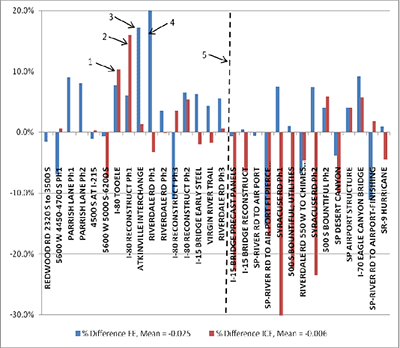
For the CMGC process it is necessary to provide a basis of comparison for the bids that are provided by the contractor at bid opening. The CMGC process allows the contractor to submit a bid without competitors. To determine if the pricing is realistic, UDOT secured the services of a third party estimating company that provides estimated bids for comparison. This company works independently of both UDOT and the contractor and neither UDOT nor the contractor can see the independent Cost Estimates (ICE) results until bid opening. According to UDOT policy, any bids that are higher than 10% of the ICE should not be awarded. After bid opening a meeting is held with UDOT, the ICE, and the contractor to review line items that differ by more than 10% to determine if both estimators considered the same assumptions, risks, and Measurement and Payment descriptions. If errors are determined in the bids both the contractor and the ICE are allowed to correct their bid and resubmit. To reduce bid item conflicts at bid opening, UDOT initiated the use of Measurement and Payment meetings and Pricing meetings prior to bid submittal. The goal is to minimize the percentage difference between the ICE and the contractor's price and the Engineers Estimate and the contractor's price. Percentages above zero suggest UDOT was not getting the best price and percentages below zero suggest UDOT is getting a better price than expected. Bid opening are chronological and the earlier projects show a wide variance in the engineer's estimate. Knowing that UDOT had retained an ICE, the designers did not put much rigor into their cost estimates. Recognizing this, UDOT reinforced the importance of both estimates to provide quality cost comparisons.
 |
| Notes to Figure 1
|
4.1.2 Bidding of Projects
The challenge of the CMGC delivery method is the lack of competitive pricing in the construction bid. This risk has two uncertainties:
- Once a contractor is selected, what motivations them to keep costs competitive?
- Once the project is bid, how do we know we are getting a fair and reasonable price?
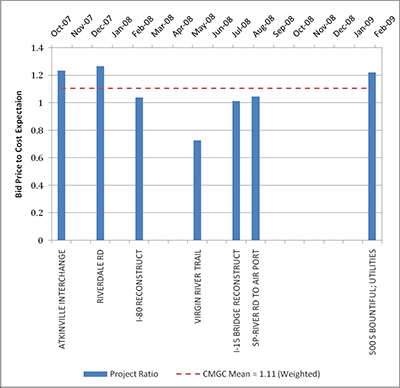
UDOT developed methods of analysis to investigate these risks. The analysis is meant to determine if competitive pricing is achieved, or if measures can be taken to ensure that it is achieved. UDOT addressed the absence of competitive bidding after the contractor is selected by establishing a cost expectation during selection and using an Independent Cost Estimate as described above. UDOT then tracks prices from selection to bid, and measures them against the cost expectation. Gathering price information in the selection process was a modification to the CMGC process. Until October of 2007, UDOT selected contractors for CMGC strictly through a qualifications-based evaluation. The Atkinville Interchange project was the first to consider price in selection. Each contractor was required to give bid prices on selected bid items for comparison.
 |
After selection, this pricing information establishes UDOT's cost expectation.
Setting a cost expectation that is competitively established during the contractor section process gives UDOT a means to measure unit price creep. The dashed line in Figure 2 is the average of CMGC projects presented in the chart and shows that overall pricing increases by 11% during design. Despite this average trend, one project succeeded in lowering bid prices during the design stage by mitigating project risk and using innovations to increase efficiencies. The Virgin River Trail project provided pricing lower than suggested during the contractor selection by 17%. Since 2007, pricing metrics have been utilized to determine the success of projects. Pricing expectations of CMGC can only be met if these expectations are established in the selection process and measured in the design process.
The partnership effort between the contractor and design team largely depends on the quality of the estimates that the contractor provides. By incorporating pricing into the selection process, the contractor can set prices artificially low to win the contract. It is important that any pricing analysis help to promote the partnering process that CMGC is founded upon. UDOT addressed uncertainty regarding whether bids are fair and reasonable by implementing a state average unit price comparison algorithm to determine the status of pricing for each CMGC project. Figure 3 shows the ratio of project price to state averages unit prices.
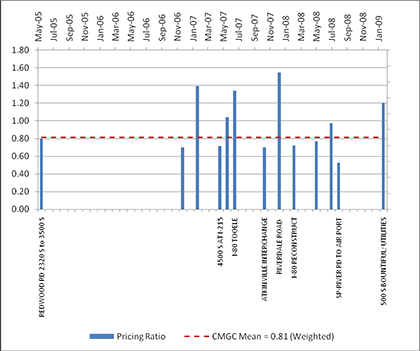 |
A ratio of 1 indicates that the bid unit prices equal the state average values. Preliminary results indicate that CMGC project bids are 19% lower than state average prices. It is important to investigate both the state average pricing results shown in Figure 3, and the cost expectations shown in Figure 2. This helps to determine if the proposal prices were artificially low. For example, the I-80 Reconstruct bid was opened in February of 2008. Many people felt that the contractor artificially lowered his proposal price to win a high profile project. Figure 2 indicates that the bid was only 4% higher than the proposal prices suggested; however, Figure 3 shows that the overall project bid was 72% of the state average unit prices. Even with price creep between the proposal stage and bid opening, this project achieved prices lower than suggested by the other contractors during selection. This confirms that CMGC can secure fair and reasonable prices that may in some cases be even lower than prices that would have been obtained if the project were competitively bid.
4.1.3 Savings through Innovation
CMGC produces its greatest savings through innovations that address risks—particularly risks associated with the duration of construction. Traditionally, the mobilization and maintenance of traffic in the work zone is the responsibility of the
| Project Description | Contractor Price | Estimated Direct Savings | Estimated User Cost Savings |
|---|---|---|---|
| 4500 S AT I-215 | $6,896,917.19 | $40,000,000.00 | |
| ATKINVILLE INTERCHANGE | $42,084,814.57 | $4,700,000.00 | |
| I-15 BRIDGE RECONSTRUCT | $9,032,135.05 | $240,000.00 | $43,000,000.00 |
| I-80 RECONSTRUCT Ph2 | $116,425,488.79 | $4,000,000.00 | $122,000,000.00 |
| RIVERDALE RD Ph3 | $41,748,562.31 | $3,260,000.00 | $84,000,000.00 |
| VIRGIN RIVER TRAIL | $1,296,518.74 | $180,000.00 | |
| SP-RIVER RD TO AIR PORT | $14,024,172.74 | $1,400,000.00 | |
| Total | $231,508,609.39 | $13,780,000.00 | $289,000,000.00 |
| Savings as a Percent of Anticipated Price: | 6% | 125% |
contractor. This approach generates MOT plans that only address what the contractor needs to complete the project within the construction schedule. In CMGC, the MOT plan can be developed during design and tailored to meet all types of constraints including; public preferences, right of way timing, and accelerated construction schedule
Table 2 shows UDOT savings associated with innovations developed during design. Direct savings resulted from contractor's influence to modify the design thereby enhancing constructability. User cost savings are due to the contractor's influence to reduce the construction period, thereby delivering the project to the public early.
CMGC provides the best setting to experiment with technical innovations. CMGC enables the team to share risk and allows the free exchange of information required to learn about the application of the innovation. Contingency costs are reduced and all members of the team gain valuable experience that can be transferred to other delivery methods. The mobilization of bridges on the I-80 Reconstruct provides the best example of this benefit. Mobilizing a bridge costs more than onsite construction; however, the User Cost savings of the public ($122,000,000) far exceed the mobilization cost. UDOT used CMGC to learn how to move large structures so that this method could be performed through Design Build and Design Bid Build methods in the future. For more information on the impact of bridge mobilization, please see the I-80 reconstruction CMGC reports.
Current projects show that these savings in innovations are realistic. The largest UDOT CMGC project currently underway is the Mountain View Corridor (Redwood Road to 90th South). Currently in design, the innovation savings are being tracked and validated showing a total savings of over $24 million (9.3 % of the anticipated project cost). These savings will not be shared with the contractor, as is the case with Design Build and Design Bid Build projects. CMGC promotes value engineering by obtaining the contractor's expertise, making it easy to implement cost-saving suggestions, and allowing the Department to retain the full benefit of the savings.
4.1.4 Change Orders and Overruns
Change orders and overruns for the CMGC process shows a savings of 6.6% when compared to traditional projects and 6% when compared to Design Build projects. This reduction is caused by the process innovations inherent in CMGC. The price of a project at bid opening is seldom the final cost of the project. During the construction of traditional projects costs increase due to change orders and bid item overruns. Change orders and bid item overruns are minimized through the CMGC process due to increased design evaluations and verification of quantities. The costs of change orders and overruns as a percentage of the project costs are compared to other delivery methods in Figure 4. The CMGC Process results in superior designs and lowers overall construction costs.
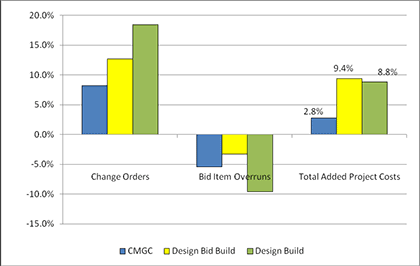
Figure 4 Change Orders and Overruns Compared to Other Delivery Methods
4.1.5 Overall Savings
By simply considering the current bidding costs and the reduction in construction changes, CMGC exhibits a savings of 15% compared to state average costs. This value is based on the actual costs of the projects compared to the anticipated costs utilizing state averages. A ratio of Project Cost to Anticipated Cost is shown in Figure 5. See Appendix B for the derivation of this ratio and the associated calculations.
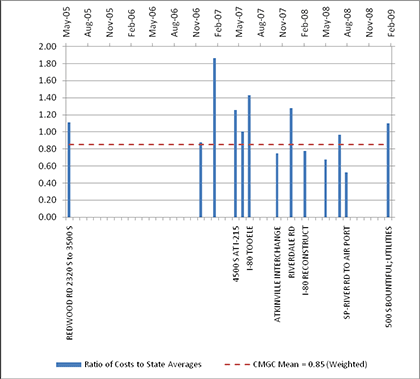
Figure 5 CMGC Cost Comparison to State Average Data
The application of CMGC has shown that:
- Fair pricing can be achieved through a clear statement of pricing expectations and measurement of the processes involved.
- Both small and large projects achieved savings.
- Innovations that reduce project schedule result in the most savings.
- Change orders and bid item overruns are minimized due to more robust designs.
- Not all projects using CMGC have realized substantial savings.
- Overall savings of CMGC is 15%
Savings achieved by CMGC are greater than DBB and DB. This is because contractors are willing to reduce costs as long as their profit margins are maintained through increased efficiencies in construction. These efficiencies are due to innovations during design. These qualities make CMGC an effective tool for road construction.
4.2 Savings Associated with Risk Mitigation
CMGC best enables the project team to take advantages of opportunities to reduce risks that threaten to increase project costs. Traditionally UDOT has addressed risk through a process of identification and mitigation that is not substantiated by rigorous analysis. However, with the implementation of large CMGC projects, better analysis efforts have been established. Mountain View Corridor; MP-0182(6), (MVC) is a current state funded project that illustrates the capabilities of CMGC to analyze and mitigate risks. Figure 6 shows the “Opinion of Probable Construction Costs” (OPCC) at various stages of the project. OPCC1 represents the construction costs as determined by the designers. OPCC2A indicates the construction costs based on designers costs with contractor's input. This shows that the contractor's insight provides real cost that was overlooked by the designers. For MVC this increased cost equates to $38.7 million (difference of the 50% Probability of Exceeding level). This produces the baseline of the project cost at $346.2 million. The contingency for the base line cost is $56.7 million (difference of the OPCC2A curve at the 90% and 50% probability).
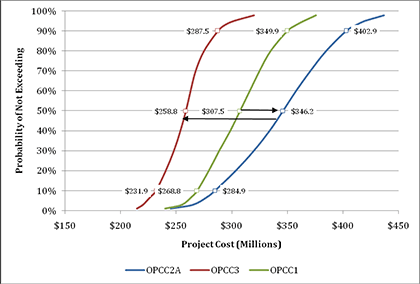
Figure 6 MVC Adjusted Construction Cost as of December 17, 2009
OPCC3 represents the efforts of the team to mitigate the risks associated with costs. Currently the project costs have been reduced to $258.8 million, a savings of $87.4 million (33.8% of the anticipated price of the project). Furthermore, the contingency requirements have also been reduced to $28.7 million. This ongoing project demonstrates that the efforts of both the design team and the contractor can lead to a better understanding and mitigation of risk. For further information please refer to Project Management, Design and Risk Workshop Results for OPPC3 prepared by the Mountain View Program Management Team.
4.3 Performance Conclusions
| Advantages | Disadvantages |
|---|---|
|
|
The analysis provided in this section has shown that CMGC facilitates the responsible use of budget and schedule. By maximizing the contractor's efficiencies during construction, CMGC helps to control cost, introduce innovations and reduce overall project time. Though all projects do not share the same level of success, the benefits of CMGC have been recognized by the designer, owner's representatives, and contractors alike. Table 3 shows a list of CMGC performance results.
Cost control must be established during the bidding process and carried out through construction. By carefully monitoring costs and declaring a clear expectation of pricing, UDOT succeeded in achieving fair and reasonable pricing of projects. Once in construction the amount of contract changes is reduced to save additional money by avoiding change orders and bid item overruns typical of other delivery methods. These savings have resulted in an overall process savings of 15% of the construction costs compared to state average prices. Additional savings are achieved through the application of innovations that reduce construction schedules and maximize contractor's efficiencies.
5. Criteria for Evaluating the Applicability
As required by FHWA MOU, UDOT gathered information from project teams to determine if the CMGC process gives an advantage in producing constructible designs through innovation, providing learning opportunities, promoting environmental stewardship, and increasing the benefit to the public. Project team members responded to interview questions regarding each of those Criteria for Evaluating the Applicability. The interview responses provided evidence that CMGC has produced these advantages by citing several examples. Appendix A compiles these examples in a detailed report. The report shows that CMGC made it possible to:
- Avoid change orders by addressing constructability issues, unforeseen by the designer, through modifications to the plans
- Develop innovations directed at shortening the schedule, reducing cost, mitigating risk, and applying technology.
- Begin construction as early as possible.
- Develop technical solutions to unknown conditions before they were encountered in the field.
- Assign responsibility for risks and control their costs.
- Take advantage of less expensive local resources, and opportunities to reduce user costs.
- Test many new technologies.
Because of the results summarized herein, UDOT believes that continuation of the CMGC program will consistently provide project teams with a well-developed tool that can be used to achieve the results presented in the this section.
6. UDOT CMGC Process
UDOT has established a standardized process for completing CMGC projects. The process was developed to ensure continuity and protect the interests of UDOT and the FHWA. The CMGC process includes three basic phases:
- Concept Development
- Design
- Construction
This section describes what takes place during each of these phases shown in Figure 7.
6.1 Concept Development
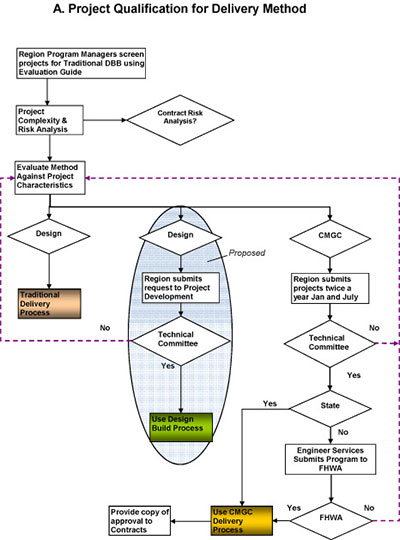
A flowchart showing the activities in the Concept Development phase is provided in figure 6. The tasks accomplished during the Concept Development phase are:
- Region Program Manager evaluates prospective CMGC projects according to the 7 Criteria for Applicability identified in the MOU between UDOT and the FHWA.
- Region submits a request to use CMGC for Technical Committee Approval.
- Once Technical Committee approval has been granted the State reviews the project and approves or disapproves.
- If federal funding is used UDOT Engineering Services submits a request for approval to FHWA.
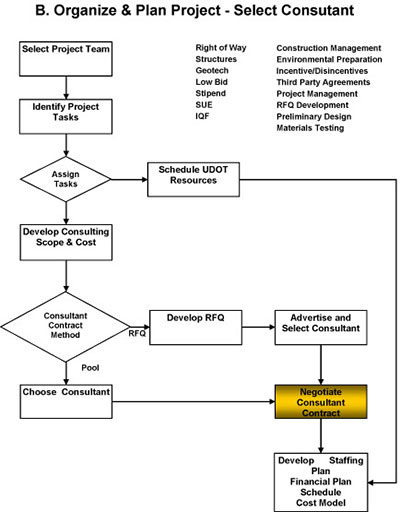
- The project team develops a consulting scope and cost and negotiates with consultants who either respond to an RFQ or are part of the consultant pool to select a consultant.
The deliverables of the Concept Development phase are:
- Staffing Plan
- Financial Plan
- Schedule
- Cost Model
6.2 Design
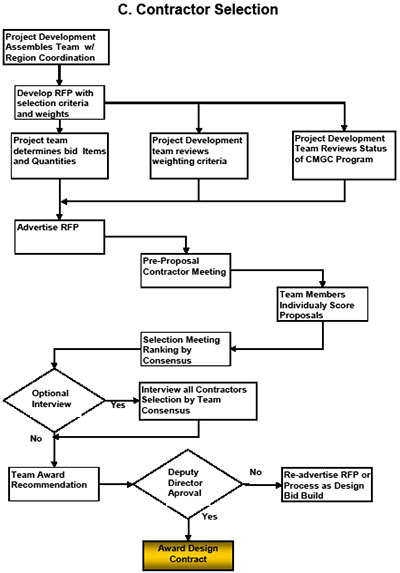
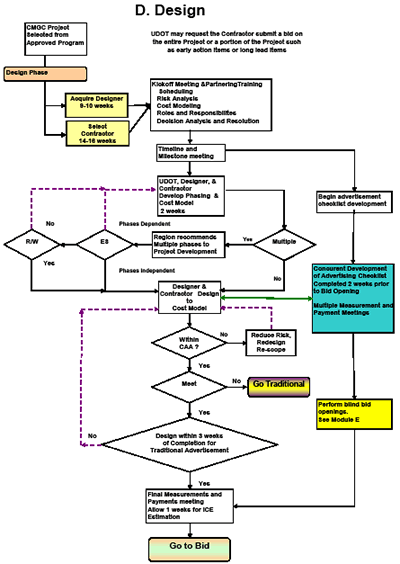
A flowchart showing the activities in the Design phase is provided in figure 6. The tasks accomplished during the design phase are:
- The team selects a contractor to provide input during the design phase.
To select a contractor the team:
- Develops and advertises an RFP. This includes establishing and weighting selection criteria.
- Selects a winning proposal based on technical proposal, price proposal, and interviews.
The contractor contributes to the development of the plan set by:
- Verifying the designer's assumptions.
- Determining the tasks needed to complete the Project and estimating the costs, duration, and sequence of these tasks.
- Identifying risks and possible mitigations.
- Identifying innovations that will reduce risk and cost.
- Identify and provide estimates for design alternatives.
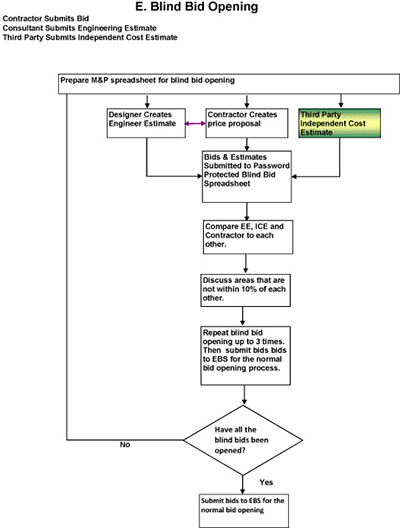
The intended outcome of this process is for the contractor to prepare a GMP proposal to UDOT with appropriate backup documentation. To achieve this outcome the contractor is required to participate in blind bid openings and track risks and innovations associated with their input in design. Risk and Innovation are tracked throughout the design process and are monitored for change over time. The blind bid opening takes place as follows:
- Designer, Contractor, and Independent Cost Estimator (ICE) prepare estimates.
- Bid items are compared confidentially.
- Bid items where one estimate is 10% above any other estimate are discussed.
- This may be repeated 3 times and then final bids are submitted.
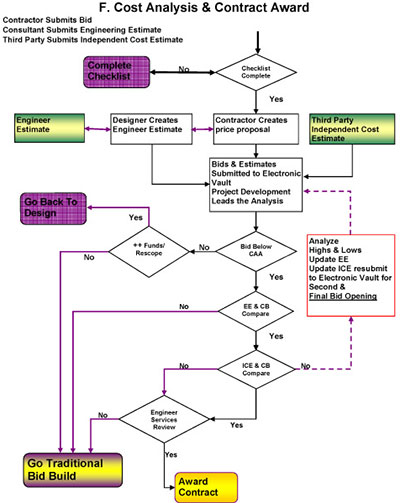
Once final bids are obtained the Department may chose to award the contractor with the construction contract, or sever CMGC and prepare the project for DBB.
6.3 Construction
If the contract is awarded to the CMGC contractor construction proceeds as normal, with the exception that the designer is expected to participate in problem solving during construction. The designer follows up on risks that were identified in the design phase, but could not be finalized until construction. The entire project is approached by all members of the design team, rather than the designer completing the design and turning everything over to the contractor.
Under CMGC two other types of early construction contracts may be let while the project is still in design, including:
- Early Procurement, which can be helpful in obtaining long-lead items so that they are on-hand when the design is completed and the construction contract is awarded.
- Preliminary Phases of Work, which can be released in order to begin construction while remaining elements of the design are finalized.
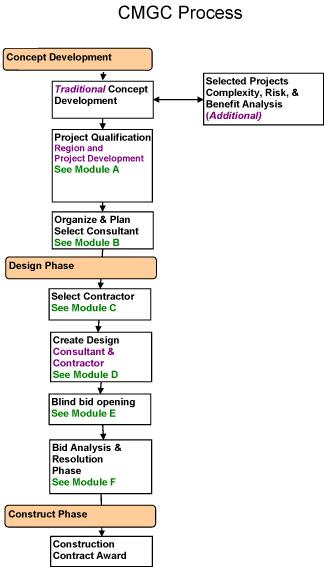
Figure 7 CMGC Process (See Appendix C)
Appendix A Criteria for Evaluating Applicability
UDOT feels that the following project goals can be best met through the CMGC process; producing a more constructible design, facilitating innovation, optimizing the project schedule, controlling risk, providing learning opportunities, promoting environmental stewardship, and increasing the benefit to the public. This section evaluates how successfully recent CMGC projects have met those goals. The information included in this section was gathered by conducting interviews with representatives from UDOT, the Designer, and the Contractor on 8 projects reviewed throughout the UDOT CMGC experience. A list of the interviewees and their contact information is included at the end of this appendix.
Design and Constructability
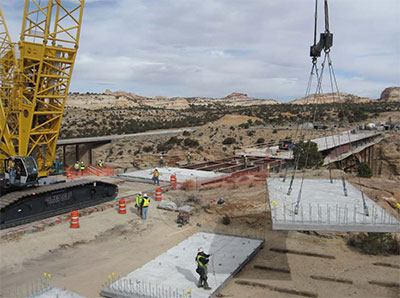 |
| Figure 1. Eagle Canyon Bridge - Oversize Crane Required due to Bridge Inefficiencies |
The CMGC process allows designers to prepare a more practical design by obtaining contractors' recommendations based on means and methods. Contractors appreciate CMGC because it “puts constructability at the forefront of design,” (Granite). Designers benefit from being involved in a CMGC project because “input from the contractors changes the designer's perception of how to build the project,” (Horrocks). This was evident on the Eagle Canyon Bridge, where “conventional crane operative capabilities could not install the bridge panels as anticipated by the designer. The contractor suggested using an oversized crane or SPMT [self propelled modular transport]device for installing precast panels,” (Monte Aldridge). The project team elected to use the oversized crane, which allowed them to maintain standardized panel installation and install the bridge components more quickly. Use of the oversized crane necessitated modifications to other aspects of the design including the use of lightweight concrete, and post-tensioning in place of rebar. These modifications in turn produced incidental benefits such as improved quality and lightened loads on the structure (See Appendix A-Eagle Canyon Phase One). This is just one example of how “the contractor's continuous input on constructability issues allowed for customizing the design to match the contractor's methods,” (D Grahm, R Richins). The consensus among members of the project teams is that CMGC results “in a combined solution that the engineer can design, and the contractor can build,” (Eagle Canyon Project Team).
The CMGC projects that UDOT has conducted recently provide a great deal of evidence that the contractors added significant value to the design process. The primary way in which contractors added value was by offering their expertise on matters related to constructability and cost (Monte Aldridge).
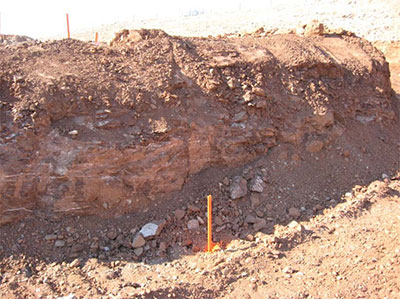 |
| Figure 2. Southern Parkway - Contractor Conducted Soil Surveys to Map to Help Avoid Rock Excavation in Proposed Routes |
On the 500 South widening the contractor helped the team reduce the cost and complexity of the grading. “Initially the project was 60,000 yards out of balance. The contractor recommending raising the grade 4 inches, which eliminated 30,000 yards of haul,” (Steve Sussdorff). The contractor also suggested a switch “from HMA to PCC pavement, saving 3 inches in depth for the sub base, further helping with balancing issue,” (Steve Sussdorff). On the Syracuse Road widening project the contractor also provided a savings by recommending the installation of water and storm lines using polyethylene pipe (which is cheaper than copper) allowing contractor to install the mid section and cap for connection later,” (Shane Albrecht).
Many of the project teams have also stated that the contractor adds value by identifying opportunities to make use of local materials, and by suggesting more cost-effective ways of mitigating problems. On the Southern Parkway project, “The contractor identified a nearby property owner as a subcontractor. The property owner had the necessary water, materials, and access. This provided tremendous savings to UDOT,” (Russel Youd). The I-80 project provides a good example of how a simple suggestion made by the contractor dramatically reduced the cost of mitigating a problem. On that project “bridges were moved 8' to one side or the other to avoid conflicts with overhead power lines during pile driving. Without contractor participation, the need to do this may not have been realized until after design was complete,” (Wayne Bowden).
The results of recent CMGC projects have shown that the contractor's involvement has delivered the anticipated benefits, but each team took risks when they chose to implement the contractors' suggestions. To alleviate those risks the contractors went out of their way to substantiate their claims. On the Southern Parkway project there were some geotechnical concerns that the design team was having trouble addressing. “The Contractor conducted soil surveys, and quantified rock excavations. Having the Contractor investigate geotechnical issues allowed us to avoid a situation where bids would include a great deal of risk. As a result, we were able to develop a unit cost for excavation which helped us reach a GMP,” (Southern Parkway). Utilities were a sensitive issue on the SR-9 project, and the contractor provided input to develop a 3D model for the relocation of utilities (SR-9). These are just two examples that show how the contractors have been willing to help the project teams gather enough information to confidently implement the contractors' suggestions.
Once the project teams had enough information to properly evaluate the contractors' suggestions the next challenge was to establish a fair way to decide which suggestions to implement. The project teams stated that most decisions were reached through open discussion (Shane Albrecht, D Grahm, R Richins). This worked well on the 4500 South Bridge Reconstruction Project, where “all of the decisions were made with the contractor there, which made for a good transition for implementation in the field,” (Lisa Wilson). This decision-by-committee process also allowed UDOT to give the project team more direction when necessary. This was the case on the Syracuse Road Widening, where “minor decisions were often decided between the designer and contractor, but UDOT was kept in the loop. On major decisions, UDOT was involved. For example, on the decision to move from HMA to PCC, the PM, RMT, RE, and district engineer all weighed in on the decision,” (Nathan Peterson). On the Southern Parkway project UDOT was also able to provide the team with direction, as “Many of the Contractor's suggestions were evaluated with the help of UDOT materials engineers and UDOT structures engineers,” (Southern Parkway).
The result of this open collaboration is that the terms “design,” and “constructability” become synonymous. In the past the two have been opposite to one another, and it has traditionally generated a lot of friction, through change orders, RFC's, etc., to bring them together. Involving the contractor in design has turned it “into an iterative process where the design and the methodology are tailored to one another,” (Monte Aldridge).
As with many of the projects, this philosophical shift was realized on the Riverdale Road project, where “the contractor was able to apprehend the intent of the designs, and see what constraints influenced the design. As a result the contractor could suggest means of meeting the intent of the designs and working around the constraints,” (Randy Jeffries). Recent CMGC projects have shown that when a contractor is given the opportunity to provide such input they have helped the group arrive at workable solutions. This claim is best supported by the SR9 project. On that project the team presented the “contractor with a cost model up-front, which caused him to seriously consider how he would construct the project under the constraints of a Guaranteed Maximum Price and a goal of zero change orders,” (SR9 notes 2nd draft). This goal was met, as “the structure over Ft. Pierce Wash had zero change orders,” (Russel Youd).
Other common project goals that have been positively affected by the CMGC process are reduced costs, improved quality, shortened schedule, and reduced impact to the public. While CMGC continues to deliver projects that successfully target the project goals, the recent projects have helped us to identify areas where the process could still use some refinement.
Innovation
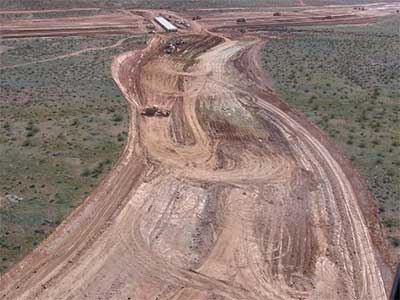 |
Figure 3 Southern Parkway - Borrow from Adjacent Wash Minimized Material Costs |
One of the attractive features of CMGC is the notion that it creates an environment that will produce innovative solutions to challenges that the project team faces. To determine if that has been the case on recent CMGC projects, UDOT asked members of the project teams to identify the innovative solutions that they came up with. These innovations were directed at reducing cost, shortening the schedule, improving quality, and applying technology.
The project teams applied many innovations to reduce costs. On the Southern Parkway project the imposition of a GMP “encouraged the contractor to seek out and propose better construction methods. On this project the contractor proposed changing the base course and thickening up a section in order to take advantage of nearby sources of materials. After verifying the proposal with geotechnical and materials engineers we were able to take advantage of the opportunity,” (Southern Parkway).
The Syracuse Road Widening provides another example where the team capitalized on an opportunity to realize some savings by working together to change its approach to a technical issue. This opportunity was created by the “Early procurement of 1 inch dowels for pavement. UDOT decided after this procurement had occurred that the pavement depth should be increased from 8 inches to 10 inches, resulting in the need to upgrade to 1 ¼ inch dowels. The contractor agreed to do a 10 inch pavement for the price of 8 inch, if UDOT would allow for a design exception of 1 inch dowels. UDOT agreed to design standard change,” (Shane Albrecht).
The original plan for the I-80 project was to build all bridges next to the ones they would replace. This would have lead to tremendous remediation and MOT costs at each bridge. As an alternative, the contractor recommended that all of the bridges be built in one location and driven into place using SPMTs. “The ‘bridge farm' resulted in savings from economies of scale,” (Brian Atkinson). More cost saving innovations that involved Accelerated Bridge Construction (ABC) include the partial depth panes and minimization of closure pours on the I-15 Bridge Deck Replacement project (Evan Nixon).
Many projects saw their schedules shortened thanks to innovation. The innovation that showed the most widespread benefit to scheduling was the practice of working with the contractor to determine project phasing, and then releasing the design in segments so that work could proceed while design issues are being address. Two projects that illustrate this well are SR-9, and Southern Parkway. On SR-9 “Clearing right of way was a threat to schedule. The contractor identified the critical path of right of way required to begin construction on schedule. This allowed the rest of the right of way acquisition to be phased,” (Youd). This innovative approach to phasing also played a role in the Southern Parkway project by allowing the team to prioritize segments of the design. “Splitting the project into five severable packages allowed us to continue design of the individual packages while other packages were under construction. In some cases we have even been able to complete design of one package before construction of the previous package has been completed,” (Southern Parkway).
Other projects saw their schedules shortened thanks to innovations that took unique advantage of project-specific conditions. On the Syracuse Road project the use of “a single trunk line instead of dual [piping system] on the storm drain shortened the schedule by a few weeks,” (Nathan Peterson). With the I-80 Project “building the bridges offsite, and moving them into place, resulted in bridge replacement that was accomplished in days. Every aspect of construction of bridge decks off site and installing was an innovative process. This led to an overall savings of at least one year as opposed to a standard design-bid-build project,” (John Montoya).
The project that showed the greatest enhancement to quality as a result of innovation was Eagle Canyon. On Eagle Canyon “The bridge erection techniques and scheme were unique, such as the use of an oversized crane to remove and replace bridge deck panels. This crane allowed for keeping equipment off the bridge, avoiding overloading the structural steel of the bridge. Although the crane rental costs more than traditional equipment, it allows for faster construction, saving time and labor costs,” (Eagle Canyon Project Team). The contractor's involvement in the design of this project was critical not only because his suggestion to use an oversized crane produced the type of benefits we would hope to see on a CMGC project, but also because the designer's proposal to use a traditional crane would actually have overloaded the bridge. In addition to the erection techniques, the quality was also improved thanks to an adaptation of the way the deck panels were to be handled. “The contractor provided input on the planned storing and shipping of bridge deck panels, which allowed the designers to optimize their design, rather than have to create a design that would accommodate the numerous possible shipping and storage scenarios,” (Eagle Canyon Project Team).
Pavement design was another area in which many projects improved their quality through innovation. Team members from the Syracuse Road, 500 South Widening, and SR-9 projects all stated that the quality will be improved either by a change in pavement type, or a change in pavement design.
A number of innovations were applied to take advantage of new technologies. Many, such as Riverdale Road, I-80, Eagle Canyon, and the 4500 South Bridge Reconstruction applied ABC technology. With ABC just beginning to take hold in the transportation industry, the contractors' involvement was necessary in order to apply the technology successfully. The designer of the 4500 Bridge Reconstruction project stated that “Having the contractor on board early was a huge benefit due to the unique nature of the project and the newness of the technology. It was essential to have the general contractor and the SPMT contractor involved in design,” (Mike Arens). The 4500 South Bridge was the first one in Utah to be constructed offsite and moved into place with SPMTs. It took the collaboration of UDOT, designers, and contractors to make this project a success. After the 4500 South Bridge Replacement Utah was able to apply the knowledge gained from that collaboration to successfully move 12 more bridges with SPMTs. Other projects that applied new technologies include the Syracuse Road project, where the team used “Flexible poly pipe instead of copper on water laterals,” (Nathan Peterson), and the 500 South project, which applied “HDPE snap-tight pipes,” (Steve Sussdorff, Greg Davis).
Project Schedule
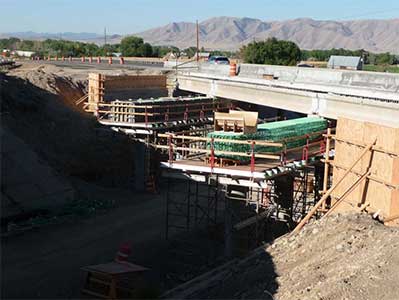 |
Figure 6. I-15 Bridge Repair - Bridge Widening Minimized Construction Impact on the Public Througout Construction |
The CMGC process has allowed project teams to shorten or make better use of the schedule in a number of ways. Some teams report dramatic reductions to the overall schedule. The team on the 4500 South Bridge Reconstruction reported time savings ranging from one “construction season,” (Lisa Wilson), to “9 months,” (Wayne Bowden). The I-80 project reported an even greater reduction to schedule. “Looking at the overall project, a 3 year project was condensed into 2 years,” (John Montoya). This section discusses some of the ways that CMGC enabled project teams to treat the schedule as an asset rather than a burden.
The biggest advantage CMGC offers over other delivery methods in terms of schedule is the opportunity it gives the team to be proactive in addressing constructability issues during design. On the Riverdale Road project Brian Griffeth estimated that this saved the team 3-12 months. Traditional projects impose a deadline on a design team that may not be able to identify or address all of the constructability issues before releasing the contract documents. This in turn puts pressure on the contractor to resolve all deferred constructability issues within the schedule they have been provided. The Eagle Canyon project shows how the CMGC process can mitigate this problem. On that project the “time spent in design saved time during construction and reduced risk. The contractor's influence during design minimized the number of assumptions of the design team and resulted in a more feasible design,” (Monte Aldridge). As a result the team “saved two months in design time due to contractor input, and overall, the project saved more time because of discovering the bridge inadequacies in design, rather than during construction,” (Granite).
Phasing was mentioned above when discussing the benefits to the public, but phasing also produces tremendous benefits to the project team. What is special about the way that the CMGC process identifies phases of a project is that it places the segments of a project in the order that a contractor would most logically build them. On the Riverdale Road project this method “allowed the project to be phased by releasing early design packages, making it possible to complete the project in one season,” (John Bale).
The phasing method also allowed project teams to isolate 3rd party issues that commonly delay most projects. On the Syracuse Road project “the contractor was able to help identify the area where construction would begin, thus allowing the design team to prioritize Right-of-Way. As a result construction was able to proceed while acquisition was underway,” (Randy Jeffries).
Utility coordination is often difficult and time consuming. The SR-9 project provides an example of how the CMGC process can reduce the impact utility issues have on the project schedule. “the contractor's early involvement in the design of utility relocations allowed the Department to partner with the utility companies. For example; the Department offered to provide surveying support to ensure that Questar placed their high pressure gas line as per designed. This allowed the Department to obtain an MOU that the utility company will compensate the Department if a specific deviation from the designed utility relocation obstructs the Contractor. This protects the Department from being liable for any costs that may be incurred from this potential conflict,” (SR-9).
Another way in which CMGC enables project teams to make better use of the schedule is by facilitating early procurement. One problem with traditional methods is that long-lead items can delay a project because they are not procured until after design is complete. The Riverdale Road project gives a good example of how releasing the project in phases can eliminate this type of delay and substantially shorten the project schedule. “The construction schedule was shortened by 6 months by awarding early packages for material acquisition and early construction package(s). If the project would not have received NTP on the materials for the bridge until final project design then the order for the girders would not have occurred until April, making delivery in September or October. Instead the girders were delivered in June and the traffic switched to the completed Phase I structure in September,” (Contractor).
Risk
The CMGC process enabled UDOT to better control risk by making it easier for the Department to assess the potential cost of risk items and assign those risks in the most appropriate way (John Clarkson). On the Riverdale Road project the contractor's involvement was helpful for obtaining estimates on risk items so that the Department could determine how much to hold in the budget to account for those risk items (Randy Jeffries). Recent CMGC projects have shown that the Department can then successfully distribute those costs by addressing risk items in the Measures and Payments. On the Riverdale Road project “risks that UDOT wished to defer to the contractor were included as lump sum items,” (Randy Jeffries). Where UDOT felt more confident with their assessment of particular risk items they accepted the risk themselves by assigning unit prices to those items. This was the case on Riverdale Rd, where “unsuitable and lightweight fills were mitigated by assigning a unit price,” (John Bale).
Members of both the 500 South project and the Syracuse Road project expressed that controlling Measures and Payments in this way effectively kept the contractors from inflating their bid prices to cover risk. On the 500 south project this was evident when “UDOT held the risk on hitting contaminated groundwater, which allowed the contractor to leave the cost of that risk out of their bid,” (Greg Davis). On the Syracuse Rd. project “working with the contractor allowed the designers to refine the M&P notes, making them clearer, particularly on lump sum and specialty items. This reduced the risk of misunderstandings, and allowed the contractor to cut risk out of the bid,” (D Grahm, R Richins).
Not only did the CMGC process allow the cost of risk to be better controlled, but it also gave project teams the opportunity to preemptively address risk items. “Using CMGC increased the planning time for the contractor to think about methods and processes. In Design Bid Build (DBB), they wouldn't have had as much time to think through their approach to issues,” (John Montoya). This was evident on the SR-9 project, where “CMGC allowed the contractor to identify where addition investigations were required to quantify, minimize, and possibly eliminate risk,” (SR9). “On this particular project the contractor possessed a potholing system, which made it possible to located all of the utilities and create the 3D model. The contractor also identified where additional geotechnical testing was required due to wet soils in the downtown area. The team then worked with the contractor and sewer company to identify the need to upgrade old, brick-lined manholes. Allowing the old man holes to remain was a certain liability for the Department,” (SR9).
Another way that CMGC has allowed the project teams to preempt risk is by providing the team with the sufficient time, expertise, and tools to develop better and more comprehensive utility strategies. On the Riverdale Rd. project, the team was able to develop a solution to utility issues that was vastly different from, and advantageous to, the traditional approach. On that project the contractor “surveyed all utilities. Having central control of all utilities and their placement eliminated time and cost associated with looping utilities: Estimated savings of $20,000.00 to $50,000.00,” (Brian Griffeth). Placing the contractor in control of all utilities also avoided duplicated efforts. “By having local utilities work within Granite's traffic control, it saved time most importantly, but also produced cost savings over having three different companies doing their own. Each company had approximately 3 months of work on the project. Estimate 90 days by 3 companies by $1000.00 per day is approximately $270,000.00,” (Brian Griffeth).
Learning Opportunities
The specific lessons learned on recent CMGC projects will be discussed in a later section. This section will focus on evaluating projects to see if the CMGC process effectively created an environment in which members of the project teams could learn from one another. When interviewed, almost all members of CMGC project teams were able to list numerous lessons learned. Most of these lessons pertain to changes team members recognized that they could make to the way they work in order to allow other team members to work more effectively. The legacy the CMGC process is likely to leave as it becomes more widespread in the transportation industry is that those who have participated in it will be capable of providing intuitive solutions.
Designers have learned a great deal by working on CMGC projects. On SR-9 the CMGC process was “a rare opportunity to get expertise from the contractor regarding constructability not normally available during,” (Youd). This specifically pertained to “understanding the constraints that the contractor is under,” and “understanding how much design detail the contractor required so that designers could focus their effort on the appropriate areas,” (Youd). On the Syracuse Rd. project this understanding helped the designers “realize the importance of looking into utility conflicts more as a designer, and to put more effort into avoiding them,” (D Grahm, R Richins).
Contractors gained a broadened perspective by learning to address a project in terms of its goals rather than in terms of its plan set. On the SR-9 project “Presenting the contractor with a cost model up-front caused the contractor to seriously consider how to construct the project under the constraints of a Guaranteed Maximum Price and a goal of zero change orders,” (SR9). This was also seen on the Riverdale Rd. project, where “The contractor learned how to provide more in-depth design input, knowing that the more you point out up front, the greater the benefit to everyone involved,” (Brian Griffeth). The I-215 Bridge Reconstruction “project was successful because the contractor was very involved and engaged early on. Although not the case in this project, contractors have a tendency to not “scour” the design until they're getting ready to bid/construct, and by then it is too late to make significant changes. The key to success is to push the contractor to be thoroughly engaged in preliminary reviews,” (Mike Arens).
Both contractors and designers saw the CMGC process as a useful way to work together to determine how best to apply new technology. The I-215 Bridge Reconstruction project was the first project in Utah to move a complete superstructure into place using Self-Propelled Modular Transporters (SPMTs). The project was a success because, working together, the team was “able to learn some interesting new technology that has been used elsewhere. This project verified that this new technology really does work and that it's a benefit to the public,” (Wayne Bowden).
Recent CMGC projects have also allowed UDOT to identify ways that it can better guide designers and contractors toward the project goals. Team members identified a need for greater continuity, as on the 500 South project “there were some challenges in dealing with differing expectations from the Complex and the Region,” (Greg Davis). The project manager's role is critical in providing this continuity. The Riverdale Road project showed that the project manager can fill that role by being “proactive and engaged in the process in order to ensure that the proper checks and balances are followed,” and by “bringing strong negotiation skills to the CMGC process,” (Randy Jeffries).
Environmental Stewardship
The CMGC process has facilitated better environmental stewardship in two ways. First, it gave the contractor more time to become familiar with the environmental issues on a project. Team members from both the Southern Parkway, and SR-9 projects both stated that this was the case. This additional time also allows contractors to gather information on how their construction methods could raise environmental concerns, as was the case on SR-9, where “having the contractor present allowed the department to educate them on the presence of the historic downtown area. This alerted the contractor to the need for a survey of the foundations of old buildings that could be impacted by construction activities carried out in their vicinity,” (SR9).
The second way that the CMGC process has facilitated better environmental stewardship is that it has allowed contractors to address environmental issues by adding input rather than receiving a list of commitments that they must bend their methods to suit. This was seen on the Syracuse Road project, where “the contractor coordinated with UDOT to get the environmental clearances for a site near the project to dump excess dirt, rather than having to dump at a commercial site 2 hours away. This was the City's preference. This move reduced trucking miles and emissions. This was the first time that UDOT environmental has cleared a waste site for a contractor,” (S Albrecht, N Peterson). Another example can be found on the 500 South project. In this case the contractor suggested “Raising the grade and using a lesser roadway cross section, which allowed him to avoid [disturbing] contaminated soil,” (Steve Sussdorff).
Benefits to Public
While everything the project team does to improve the project produces a benefit to the public, it is worth examining how CMGC creates specific opportunities to improve the public's disposition towards the project. Many project teams described the positive effects that have resulted from the unique way that CMGC partners contractors with stakeholders. On the Riverdale Road project the CMGC process introduced the contractor “to the public and other stakeholders early on, giving the project team a face. In the traditional method only the owner has interactions with the public until final design and project award. This allowed the contractor to gain valuable trust from the public as well as build relationships that were needed to resolve conflicts concerning property access issues, land use, and an overall partnering relationship with the stakeholders,” (Riverdale Road Project Team).
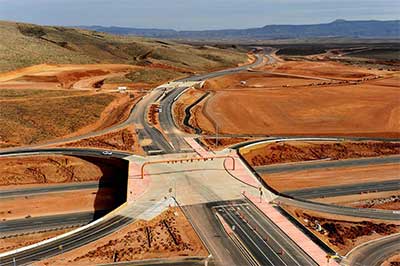 |
Figure 7. Southern Parkway - Early Completion of the SPUI Enabled new Development to Access I-15 |
Project phasing was another key feature of the CMGC process that produced direct benefits to the public. These benefits have been realized by a reduced impact to business and traffic. On the I-80 project, where the impact to traffic was critical, the contractor provided suggestions that helped develop the phasing plan for MOT (John Montoya). On the Riverdale Rd. project the contractor was able to develop an elaborate strategy to reduce the impact to businesses. The strategy involved “a Business District Advisory Committee (BDAC), formed to provide an incentive for the contractor to actively engage public involvement. The contractor had regular meetings with the BDAC to keep the public informed on each phase of construction. The contractor held open housed at the start of each construction phase, and sent out weekly or bi-weekly email canvasses on construction activities. Frontline, the public involvement subcontractor, conducted daily public outreach. Overall, businesses reported a loss in revenue ranging between 10%-40%,” and the contractor was able to complete critical phases of construction in time to reopen traffic for the holiday shopping season and completing the project 6 months early (Brian Griffeth).
The project phasing enabled by the CMGC process also allowed the public to to access I-15 via a Single Point Urban Interchange (SPUI) almost a year ahead of schedule. This occurred on the Southern Parkway, where “the SPUI on segment 1 was opened early in order to serve the small surrounding community,” (Southern Parkway). The Southern Parkway team expects the public to continue to benefit from project segmentation when “the second segment will be opened to the city so that they can access the site of the new airport,” (Southern Parkway).
| Russel Youd | Horrocks | 801-763-5100 |
| Larry Reasch | Horrocks | 801-763-5100 |
| Eric Wells | Granite | 801-526-6068 |
| Matt Stepan | Granite | 801-526-6000 |
| Mike Arens | Baker | 801-255-4400 |
| Evan Nixon | Parsons | 801- 553-3325 |
| Brian Griffeth | Granite | 801-526-6000 |
| John Bale | Parsons Brinckerhoff | 801-288-3268 |
| Wayne Bowden | Ralph L. Wadsworth | 801-301-2714 |
| Steve Sussdorff | Geneva Rock | 801-627-2801 |
| Greg Davis | URS | 801-904-4000 |
| Nathan Peterson | UDOT | 801-620-1684 |
| Shane Albrecht | Geneva Rock | 801-771-7980 |
| Ryan Richins | Horrocks | 801-763-5100 |
| Doug Grahm | Horrocks | 801-763-5100 |
| John Montoya | UDOT | 801-975-4871 |
| John Clarkson | UDOT | 801-222-3411 |
| Charles Mace | UDOT | 801-620-1685 |
| Monte Aldridge | UDOT | 435-893-4738 |
| Lisa Wilson | UDOT | 801-965-4190 |
| Tamerha Maxwell | UDOT | 435-865-5511 |
| Randy Jeffries | UDOT | 801-620-1690 |
Appendix B - Project Cost to Projected Costs of CMGC Projects Procedure
In order to uniformly evaluate cost of CMGC projects the UDOT developed a ratio of comparison for Total Project Costs to the “Projected Cost” of the Project. This ratio is represented in Equation 1 below. The Projected Cost of the project is the cost based on the state average unit prices and the average impact of change orders and overruns.
| RPC = | Tc |
| Pc |
Equation 1 - Ratio of Project Cost to Projected Cost
A value of RPC above 1 suggests that the project was overpriced when compared to state average pricing data. A value less than 1 suggests that the project costs were reasonable. The Atkinville Interchange will be performed as an example. Please see the individual report for more information.
The Total project cost is the bid price plus the change orders (including planned change orders) and overruns determined from the PDBS overrun status report for the project. It should be noted that the “other costs” shown in table are not included as they typically count for very small percentage of the costs.
Tc = B + COp + COu + o
Equation 2 Total Project Costs
Where:
B: The bid price
COP: Planned Change Orders
COU: Unplanned Change Orders
O: Overruns/underruns
TC = $ 36,293,458.81 + $5,791,355.76 + $ 809,429.12 + $ (-281,867.67) = $42,612,376.02
The Projected Cost is determined by taking the bid price (B) and multiplying it by the inverse of the silver standard ratio (SSR) as reported in Figure 2 of the main report (See Equation 3). This estimates the Projected Bid Price (PBP) assuming state average unit prices apply. For this project the silver standard ratio is 0.69 which suggests that on the bid items compared, the resulting price was 69% of the same bid items statewide for the given quantities. This analysis has been reproduced in table B-1 below. The PBP becomes the basis for calculating the change orders and bid item overruns anticipated from state average estimates. Over the last five years (2005 through last quarter of 2009) UDOT's change orders have averaged 12.7 % of the bid price and overruns of -3.3% of the bid price. By totaling these three values the Projected Cost (Pc) is determined (See Equation 4)
| PBP =B | 1 |
| SSR |
Equation 3 Determining the Projected Bid Price from State Averages
Where:
PBP: Projected Project Price
SSR: Silver Standard Ratio
Pc = PBP + (0.127 PBP) + (-0.033 * PBP)
Equation 4 Projected Cost
By Substituting Equation 3 into Equation 4 and applying the actual project data:
PC= ($ 36,293,458.81 /0.69) x 1.094
PC = $57,543,541.94
The Ratio of Total Cost to Projected Cost is simply TC/PC
RPC = $42,612,376.02 / $57,543,541.94
RPC = 0.74
| Project No: *HPP-15-1(56)1, *HPP-LC53(33) | Engineer's Estimate | Bidder: INDEPENDENT COST ESTIMATE (STANTON) 8013 HUNTER MEADOWS CIRCLE SANDY, UT 84093 |
WADSWORTH BROS CONST. CO. INC. 1350 E DRAPER PARKWAY DRAPER,UT 84020 |
|||||||||||
|---|---|---|---|---|---|---|---|---|---|---|---|---|---|---|
| Project Name: New Interchange; I-15 at MP 2, Washington County | ||||||||||||||
| Desc of Construction: CONSTRUCT NEW INTERCHANGE | ||||||||||||||
| Estimate Completion date on or before 11/15/2009 | ||||||||||||||
| County: WASHINGTON (53) Bid Opening 10/10/2007 | State Ave Prices - 2007 | Gold Standard | ||||||||||||
| Decription | Qty | Unit | Unit Price | Amount | Unit Price | Amount | Unit Price | Amount | Unit Price | Amount | Unit Price | Amount | ||
| 1 | 00830001P | Equal Opportunity Training(Est. Lump Qty: 3600 Hour) | 3600 | Hour | $10.00 | $36,000.00 | $10.00 | $36,000.00 | $10.00 | $36,000.00 | $0.80 | $2,880.00 | $0.39 | $1,399.68 |
| 2 | 012850010 | Mobilization(Est. Lump Qty: 1 Lump) | 1 | Lump | $1,500,000.00 | $1,500,000.00 | $1,909,500.00 | $1,909,500.00 | $1,500,000.00 | $1,500,000.00 | $0.00 | $1,500,000.00 | $1,500,000.00 | |
| 3 | 013150010 | Public Information Services(Est. Lump Qty: 1 Lump) | 1 | Lump | $30,000.00 | $30,000.00 | $6,000.00 | $6,000.00 | $10,000.00 | $10,000.00 | $8,445.89 | $8,445.89 | $4,104.70 | $4,104.70 |
| 4 | 015540005 | Traffic Control(Est. Lump Qty: 1 Lump) | 1 | Lump | $650,000.00 | $650,000.00 | $175,000.00 | $175,000.00 | $450,000.00 | $450,000.00 | $112,353.23 | $112,353.23 | $54,603.67 | $54,603.67 |
| 5 | 01571002P | Check Dam (Fiber Roll)(Est. Lump Qty: 280 ft) | 280 | ft | $8.00 | $2,240.00 | $6.75 | $1,890.00 | $7.50 | $2,100.00 | $7.34 | $2,055.20 | $3.57 | $998.83 |
| 6 | 01571003P | Silt Fence(Est. Lump Qty: 8100 ft) | 8100 | ft | $3.50 | $28,350.00 | $2.00 | $16,200.00 | $2.50 | $20,250.00 | $3.45 | $27,945.00 | $1.68 | $13,581.27 |
| 7 | 01571007P | Drop-Inlet Barrier (Fiber Roll)(Est. Lump Qty: 119 ft) | 119 | ft | $3.00 | $357.00 | $7.50 | $892.50 | $7.50 | $892.50 | $8.30 | $987.70 | $4.03 | $480.02 |
| 8 | 01571011P | Pipe-Inlet Barrier (Stone)(Est. Lump Qty: 5 cu yd) | 5 | cu-yd | $300.00 | $1,500.00 | $79.00 | $395.00 | $250.00 | $1,250.00 | $246.07 | $1,230.35 | $119.59 | $597.95 |
| 9 | 015710155 | Environmental Control Supervisor(Est. Lump Qty: 1 Lump) | 1 | Lump | $20,000.00 | $20,000.00 | $2,250.00 | $2,250.00 | $15,000.00 | $15,000.00 | $0.00 | $15,000.00 | $15,000.00 | |
| 10 | 01571015P | Temporary Environmental Fence(Est. Lump Qty:2150 ft) | 2150 | ft | $2.75 | $5,912.50 | $3.35 | $7,202.50 | $2.50 | $5,375.00 | $2.31 | $4,966.50 | $1.12 | $2,413.72 |
| 11 | 01572002P | Dust Control and Watering(Est. Lump Qty: 42346 1000 gal) | 42346 | 1000 gal | $4.00 | $169,384.00 | $23.00 | $973,958.00 | $6.00 | $254,076.00 | $8.83 | $373,915.18 | $4.29 | $181,722.78 |
| 12 | 017210010 | Survey(Est. Lump Qty: 1 Lump) | 1 | Lump | $300,000.00 | $300,000.00 | $258,750.00 | $258,750.00 | $125,000.00 | $125,000.00 | $39,824.33 | $39,824.33 | $19,354.62 | $19,354.62 |
| 13 | 02056000P | Borrow (Plan Quantity)(Est. Lump Qty: 244000 cu yd) | 244000 | cu-yd | $6.00 | $1,464,000.00 | $7.00 | $1,708,000.00 | $8.76 | $2,137,440.00 | $13.07 | $3,189,080.00 | $6.35 | $1,549,892.88 |
| 14 | 02056001P | Granular Borrow (Plan Quantity)(Est. Lump Qty: 27400 cu yd) | 27400 | cu-yd | $6.00 | $164,400.00 | $10.95 | $300,030.00 | $15.10 | $413,740.00 | $16.95 | $464,430.00 | $8.24 | $225,712.98 |
| 15 | 02056006P | Embankment for Bridge (Plan Quantity)(Est. Lump Qty: 68500 cu yd) | 68500 | cu-yd | $6.00 | $411,000.00 | $10.50 | $719,250.00 | $15.10 | $1,034,350.00 | $0.00 | $15.10 | $1,034,350.00 | |
| 16 | 02221001P | Obliterate Road(Est. Lump Qty: 3900 sq yd) | 3900 | sq-yd | $20.00 | $78,000.00 | $4.50 | $17,550.00 | $6.00 | $23,400.00 | $0.00 | $6.00 | $23,400.00 | |
| 17 | 02221002P | Remove Fence(Est. Lump Qty: 3300 ft) | 3300 | ft | $1.50 | $4,950.00 | $1.70 | $5,610.00 | $2.50 | $8,250.00 | $0.00 | $2.50 | $8,250.00 | |
| 18 | 02221003P | Remove Pipe Culvert(Est. Lump Qty: 70 ft) | 70 | ft | $40.00 | $2,800.00 | $16.25 | $1,137.50 | $25.00 | $1,750.00 | $19.46 | $1,362.20 | $9.46 | $662.03 |
| 19 | 02221014P | Remove Light Pole(Est. Lump Qty: 4 Each) | 4 | Each | $2,500.00 | $10,000.00 | $865.00 | $3,460.00 | $500.00 | $2,000.00 | $0.00 | $500.00 | $2,000.00 | |
| 20 | 02316002P | Roadway Excavation (Plan Quantity)(Est. Lump Qty: 33800 cu yd) | 33800 | cu-yd | $3.50 | $118,300.00 | $3.51 | $118,638.00 | $3.51 | $118,638.00 | $10.19 | $344,422.00 | $4.95 | $167,389.09 |
| 21 | 02316003P | Rock Excavation (Plan Quantity)(Est. Lump Qty: 10000 cu yd) | 10000 | cu-yd | $5.00 | $50,000.00 | $6.25 | $62,500.00 | $10.00 | $100,000.00 | $0.00 | $10.00 | $100,000.00 | |
| 22 | 02373001P | Loose Riprap(Est. Lump Qty: 232 cu yd) | 232 | cu-yd | $35.00 | $8,120.00 | $30.00 | $6,960.00 | $50.00 | $11,600.00 | $63.81 | $14,803.92 | $31.01 | $7,194.71 |
| 23 | 02511012* | 8 inch Waterline(Est. Lump Qty: 933 ft) | 933 | ft | $53.59 | $50,000.00 | $62.17 | $58,000.00 | $40.00 | $37,320.00 | $0.00 | $40.00 | $37,320.00 | |
| 24 | 02610108P | 24 Inch, Culvert, Class C, smooth(Est. Lump Qty: 1902 ft) | 1902 | ft | $65.00 | $123,630.00 | $66.00 | $125,532.00 | $58.00 | $110,316.00 | $0.00 | $58.00 | $110,316.00 | |
| 25 | 02610109P | 36 Inch, Culvert, Class C, smooth(Est. Lump Qty: 8 ft) | 8 | ft | $70.00 | $560.00 | $86.00 | $688.00 | $95.00 | $760.00 | $0.00 | $95.00 | $760.00 | |
| 26 | 02610119P | 42 Inch, Culvert, Class C, smooth(Est. Lump Qty: 694 ft) | 694 | ft | $130.00 | $90,220.00 | $89.00 | $61,766.00 | $120.00 | $83,280.00 | $0.00 | $120.00 | $83,280.00 | |
| 27 | 02610153P | 12 Inch - Deck Drain/Edge-Drain Pipe, Class C(Est. Lump Qty: 292 ft) | 292 | ft | $50.00 | $14,600.00 | $60.00 | $17,520.00 | $45.00 | $13,140.00 | $0.00 | $45.00 | $13,140.00 | |
| 28 | 02613004P | Culvert End Section 24 inch(Est. Lump Qty: 7 Each) | 7 | Each | $600.00 | $4,200.00 | $500.00 | $3,500.00 | $650.00 | $4,550.00 | $345.04 | $2,415.28 | $167.69 | $1,173.83 |
| 29 | 02613006P | Culvert End Section 36 inch(Est. Lump Qty: 1 Each) | 1 | Each | $800.00 | $800.00 | $1,000.00 | $1,000.00 | $1,200.00 | $1,200.00 | $697.24 | $697.24 | $338.86 | $338.86 |
| 30 | 02635003P | Rectangular Grate and Frame (Standard Grating)(Est. Lump Qty: 15 Each) | 15 | Each | $600.00 | $9,000.00 | $525.00 | $7,875.00 | $650.00 | $9,750.00 | $424.19 | $6,362.85 | $206.16 | $3,092.35 |
| 31 | 02635004P | Solid Cover and Frame(Est. Lump Qty: 2 Each) | 2 | Each | $800.00 | $1,600.00 | $515.00 | $1,030.00 | $650.00 | $1,300.00 | $765.14 | $1,530.28 | $371.86 | $743.72 |
| 32 | 02635005P | Manhole Steps, Std Dwg GF 6(Est. Lump Qty: 70 Each) | 70 | Each | $25.00 | $1,750.00 | $62.00 | $4,340.00 | $25.00 | $1,750.00 | $38.47 | $2,692.90 | $18.70 | $1,308.75 |
| 33 | 02721002P | Untreated Base Course (Plan Quantity)(Est. Lump Qty: 9000 cu yd) | 9000 | cu-yd | $18.00 | $162,000.00 | $30.50 | $274,500.00 | $29.00 | $261,000.00 | $67.00 | $603,000.00 | $32.56 | $293,058.00 |
| 34 | 02741006P | HMA - 3/4 inch(Est. Lump Qty: 20000 Ton) | 20000 | Ton | $62.40 | $1,248,000.00 | $66.75 | $1,335,000.00 | $66.75 | $1,335,000.00 | $66.42 | $1,328,400.00 | $32.28 | $645,602.40 |
| 35 | 02741010* | SMA - 1/2 inch | $0.01 | $0.01 | $0.01 | $0.00 | $0.01 | |||||||
| 36 | 02761010* | One-Way Reflective Pavement Marker(Est. Lump Qty: 60 Each) | 60 | Each | $12.00 | $720.00 | $5.75 | $345.00 | $9.00 | $540.00 | $0.00 | $9.00 | $540.00 | |
| 37 | 02761020* | Two-Way Reflective Pavement Marker(Est. | 30 | Each | $14.00 | $420.00 | $8.00 | $240.00 | $10.00 | $300.00 | $0.00 | $10.00 | $300.00 | |
| 38 | 02765002P | Pavement Message Paint(Est. Lump Qty: 70 | 70 | Each | $6.00 | $420.00 | $86.00 | $6,020.00 | $25.00 | $1,750.00 | $22.99 | $1,609.30 | $11.17 | $782.12 |
| 39 | 02765003P | Remove Pavement Markings(Est. Lump Qty: | 8300 | ft | $2.00 | $16,600.00 | $0.70 | $5,810.00 | $0.62 | $5,146.00 | $0.74 | $6,142.00 | $0.36 | $2,985.01 |
| 40 | 02765006P | Pavement Marking Paint(Est. Lump Qty: 34000 | 34000 | ft | $1.25 | $42,500.00 | $0.58 | $19,720.00 | $0.30 | $10,200.00 | $0.43 | $14,620.00 | $0.21 | $7,105.32 |
| 41 | 02771001P | Concrete Curb Type B5(Est. Lump Qty: 2550 ft) | 2550 | ft | $12.00 | $30,600.00 | $15.75 | $40,162.50 | $18.50 | $47,175.00 | $9.54 | $24,327.00 | $4.64 | $11,822.92 |
| 42 | 02771008P | Detectable Warning Surface(Est. Lump Qty: 6 | 6 | Each | $2,000.00 | $12,000.00 | $1,350.00 | $8,100.00 | $950.00 | $5,700.00 | $960.00 | $5,760.00 | $466.56 | $2,799.36 |
| 43 | 02771010P | Plowable End Section(Est. Lump Qty: 2 Each) | 2 | Each | $1,000.00 | $2,000.00 | $515.00 | $1,030.00 | $1,000.00 | $2,000.00 | $968.86 | $1,937.72 | $470.87 | $941.73 |
| 44 | 02776003P | Concrete Flatwork 4 inch thick(Est. Lump Qty: | 600 | sq-ft | $6.50 | $3,900.00 | $7.25 | $4,350.00 | $5.00 | $3,000.00 | $6.14 | $3,684.00 | $2.98 | $1,790.42 |
| 45 | 02776004P | Concrete Flatwork 4 inch thick (Textured and | 5550 | sq-ft | $6.50 | $36,075.00 | $7.85 | $43,567.50 | $9.00 | $49,950.00 | $0.00 | $9.00 | $49,950.00 | |
| 46 | 02822003* | Right-of-Way Fence, Type D Mod. (Metal | 4945 | ft | $5.00 | $24,725.00 | $3.15 | $15,576.75 | $6.00 | $29,670.00 | $2.83 | $13,994.35 | $1.38 | $6,801.25 |
| 47 | 02841003P | W-Beam Guardrail Transition Element(Est. | 2 | Each | $2,200.00 | $4,400.00 | $2,300.00 | $4,600.00 | $2,800.00 | $5,600.00 | $2,088.91 | $4,177.82 | $1,015.21 | $2,030.42 |
| 48 | 02841009P | W-Beam Guardrail 72 inch Steel Post(Est. | 266 | ft | $30.00 | $7,980.00 | $25.00 | $6,650.00 | $52.00 | $13,832.00 | $0.00 | $52.00 | $13,832.00 | |
| 49 | 02843000P | Crash Cushion Type A(Est. Lump Qty: 1 Each) | 1 | Each | $20,000.00 | $20,000.00 | $20,000.00 | $20,000.00 | $23,000.00 | $23,000.00 | $19,222.50 | $19,222.50 | $9,342.14 | $9,342.14 |
| 50 | 02843001P | Crash Cushion Type B(Est. Lump Qty: 2 Each) | 2 | Each | $9,000.00 | $18,000.00 | $16,000.00 | $32,000.00 | $17,000.00 | $34,000.00 | $11,973.33 | $23,946.66 | $5,819.04 | $11,638.08 |
| 51 | 02843004P | Crash Cushion Type H(Est. Lump Qty: 2 Each) | 2 | Each | $2,200.00 | $4,400.00 | $3,500.00 | $7,000.00 | $2,500.00 | $5,000.00 | $2,067.43 | $4,134.86 | $1,004.77 | $2,009.54 |
| 52 | 02844001P | Precast Concrete Full Barrier (New Jersey | 1000 | ft | $50.00 | $50,000.00 | $51.00 | $51,000.00 | $60.00 | $60,000.00 | $49.36 | $49,360.00 | $23.99 | $23,988.96 |
| 53 | 02844002P | Precast Concrete Half Barrier (New Jersey | 410 | ft | $50.00 | $20,500.00 | $50.00 | $20,500.00 | $55.00 | $22,550.00 | $36.00 | $14,760.00 | $17.50 | $7,173.36 |
| 54 | 02844006* | Cast-in-Place Parapet Transition(Est. Lump | 4 | Each | $9,000.00 | $36,000.00 | $3,800.00 | $15,200.00 | $4,500.00 | $18,000.00 | $0.00 | $4,500.00 | $18,000.00 | |
| 55 | 02912005P | Strip, Stockpile, and Spread Topsoil (Plan | 26000 | sq-yd | $0.75 | $19,500.00 | $2.20 | $57,200.00 | $1.50 | $39,000.00 | $0.60 | $15,600.00 | $0.29 | $7,581.60 |
| 56 | 03211001P | Reinforcing Steel - Coated (Plan Quantity)(Est. | 4844 | lb | $1.20 | $5,812.80 | $1.15 | $5,570.60 | $2.00 | $9,688.00 | $1.30 | $6,297.20 | $0.63 | $3,060.44 |
| 57 | 03310002P | Concrete- Small Structure(Est. Lump Qty: 40 cu | 40 | cu-yd | $1,500.00 | $60,000.00 | $985.00 | $39,400.00 | $900.00 | $36,000.00 | $1,248.66 | $49,946.40 | $606.85 | $24,273.95 |
| 58 | 16561002* | Future Use Conduit(Est. Lump Qty: 2790 ft) | 2790 | ft | $8.00 | $22,320.00 | $11.50 | $32,085.00 | $12.00 | $33,480.00 | $0.00 | $12.00 | $33,480.00 | |
| 59 | 00830001P | Equal Opportunity Training(Est. Lump Qty: 5400 | 5400 | Hour | $10.00 | $54,000.00 | $10.00 | $54,000.00 | $10.00 | $54,000.00 | $0.80 | $4,320.00 | $0.39 | $2,099.52 |
| 60 | 012850010 | Mobilization(Est. Lump Qty: 1 Lump) | 1 | Lump | $1,700,000.00 | $1,700,000.00 | $1,909,500.00 | $1,909,500.00 | $2,000,000.00 | $2,000,000.00 | $0.00 | $2,000,000.00 | $2,000,000.00 | |
| 61 | 013150010 | Public Information Services(Est. Lump Qty: 1 | 1 | $20,000.00 | $20,000.00 | $6,000.00 | $6,000.00 | $10,000.00 | $10,000.00 | $0.00 | $10,000.00 | $10,000.00 | ||
| 62 | 015540005 | Traffic Control(Est. Lump Qty: 1 Lump) | 1 | Lump | $100,000.00 | $100,000.00 | $175,000.00 | $175,000.00 | $40,000.00 | $40,000.00 | $0.00 | $40,000.00 | $40,000.00 | |
| 63 | 01571002P | Check Dam (Fiber Roll)(Est. Lump Qty: 1138 ft) | 1138 | ft | $8.00 | $9,104.00 | $6.75 | $7,681.50 | $7.50 | $8,535.00 | $0.00 | $7.50 | $8,535.00 | |
| 64 | 01571003P | Silt Fence(Est. Lump Qty: 29000 ft) | 29000 | ft | $3.50 | $101,500.00 | $2.00 | $58,000.00 | $2.35 | $68,150.00 | $3.45 | $100,050.00 | $1.68 | $48,624.30 |
| 65 | 01571007P | Drop-Inlet Barrier (Fiber Roll)(Est. Lump Qty: | 101 | ft | $15.00 | $1,515.00 | $7.50 | $757.50 | $7.50 | $757.50 | $0.00 | $7.50 | $757.50 | |
| 66 | 015710155 | Environmental Control Supervisor(Est. Lump | 1 | Lump | $30,000.00 | $30,000.00 | $2,250.00 | $2,250.00 | $15,000.00 | $15,000.00 | $0.00 | $15,000.00 | $15,000.00 | |
| 67 | 01571015P | Temporary Environmental Fence(Est. Lump Qty: | 8100 | ft | $2.75 | $22,275.00 | $3.35 | $27,135.00 | $2.50 | $20,250.00 | $2.31 | $18,711.00 | $1.12 | $9,093.55 |
| 68 | 01572002P | Dust Control and Watering(Est. Lump Qty: | 73884 | 1000 gal | $4.00 | $295,536.00 | $23.00 | $1,699,332.00 | $6.00 | $443,304.00 | $8.83 | $652,395.72 | $4.29 | $317,064.32 |
| 69 | 017210010 | Survey | 1 | Lump | $450,000.00 | $450,000.00 | $258,750.00 | $258,750.00 | $225,000.00 | $225,000.00 | $39,824.33 | $39,824.33 | $19,354.62 | $19,354.62 |
| 70 | 01892004P | Reconstruct Valve Box(Est. Lump Qty: 2 Each) | 2 | Each | $700.00 | $1,400.00 | $600.00 | $1,200.00 | $500.00 | $1,000.00 | $662.53 | $1,325.06 | $321.99 | $643.98 |
| 71 | 01892005P | Reconstruct Manhole(Est. Lump Qty: 2 Each) | 2 | Each | $1,200.00 | $2,400.00 | $1,150.00 | $2,300.00 | $1,200.00 | $2,400.00 | $1,056.70 | $2,113.40 | $513.56 | $1,027.11 |
| 72 | 02056000P | Borrow (Plan Quantity)(Est. Lump Qty: 87000 | 87000 | cu-yd | $6.00 | $522,000.00 | $7.00 | $609,000.00 | $8.76 | $762,120.00 | $13.07 | $1,137,090.00 | $6.35 | $552,625.74 |
| 73 | 02056001P | Granular Borrow (Plan Quantity)(Est. Lump Qty: | 142300 | cu-yd | $6.00 | $853,800.00 | $10.95 | $1,558,185.00 | $15.10 | $2,148,730.00 | $16.95 | $2,411,985.00 | $8.24 | $1,172,224.71 |
| 74 | 02056006P | Embankment for Bridge (Plan Quantity)(Est. | 14300 | cu-yd | $6.00 | $85,800.00 | $10.50 | $150,150.00 | $15.10 | $215,930.00 | $0.00 | $15.10 | $215,930.00 | |
| 75 | 02056007P | Subgrade Preparation(Est. Lump Qty: 1 Lump) | 1 | Lump | $100,000.00 | $100,000.00 | $304,000.00 | $304,000.00 | $530,000.00 | $530,000.00 | $0.00 | $530,000.00 | $530,000.00 | |
| 76 | 02083020* | Relocate Fire Hydrant(Est. Lump Qty: 1 Each) | 1 | Each | $4,000.00 | $4,000.00 | $6,400.00 | $6,400.00 | $2,500.00 | $2,500.00 | $0.00 | $2,500.00 | $2,500.00 | |
| 77 | 02221008P | Remove Fence(Est. Lump Qty: 4200 ft) | 4200 | ft | $1.50 | $6,300.00 | $1.70 | $7,140.00 | $2.50 | $10,500.00 | $1.06 | $4,452.00 | $0.52 | $2,163.67 |
| 78 | 02316002P | Roadway Excavation (Plan Quantity)(Est. Lump | 593600 | cu-yd | $3.52 | $2,089,472.00 | $3.51 | $2,083,536.00 | $3.51 | $2,083,536.00 | $10.19 | $6,048,784.00 | $4.95 | $2,939,709.02 |
| 79 | 02316003P | Rock Excavation (Plan Quantity)(Est. Lump | 60000 | cu-yd | $5.00 | $300,000.00 | $6.25 | $375,000.00 | $8.50 | $510,000.00 | $0.00 | $8.50 | $510,000.00 | |
| 80 | 02373001P | Loose Riprap(Est. Lump Qty: 1600 cu yd) | 1600 | cu-yd | $35.00 | $56,000.00 | $30.00 | $48,000.00 | $50.00 | $80,000.00 | $63.81 | $102,096.00 | $31.01 | $49,618.66 |
| 81 | 02511014* | 8 inch Secondary Waterline(Est. Lump Qty: | 5000 | ft | $30.00 | $150,000.00 | $13.60 | $68,000.00 | $15.00 | $75,000.00 | $0.00 | $15.00 | $75,000.00 | |
| 82 | 02610108P | 18 Inch, Culvert, Class C, smooth | 1 | Lump | $0.01 | $0.01 | $0.01 | $0.01 | $0.01 | $0.01 | $0.00 | $0.01 | $0.01 | |
| 83 | 02610109P | 24 Inch, Culvert, Class C, smooth(Est. Lump | 681 | ft | $55.00 | $37,455.00 | $66.00 | $44,946.00 | $54.00 | $36,774.00 | $0.00 | $54.00 | $36,774.00 | |
| 84 | 02610110P | 36 Inch, Culvert, Class C, smooth(Est. Lump | 443 | ft | $70.00 | $31,010.00 | $88.75 | $39,316.25 | $95.00 | $42,085.00 | $0.00 | $95.00 | $42,085.00 | |
| 85 | 02610153P | 12 Inch - Deck Drain/Edge-Drain Pipe, Class | 76 | ft | $50.00 | $3,800.00 | $60.00 | $4,560.00 | $45.00 | $3,420.00 | $0.00 | $45.00 | $3,420.00 | |
| 86 | 02613003P | Culvert End Section 18 inch | 1 | Lump | $0.01 | $0.01 | $0.01 | $0.01 | $0.01 | $0.01 | $0.00 | $0.01 | $0.01 | |
| 87 | 02613004P | Culvert End Section 24 inch(Est. Lump Qty: 3 | 3 | Each | $800.00 | $2,400.00 | $550.00 | $1,650.00 | $650.00 | $1,950.00 | $345.04 | $1,035.12 | $167.69 | $503.07 |
| 88 | 02613006P | Culvert End Section 36 inch(Est. Lump Qty: 2 | 2 | Each | $800.00 | $1,600.00 | $1,000.00 | $2,000.00 | $1,200.00 | $2,400.00 | $697.24 | $1,394.48 | $338.86 | $677.72 |
| 89 | 02635003P | Rectangular Grate and Frame (Standard | 6 | Each | $600.00 | $3,600.00 | $525.00 | $3,150.00 | $650.00 | $3,900.00 | $0.00 | $650.00 | $3,900.00 | |
| 90 | 02721002P | Untreated Base Course (Plan Quantity)(Est. | 47000 | cu-yd | $18.00 | $846,000.00 | $30.50 | $1,433,500.00 | $29.00 | $1,363,000.00 | $67.00 | $3,149,000.00 | $32.56 | $1,530,414.00 |
| 91 | 02741006P | HMA - 3/4 inch(Est. Lump Qty: 72000 Ton) | 72000 | Ton | $62.40 | $4,492,800.00 | $66.75 | $4,806,000.00 | $66.75 | $4,806,000.00 | $66.42 | $4,782,240.00 | $32.28 | $2,324,168.64 |
| 92 | 02741010* | SMA - 1/2 inch | 0 | Ton | #DIV/0! | $0.01 | #DIV/0! | $0.01 | #DIV/0! | $0.01 | $0.00 | $0.01 | ||
| 93 | 02761010* | One-Way Reflective Pavement Marker(Est. | 1365 | Each | $12.00 | $16,380.00 | $5.75 | $7,848.75 | $9.00 | $12,285.00 | $0.00 | $9.00 | $12,285.00 | |
| 94 | 02761020* | Two-Way Reflective Pavement Marker(Est. | 170 | Each | $14.00 | $2,380.00 | $8.00 | $1,360.00 | $10.00 | $1,700.00 | $0.00 | $10.00 | $1,700.00 | |
| 95 | 02765002P | Pavement Message Paint(Est. Lump Qty: 60 | 60 | Each | $25.00 | $1,500.00 | $86.00 | $5,160.00 | $25.00 | $1,500.00 | $22.99 | $1,379.40 | $11.17 | $670.39 |
| 96 | 02765006P | Pavement Marking Paint(Est. Lump Qty: | 113000 | ft | $1.25 | $141,250.00 | $0.58 | $65,540.00 | $0.30 | $33,900.00 | $0.43 | $48,590.00 | $0.21 | $23,614.74 |
| 97 | 02771001P | Concrete Curb Type B5(Est. Lump Qty: 4250 ft) | 4250 | ft | $12.00 | $51,000.00 | $15.75 | $66,937.50 | $18.50 | $78,625.00 | $9.54 | $40,545.00 | $4.64 | $19,704.87 |
| 98 | 02771002P | 48 inch Concrete Roll Gutter(Est. Lump Qty: | 430 | ft | $35.00 | $15,050.00 | $43.00 | $18,490.00 | $40.00 | $17,200.00 | $0.00 | $40.00 | $17,200.00 | |
| 99 | 02771010P | Plowable End Section(Est. Lump Qty: 2 Each) | 2 | Each | $1,000.00 | $2,000.00 | $515.00 | $1,030.00 | $1,000.00 | $2,000.00 | $968.86 | $1,937.72 | $470.87 | $941.73 |
| 100 | 02776004P | Concrete Flatwork 4 inch thick (Textured and | 3920 | sq-ft | $6.50 | $25,480.00 | $7.85 | $30,772.00 | $9.00 | $35,280.00 | $0.00 | $9.00 | $35,280.00 | |
| 101 | 02822003* | Right-of-Way Fence, Type D Mod. (Metal | 57135 | ft | $5.00 | $285,675.00 | $3.15 | $179,975.25 | $5.00 | $285,675.00 | $2.83 | $161,692.05 | $1.38 | $78,582.34 |
| 102 | 02825001P | Precast Concrete Cattle Guard(Est. Lump Qty: | 1 | Each | $25,000.00 | $25,000.00 | $25,000.00 | $25,000.00 | $55,000.00 | $55,000.00 | $22,974.57 | $22,974.57 | $11,165.64 | $11,165.64 |
| 103 | 02843001P | Crash Cushion Type B(Est. Lump Qty: 4 Each) | 4 | Each | $9,000.00 | $36,000.00 | $16,000.00 | $64,000.00 | $17,000.00 | $68,000.00 | $11,973.33 | $47,893.32 | $5,819.04 | $23,276.15 |
| 104 | 02844001P | Precast Concrete Full Barrier (New Jersey | 1100 | ft | $50.00 | $55,000.00 | $51.00 | $56,100.00 | $60.00 | $66,000.00 | $49.36 | $54,296.00 | $23.99 | $26,387.86 |
| 105 | 02844006* | Cast-in-Place Parapet Transition(Est. Lump | 6 | Each | $7,000.00 | $42,000.00 | $3,800.00 | $22,800.00 | $4,500.00 | $27,000.00 | $0.00 | $4,500.00 | $27,000.00 | |
| 106 | 02911001P | Wood Fiber Mulch(Est. Lump Qty: 50 Acre) | 50 | Acre | $1,100.00 | $55,000.00 | $1,380.00 | $69,000.00 | $1,500.00 | $75,000.00 | $1,034.71 | $51,735.50 | $502.87 | $25,143.45 |
| 107 | 02912005P | Strip, Stockpile, and Spread Topsoil (Plan | 260000 | sq-yd | $0.75 | $195,000.00 | $2.20 | $572,000.00 | $1.50 | $390,000.00 | $0.60 | $156,000.00 | $0.29 | $75,816.00 |
| 108 | 02922001P | Drill Seed(Est. Lump Qty: 50 Acre) | 50 | Acre | $600.00 | $30,000.00 | $2,650.00 | $132,500.00 | $760.00 | $38,000.00 | $545.25 | $27,262.50 | $264.99 | $13,249.58 |
| 109 | 02922004P | Broadcast Seed(Est. Lump Qty: 415 1000sqft) | 415 | 1000sq-ft | $50.00 | $20,750.00 | $40.00 | $16,600.00 | $28.00 | $11,620.00 | $17.04 | $7,071.60 | $8.28 | $3,436.80 |
| 110 | 03211001P | Reinforcing Steel - Coated (Plan Quantity)(Est. | 5547 | lb | $1.20 | $6,656.40 | $1.15 | $6,379.05 | $2.00 | $11,094.00 | $1.30 | $7,211.10 | $0.63 | $3,504.59 |
| 111 | 03310002P | Concrete- Small Structure(Est. Lump Qty: 47 cu | 47 | cu-yd | $1,500.00 | $70,500.00 | $985.00 | $46,295.00 | $900.00 | $42,300.00 | $1,248.66 | $58,687.02 | $606.85 | $28,521.89 |
| 112 | 02056002P | Granular Backfill Borrow (Plan Quantity)(Est. | 75 | cu-yd | $60.00 | $4,500.00 | $28.00 | $2,100.00 | $60.00 | $4,500.00 | $0.00 | $60.00 | $4,500.00 | |
| 113 | 02221005P | Remove Concrete Headwall 61 inch - 84 inch | 2 | Each | $2,500.00 | $5,000.00 | $2,650.00 | $5,300.00 | $8,000.00 | $16,000.00 | $0.00 | $8,000.00 | $16,000.00 | |
| 114 | 03211001P | Reinforcing Steel - Coated(Est. Lump Qty: | 28647 | lb | $1.20 | $34,376.40 | $1.23 | $35,235.81 | $1.25 | $35,808.75 | $1.30 | $37,241.10 | $0.63 | $18,099.17 |
| 115 | 03310001D | Structural Concrete(Est. Lump Qty: 196 cu yd) | 196 | cu-yd | $350.00 | $68,600.00 | $345.00 | $67,620.00 | $345.00 | $67,620.00 | $1,000.00 | $196,000.00 | $486.00 | $95,256.00 |
| 116 | 03924009* | Structural Concrete Repair(Est. Lump Qty: 2 | 2 | Each | $5,000.00 | $10,000.00 | $8,625.00 | $17,250.00 | $2,500.00 | $5,000.00 | $0.00 | $2,500.00 | $5,000.00 | |
| 117 | 02056025P | Granular Backfill Borrow (Plan Quantity)(Est. | 220 | cu-yd | $60.00 | $13,200.00 | $28.00 | $6,160.00 | $60.00 | $13,200.00 | $0.00 | $60.00 | $13,200.00 | |
| 118 | 03211001P | Reinforcing Steel - Coated(Est. Lump Qty: | 81507 | lb | $1.20 | $97,808.40 | $1.23 | $100,253.61 | $1.21 | $98,623.47 | $1.30 | $105,959.10 | $0.63 | $51,496.12 |
| 119 | 03310001D | Structural Concrete(Est. Lump Qty: 570 cu yd) | 570 | cu-yd | $350.00 | $199,500.00 | $345.00 | $196,650.00 | $345.00 | $196,650.00 | $1,000.00 | $570,000.00 | $486.00 | $277,020.00 |
| 120 | 02056025P | Granular Backfill Borrow (Plan Quantity)(Est. | 137 | cu-yd | $60.00 | $8,220.00 | $30.00 | $4,110.00 | $60.00 | $8,220.00 | $0.00 | $60.00 | $8,220.00 | |
| 121 | 03211001P | Reinforcing Steel - Coated(Est. Lump Qty: | 60775 | lb | $1.20 | $72,930.00 | $1.23 | $74,753.25 | $1.24 | $75,361.00 | $1.30 | $79,007.50 | $0.63 | $38,397.65 |
| 122 | 03310001D | Structural Concrete(Est. Lump Qty: 447 cu yd) | 447 | cu-yd | $350.00 | $156,450.00 | $345.00 | $154,215.00 | $345.00 | $154,215.00 | $1,000.00 | $447,000.00 | $486.00 | $217,242.00 |
| 123 | 03312007* | Aesthetic Treatments | 1 | Lump | $20,000.00 | $20,000.00 | $30,000.00 | $30,000.00 | $12,000.00 | $12,000.00 | $0.00 | $12,000.00 | $12,000.00 | |
| 124 | 02056001P | Granular Borrow (Plan Quantity)(Est. Lump Qty: | 730 | cu-yd | $60.00 | $43,800.00 | $55.00 | $40,150.00 | $60.00 | $43,800.00 | $0.00 | $60.00 | $43,800.00 | |
| 125 | 02466001P | Drilled Caissons (36 inch)(Est. Lump Qty: 1249 | 1249 | ft | $350.00 | $437,150.00 | $349.00 | $435,901.00 | $350.00 | $437,150.00 | $0.00 | $350.00 | $437,150.00 | |
| 126 | 02771008P | Detectable Warning Surface(Est. Lump Qty: 3 | 3 | Each | $1,000.00 | $3,000.00 | $370.00 | $1,110.00 | $950.00 | $2,850.00 | $960.00 | $2,880.00 | $466.56 | $1,399.68 |
| 127 | 03211001P | Reinforcing Steel - Coated(Est. Lump Qty: | 600000 | lb | $1.20 | $720,000.00 | $1.23 | $738,000.00 | $1.27 | $762,000.00 | $1.30 | $780,000.00 | $0.63 | $379,080.00 |
| 128 | 03310001D | Structural Concrete(Est. Lump Qty: 3100 cu yd) | 3100 | cu-yd | $350.00 | $1,085,000.00 | $345.00 | $1,069,500.00 | $345.00 | $1,069,500.00 | $1,000.00 | $3,100,000.00 | $486.00 | $1,506,600.00 |
| 129 | 03312007* | Aesthetic Treatments(Est. Lump Qty: 1 Lump) | 1 | Lump | $100,000.00 | $100,000.00 | $109,500.00 | $109,500.00 | $120,000.00 | $120,000.00 | $0.00 | $120,000.00 | $120,000.00 | |
| 130 | 03412001P | Prestressed Concrete Member 92 ft- 8 inch | 34 | Each | $30,000.00 | $1,020,000.00 | $27,000.00 | $918,000.00 | $28,500.00 | $969,000.00 | $0.00 | $28,500.00 | $969,000.00 | |
| 131 | 05120001D | Structural Steel(Est. Lump Qty: 3300 lb) | 3300 | lb | $5.00 | $16,500.00 | $3.48 | $11,500.00 | $1.52 | $5,000.00 | $0.00 | $1.52 | $5,000.00 | |
| 132 | 05832001P | Expansion Joint(Est. Lump Qty: 402 ft) | 402 | ft | $250.00 | $100,500.00 | $190.00 | $76,380.00 | $250.00 | $100,500.00 | $205.70 | $82,691.40 | $99.97 | $40,188.02 |
| 133 | 165260010 | Electrical Work Bridges(Est. Lump Qty: 1 | 1 | Lump | $30,000.00 | $30,000.00 | $18,400.00 | $18,400.00 | $25,000.00 | $25,000.00 | $4,476.60 | $4,476.60 | $2,175.63 | $2,175.63 |
| 134 | 02056025P | Granular Backfill Borrow (Plan Quantity)(Est. | 388 | cu-yd | $60.00 | $23,280.00 | $55.00 | $21,340.00 | $60.00 | $23,280.00 | $0.00 | $60.00 | $23,280.00 | |
| 135 | 02466005P | Drilled Caissons (36 inch)(Est. Lump Qty: 791 | 791 | ft | $350.00 | $276,850.00 | $365.00 | $288,715.00 | $350.00 | $276,850.00 | $0.00 | $350.00 | $276,850.00 | |
| 136 | 03211005P | Reinforcing Steel - Coated(Est. Lump Qty: | 237502 | lb | $1.20 | $285,002.40 | $1.23 | $292,127.46 | $1.21 | $287,377.42 | $0.00 | $1.21 | $287,377.42 | |
| 137 | 03310001D | Structural Concrete(Est. Lump Qty: 1240 cu yd) | 1240 | cu-yd | $350.00 | $434,000.00 | $345.00 | $427,800.00 | $345.00 | $427,800.00 | $1,000.00 | $1,240,000.00 | $486.00 | $602,640.00 |
| 138 | 03312007* | Aesthetic Treaments | 1 | Lump | $62,000.00 | $62,000.00 | $24,000.00 | $24,000.00 | $80,000.00 | $80,000.00 | $0.00 | $80,000.00 | $80,000.00 | |
| 139 | 03412002P | Prestressed Concrete Member 128 ft-4 1/4 inch | 12 | Each | $51,336.00 | $616,032.00 | $40,000.00 | $480,000.00 | $45,000.00 | $540,000.00 | $0.00 | $45,000.00 | $540,000.00 | |
| 140 | 05120001D | Structural Steel(Est. Lump Qty: 546 lb) | 546 | lb | $5.00 | $2,730.00 | $2.50 | $1,365.00 | $2.75 | $1,500.00 | $0.00 | $2.75 | $1,500.00 | |
| 141 | 05832001P | Expansion Joint(Est. Lump Qty: 266 ft) | 266 | ft | $250.00 | $66,500.00 | $190.00 | $50,540.00 | $230.00 | $61,180.00 | $205.70 | $54,716.20 | $99.97 | $26,592.07 |
| 142 | 165260010 | Electrical Work Bridges | 1 | Lump | $5,000.00 | $5,000.00 | $10,350.00 | $10,350.00 | $15,000.00 | $15,000.00 | $4,476.60 | $4,476.60 | $2,175.63 | $2,175.63 |
| 143 | 02891025P | Overhead Sign Structure(Est. Lump Qty: 1 | 1 | Each | $130,000.00 | $130,000.00 | $135,700.00 | $135,700.00 | $165,000.00 | $165,000.00 | $0.00 | $165,000.00 | $165,000.00 | |
| 144 | 02891026P | Overhead Sign Structure(Est. Lump Qty: 1 | 1 | Each | $110,000.00 | $110,000.00 | $155,000.00 | $155,000.00 | $200,000.00 | $200,000.00 | $0.00 | $200,000.00 | $200,000.00 | |
| 145 | 02891027P | Sign Foundation(Est. Lump Qty: 2 Each) | 2 | Each | $15,000.00 | $30,000.00 | $7,500.00 | $15,000.00 | $20,000.00 | $40,000.00 | $0.00 | $20,000.00 | $40,000.00 | |
| 146 | 02831015* | R-505 (Retaining Wall )(Est. Lump Qty: 11841 | 11841 | sq-ft | $80.23 | $950,000.00 | $74.06 | $877,000.00 | $82.00 | $970,962.00 | $0.00 | $82.00 | $970,962.00 | |
| 147 | 02812016* | Retaining Wall (R-509)(Est. Lump Qty: 7767 sq | 7767 | sq-ft | $83.69 | $650,000.00 | $79.63 | $618,500.00 | $98.00 | $761,166.00 | $0.00 | $98.00 | $761,166.00 | |
| 148 | 02312001P | Landscape Grading(Est. Lump Qty: 250000 sq | 250000 | sq-ft | $0.12 | $30,000.00 | $0.06 | $15,000.00 | $0.25 | $62,500.00 | $0.00 | $0.25 | $62,500.00 | |
| 149 | 02373002P | Hand-Placed Riprap(Est. Lump Qty: 1620 cu | 1620 | cu-yd | $100.00 | $162,000.00 | $150.00 | $243,000.00 | $109.00 | $176,580.00 | $0.00 | $109.00 | $176,580.00 | |
| 150 | 02511070* | Water Meter Installation-City Furnished(Est. | 1 | Each | $7,500.00 | $7,500.00 | $2,000.00 | $2,000.00 | $2,000.00 | $2,000.00 | $0.00 | $2,000.00 | $2,000.00 | |
| 151 | 028120010 | Pressurized Irrigation System(Est. Lump Qty: 1 | 1 | Lump | $65,000.00 | $65,000.00 | $168,500.00 | $168,500.00 | $196,650.00 | $196,650.00 | $124,428.53 | $124,428.53 | $60,472.27 | $60,472.27 |
| 152 | 02911001* | Shredded Bark Mulch, 2 inch thick(Est. Lump | 205 | cu-yd | $75.00 | $15,375.00 | $49.00 | $10,045.00 | $90.00 | $18,450.00 | $0.00 | $90.00 | $18,450.00 | |
| 153 | 02911002* | Rock Mulch - Type 1(Est. Lump Qty: 864 cu yd) | 864 | cu-yd | $125.00 | $108,000.00 | $93.00 | $80,352.00 | $105.00 | $90,720.00 | $0.00 | $105.00 | $90,720.00 | |
| 154 | 02911003* | Rock Mulch - Type 2(Est. Lump Qty: 370 cu yd) | 370 | cu-yd | $100.00 | $37,000.00 | $93.00 | $34,410.00 | $112.00 | $41,440.00 | $0.00 | $112.00 | $41,440.00 | |
| 155 | 02911004* | Rock Mulch - Type 3(Est. Lump Qty: 297 cu yd) | 297 | cu-yd | $100.00 | $29,700.00 | $84.00 | $24,948.00 | $100.00 | $29,700.00 | $0.00 | $100.00 | $29,700.00 | |
| 156 | 02911005* | Rock Mulch - Type 4(Est. Lump Qty: 806 cu yd) | 806 | cu-yd | $100.00 | $80,600.00 | $97.00 | $78,182.00 | $115.00 | $92,690.00 | $0.00 | $115.00 | $92,690.00 | |
| 157 | 02911007* | Steel Edging(Est. Lump Qty: 11000 ft) | 11000 | ft | $10.00 | $110,000.00 | $2.75 | $30,250.00 | $7.00 | $77,000.00 | $0.00 | $7.00 | $77,000.00 | |
| 158 | 02911008P | Wood Fiber Mulch(Est. Lump Qty: 9 Acre) | 9 | Acre | $1,100.00 | $9,900.00 | $1,380.00 | $12,420.00 | $1,400.00 | $12,600.00 | $0.00 | $1,400.00 | $12,600.00 | |
| 159 | 02922001P | Drill Seed(Est. Lump Qty: 6 Acre) | 6 | Acre | $600.00 | $3,600.00 | $2,650.00 | $15,900.00 | $800.00 | $4,800.00 | $545.25 | $3,271.50 | $264.99 | $1,589.95 |
| 160 | 02922004P | Broadcast Seed(Est. Lump Qty: 146 1000sqft) | 146 | 1000 sq-ft | $50.00 | $7,300.00 | $40.00 | $5,840.00 | $28.00 | $4,088.00 | $17.04 | $2,487.84 | $8.28 | $1,209.09 |
| 161 | 02932001P | Plant - 8 ft (Joshua Tree)(Est. Lump Qty: 7 | 7 | Each | $1,000.00 | $7,000.00 | $250.00 | $1,750.00 | $650.00 | $4,550.00 | $0.00 | $650.00 | $4,550.00 | |
| 162 | 02932002P | Plant - No. 1 Containter (Groundcover)(Est. | 2023 | Each | $12.50 | $25,287.50 | $8.75 | $17,701.25 | $10.50 | $21,241.50 | $0.00 | $10.50 | $21,241.50 | |
| 163 | 02932003P | Plant - No. 1 Containter (Shrubs)(Est. Lump | 949 | Each | $12.50 | $11,862.50 | $6.25 | $5,931.25 | $11.50 | $10,913.50 | $10.79 | $10,239.71 | $5.24 | $4,976.50 |
| 164 | 02932004P | Plant - No. 5 Container (Shrubs)(Est. Lump Qty: | 1115 | Each | $45.00 | $50,175.00 | $16.50 | $18,397.50 | $34.50 | $38,467.50 | $0.00 | $34.50 | $38,467.50 | |
| 165 | 02932005P | Plant - No. 15 Container (Tree)(Est. Lump Qty: | 75 | Each | $125.00 | $9,375.00 | $109.00 | $8,175.00 | $170.00 | $12,750.00 | $0.00 | $170.00 | $12,750.00 | |
| 166 | 02842001P | Delineator Type I(Est. Lump Qty: 248 Each) | 248 | Each | $30.00 | $7,440.00 | $45.00 | $11,160.00 | $40.00 | $9,920.00 | $25.21 | $6,252.08 | $12.25 | $3,038.51 |
| 167 | 02891002P | Auxiliary Sign, Type A-1(Est. Lump Qty: 57 sq | 57 | sq-ft | $50.00 | $2,850.00 | $115.00 | $6,555.00 | $112.00 | $6,384.00 | $12.51 | $713.07 | $6.08 | $346.55 |
| 168 | 02891021P | Sign Type A-I, 36 inch X 48 inch(Est. Lump | 7 | Each | $700.00 | $4,900.00 | $310.00 | $2,170.00 | $315.00 | $2,205.00 | $0.00 | $315.00 | $2,205.00 | |
| 169 | 02891030P | Sign Type A-I, 48 inch X 24 inch(Est. Lump | 1 | Each | $500.00 | $500.00 | $375.00 | $375.00 | $375.00 | $375.00 | $0.00 | $375.00 | $375.00 | |
| 170 | 02891050P | Sign Type A-I, 24 inch X 30 inch(Est. Lump | 4 | Each | $450.00 | $1,800.00 | $285.00 | $1,140.00 | $285.00 | $1,140.00 | $0.00 | $285.00 | $1,140.00 | |
| 171 | 02891060P | Sign Type A-I, 30 inch X 30 inch(Est. Lump | 5 | Each | $450.00 | $2,250.00 | $300.00 | $1,500.00 | $300.00 | $1,500.00 | $0.00 | $300.00 | $1,500.00 | |
| 172 | 02891065P | Sign Type A-I, 36 inch X 36 inch(Est. Lump | 1 | Each | $500.00 | $500.00 | $325.00 | $325.00 | $325.00 | $325.00 | $0.00 | $325.00 | $325.00 | |
| 173 | 02891070P | Sign Type A-I, 48 inch X 48 inch(Est. Lump | 12 | Each | $800.00 | $9,600.00 | $575.00 | $6,900.00 | $560.00 | $6,720.00 | $0.00 | $560.00 | $6,720.00 | |
| 174 | 02891075P | Auxiliary Sign Type A-2(Est. Lump Qty: 30 sq | 30 | sq-ft | $60.00 | $1,800.00 | $43.70 | $1,311.00 | $38.00 | $1,140.00 | $0.00 | $38.00 | $1,140.00 | |
| 175 | 02891097P | Sign Type A-2, 24 inch x 24 inch(Est. Lump | 8 | Each | $400.00 | $3,200.00 | $350.00 | $2,800.00 | $350.00 | $2,800.00 | $0.00 | $350.00 | $2,800.00 | |
| 176 | 02891115P | Sign Type A-2, 30 inch X 30 inch(Est. Lump | 1 | Each | $500.00 | $500.00 | $575.00 | $575.00 | $350.00 | $350.00 | $0.00 | $350.00 | $350.00 | |
| 177 | 02891125P | Sign Type A-2, 48 inch X 48 inch(Est. Lump | 3 | Each | $800.00 | $2,400.00 | $650.00 | $1,950.00 | $650.00 | $1,950.00 | $0.00 | $650.00 | $1,950.00 | |
| 178 | 02891132P | Sign Type P-2(Est. Lump Qty: 375 sq ft) | 375 | sq-ft | $120.00 | $45,000.00 | $110.00 | $41,250.00 | $85.00 | $31,875.00 | $0.00 | $85.00 | $31,875.00 | |
| 179 | 02891275P | Remove Sign Greater Than or Equal to 20 | 5 | Each | $900.00 | $4,500.00 | $287.50 | $1,437.50 | $300.00 | $1,500.00 | $0.00 | $300.00 | $1,500.00 | |
| 180 | 02842001P | Delineator Type I(Est. Lump Qty: 23 Each) | 23 | Each | $30.00 | $690.00 | $45.00 | $1,035.00 | $40.00 | $920.00 | $25.21 | $579.83 | $12.25 | $281.80 |
| 181 | 02842002P | Delineator Type II(Est. Lump Qty: 55 Each) | 55 | Each | $30.00 | $1,650.00 | $44.50 | $2,447.50 | $43.00 | $2,365.00 | $30.48 | $1,676.40 | $14.81 | $814.73 |
| 182 | 02891000P | Auxiliary Sign Type A-1(Est. Lump Qty: 36 sq | 36 | sq-ft | $60.00 | $2,160.00 | $115.00 | $4,140.00 | $115.00 | $4,140.00 | $0.00 | $115.00 | $4,140.00 | |
| 183 | 02891001P | Sign Type A-I, 24 inch X 18 inch(Est. Lump | 1 | Each | $400.00 | $400.00 | $285.00 | $285.00 | $345.00 | $345.00 | $0.00 | $345.00 | $345.00 | |
| 184 | 02891002* | Sign Type A-I, 36 inch X 48 inch(Est. Lump | 2 | Each | $700.00 | $1,400.00 | $310.00 | $620.00 | $320.00 | $640.00 | $0.00 | $320.00 | $640.00 | |
| 185 | 02891005* | Sign Type A-I, 48 inch X 60 inch(Est. Lump | 1 | Each | $1,000.00 | $1,000.00 | $690.00 | $690.00 | $700.00 | $700.00 | $0.00 | $700.00 | $700.00 | |
| 186 | 02891006P | Sign Type A-I, 36 inch X 36 inch(Est. Lump | 2 | Each | $500.00 | $1,000.00 | $325.00 | $650.00 | $200.00 | $400.00 | $0.00 | $200.00 | $400.00 | |
| 187 | 02891007P | Sign Type A-I, 48 inch X 48 inch(Est. Lump | 8 | Each | $900.00 | $7,200.00 | $575.00 | $4,600.00 | $560.00 | $4,480.00 | $826.07 | $6,608.56 | $401.47 | $3,211.76 |
| 188 | 02891008P | Auxiliary Sign Type A-2(Est. Lump Qty: 53 sq | 53 | sq-ft | $60.00 | $3,180.00 | $37.00 | $1,961.00 | $37.00 | $1,961.00 | $0.00 | $37.00 | $1,961.00 | |
| 189 | 02891009* | Sign Type A-2, 42 inch X 30 inch(Est. Lump | 4 | Each | $500.00 | $2,000.00 | $450.00 | $1,800.00 | $450.00 | $1,800.00 | $0.00 | $450.00 | $1,800.00 | |
| 190 | 02891012P | Sign Type A-2, 36 inch X 36 inch(Est. Lump | 6 | Each | $500.00 | $3,000.00 | $350.00 | $2,100.00 | $350.00 | $2,100.00 | $562.80 | $3,376.80 | $273.52 | $1,641.12 |
| 191 | 02891013P | Sign Type A-2, 48 inch X 48 inch(Est. Lump | 4 | Each | $800.00 | $3,200.00 | $650.00 | $2,600.00 | $650.00 | $2,600.00 | $0.00 | $650.00 | $2,600.00 | |
| 192 | 02891018P | Sign Type P-2(Est. Lump Qty: 1242 sq ft) | 1242 | sq-ft | $120.00 | $149,040.00 | $110.00 | $136,620.00 | $110.00 | $136,620.00 | $0.00 | $110.00 | $136,620.00 | |
| 193 | 02891019P | Auxiliary Sign Type P-2(Est. Lump Qty: 589 sq | 589 | sq-ft | $150.00 | $88,350.00 | $86.00 | $50,654.00 | $85.00 | $50,065.00 | $0.00 | $85.00 | $50,065.00 | |
| 194 | 02891024P | Panel Overlay(Est. Lump Qty: 127 sq ft) | 127 | sq-ft | $30.00 | $3,810.00 | $43.50 | $5,524.50 | $44.00 | $5,588.00 | $0.00 | $44.00 | $5,588.00 | |
| 195 | 02891027P | Remove Sign Greater Than or Equal to 20 | 8 | Each | $900.00 | $7,200.00 | $287.50 | $2,300.00 | $290.00 | $2,320.00 | $83.19 | $665.52 | $40.43 | $323.44 |
| 196 | 02891029P | Relocate Sign Greater Than 20 Square | 2 | Each | $1,200.00 | $2,400.00 | $470.00 | $940.00 | $350.00 | $700.00 | $977.50 | $1,955.00 | $475.07 | $950.13 |
| 197 | 02892001D | Traffic Signal System So. Pkwy/ I-15(Est. Lump | 1 | Lump | $200,000.00 | $200,000.00 | $138,000.00 | $138,000.00 | $199,000.00 | $199,000.00 | $0.00 | $199,000.00 | $199,000.00 | |
| 198 | 16525001D | Highway Lighting System SP / East Frontage | 1 | Lump | $50,000.00 | $50,000.00 | $157,000.00 | $157,000.00 | $82,000.00 | $82,000.00 | $0.00 | $82,000.00 | $82,000.00 | |
| 199 | 16525001D | Highway Lighting System So. Pkwy/ I-15(Est. | 1 | Lump | $100,000.00 | $100,000.00 | $115,000.00 | $115,000.00 | $190,000.00 | $190,000.00 | $0.00 | $190,000.00 | $190,000.00 | |
| 200 | 13553001P | ATMS Conduit(Est. Lump Qty: 22000 ft) | 22000 | ft | $9.50 | $209,000.00 | $14.50 | $319,000.00 | $21.15 | $465,300.00 | $10.00 | $220,000.00 | $4.86 | $106,920.00 |
| 204 | 13555001P | ATMS Cabinet(Est. Lump Qty: 1) | 1 | Lump | $5,000.00 | $5,000.00 | $3,450.00 | $3,450.00 | $6,000.00 | $6,000.00 | $0.00 | $6,000.00 | $6,000.00 | |
| 205 | 13556001P | Closed Circuit Television (CCTV) Assembly | 1 | Lump | $9,000.00 | $9,000.00 | $30,000.00 | $30,000.00 | $5,750.00 | $5,750.00 | $0.00 | $5,750.00 | $5,750.00 | |
| 206 | 13594001P | Fiber Optic Communication System(Est. Lump | 1 | Lump | $100,000.00 | $100,000.00 | $20,000.00 | $20,000.00 | $30,000.00 | $30,000.00 | $80,000.00 | $80,000.00 | $38,880.00 | $38,880.00 |
| 207 | 02610109P | 48 Inch, Culvert, Class C, smooth(Est. Lump | 1 | Lump | $65,700.00 | $65,700.00 | $43,800.00 | $43,800.00 | $65,700.00 | $65,700.00 | $0.00 | $65,700.00 | $65,700.00 | |
| 208 | 02624001P | Approach Slab Catch Basin(Est. Lump Qty: 13 | 13 | Each | $2,000.00 | $26,000.00 | $2,000.00 | $26,000.00 | $1,950.00 | $25,350.00 | $0.00 | $1,950.00 | $25,350.00 | |
| 209 | 02785002P | Chip Seal Coat, Type II(Est. Lump Qty: 237690 | 237690 | sq-yd | $1.00 | $237,690.00 | $1.27 | $301,866.30 | $1.04 | $247,197.60 | $0.62 | $147,367.80 | $0.30 | $71,620.75 |
| 210 | 02785005P | Emulsified Asphalt CRS-2P(Est. Lump Qty: 500 | 500 | Ton | $600.00 | $300,000.00 | $575.00 | $287,500.00 | $635.00 | $317,500.00 | $551.23 | $275,615.00 | $267.90 | $133,948.89 |
| 207 | ||||||||||||||
| TOTAL | $30,975,848.94 | $35,814,638.62 | $36,293,458.78 | $29,416,687.53 | ||||||||||
| Sum that Matched | $23,170,940.82 | $33,527,097.89 | ||||||||||||
| Number of items that matched | 99 | |||||||||||||
| Percent of items matched | 47.8% | |||||||||||||
| Percent of price that matched | 63.8% | |||||||||||||
| Silver Standard Ratio | 0.691 | =($23,170,940.82 / $33,527,097.89) | ||||||||||||
| Gold Standard Ratio | 1.23 | = ($36,293,458.78 / $29,416,687.53) | ||||||||||||
Appendix C- CMGC Process Modules