U.S. Department of Transportation
Federal Highway Administration
1200 New Jersey Avenue, SE
Washington, DC 20590
202-366-4000
Federal Highway Administration Research and Technology
Coordinating, Developing, and Delivering Highway Transportation Innovations
|
LTPP News This newsletter is an archived publication and may contain dated technical, contact, and link information. |
|
 |
| Publication Number: FHWA-HRT-10-074 Date: Summer 2010 |
Publication Number:
FHWA-HRT-10-074
Issue No: Vol. 6 No. 3 Date: Summer 2010 |
| Email Distribution List |
|
| Contact |
Customer Service
|
Since 1992, the Federal Highway Administration (FHWA) has sought and received stakeholder input concerning the technical and programmatic plans and progress of the Long-Term Pavement Performance (LTPP) program. This input is provided to the FHWA through meetings of volunteer committees established by the National Academies' Transportation Research Board (TRB). At one point in the program, there were a total of seven committees that advised the FHWA. Due to funding limitations, several of these committees were later consolidated into one committee (which will be discussed later) whose scope includes those of the committees it replaced. Today, there are three TRB committees that provide advice to the LTPP Team and FHWA management.
The principal committee provides strategic input for the entire program, while the other two committees provide technical expertise for the various program areas. It is important to mention that although the number of committees providing stakeholder input has decreased, the advice given to FHWA by the three current committees continues to cover all aspects of the program and remains relevant, timely, and important to fulfilling the mission of the LTPP program.
The principal committee, officially known as the TRB LTPP Committee (LCOM), provides recommendations on the planning and execution of the program. These recommendations usually take the form of letter reports addressed to the FHWA Administrator and the Executive Director of the American Association of State Highway and Transportation Officials (AASHTO). In addition, the Committee periodically issues reports that are published by TRB. In 2009, this Committee wrote Preserving and Maximizing the Utility of the Pavement Performance Database. This document addresses the need to continue the LTPP program beyond the expected expiration of the Safe, Accountable, Flexible, Efficient Transportation Equity Act: A Legacy for Users (SAFETEA-LU) legislation in 2009 in order to fulfill the original LTPP program objectives. It is a TRB publication and can be found at http://onlinepubs.trb.org/Onlinepubs/sp/ltpp_report_2009.pdf.
One of the key activities for the Committee this year is its sponsorship in September of the LTPP Pavement Analysis Forum that will bring together pavement design, management, preservation, and traffic data experts to update the Strategic Plan for LTPP Data Analysis. The results of this forum will be presented in this newsletter later this year. This Committee also sponsors the annual LTPP State Coordinators Meeting that is held in January during the TRB Annual Meeting.
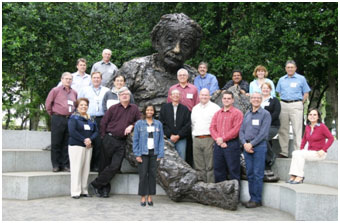
Attendees of the Spring 2010 LSPEC ETG Meeting in Washington, DC.
One of the other two committees, which play subsidiary roles in support of the LTPP program, but are TRB advisory committees on a par with the LCOM, is the Expert Task Group (ETG) on LTPP Special Activities (LSPEC), also known as the “LSPEC ETG.” As stated earlier, this committee (with the exception of the program’s traffic activities) provides stakeholder input on LTPP activities that includes data collection, processing, analysis, database activities, and product development. This ETG works with the LTPP Team to ensure that LTPP data is sufficient and of high quality to support data analysis projects and product development activities. The LSPEC ETG also reviews and provides feedback on LTPP reports and plans, and reports its recommendations to both the LTPP Team and the principal LTPP Committee.
The other committee is the Expert Task Group on LTPP Traffic Data Collection and Analysis, better known as the “Traffic ETG.” Similar to the LSPEC ETG, this committee provides stakeholder input on data collection, processing, analysis, database, and product development activities for LTPP traffic activities. This ETG works with the LTPP Team to ensure that LTPP traffic data is sufficient and of high quality to support data analysis projects and product development activities. The ETG further encourages and supports the development of traffic products for State highway agencies to use with their own traffic programs— such as the LTPP Field Operations Guide for Specific Pavement Study (SPS) Weigh-In-Motion (WIM) Sites (which are WIM data quality guidelines), the AASHTO Provisional Specification for Smoothness of Pavement in Weigh-in-Motion Systems (MP 14-05), and the LTPP Classification Scheme.
Below is a summary of the main topics discussed at this year’s spring meetings by these three committees:
LCOM Meeting
The topics for the TRB LCOM meeting included an overview of the LTPP program status; reports from the subsidiary committees; review of the post-2009 activities; discussion of the 2010-2015 Information Management System (IMS) Strategic Plan; and an overview of the document summarizing the benefits of the LTPP program. The main topic of discussion was review and comment on the IMS Strategic Plan. The Committee provided invaluable input for the development of the next version of the strategic plan.
LSPEC ETG Meeting
The LSPEC ETG focused its attention on brainstorming methods for extracting data from the LTPP IMS. The goal is to make data extraction easier for users. LSPEC’s suggestions for achieving this will be considered for incorporation in the next version of LTPP DataPave Online. A beta version of the Web site intended to make the database easier to use will be available for testing in early 2011. LSPEC also provided the LTPP Team with written suggestions for enhancing DataPave Online and the IMS Strategic Plan.
Traffic ETG Meeting
The Traffic ETG received an update on two traffic data analysis projects that the ETG had previously classified as a high priority for initiation ("Verification, Refinement, and Applicability of the LTPP Classification Scheme" and "Development of New Default Traffic Datasets for the Mechanistic-Empirical Pavement Design Guide Using the SPS Traffic Data Collection Pooled-Fund Study Data"). The ETG identified and evaluated options for disseminating timely information on the quality of the traffic data now being collected from select LTPP sites. The ETG also received an update on the products developed as a result of the traffic pooled-fund study and the status of all traffic data processing for the program.
The ongoing interaction of the LTPP Team with these TRB committees is invaluable to the vitality and success of the LTPP program. The roles played by these committees exemplify LTPP's continuing commitment to request and acquire stakeholder input, and to use this advice to help guide the program.
For more information, contact Aramis López at aramis.lopez@dot.gov, or (202) 493-3145.On May 25-27, 2010, the LTPP program held its 36th Pavement Distress Accreditation Workshop in Columbus, Ohio. LTPP test sections on the Ohio Test Road were used for the workshop field exercises. The very first workshop was held April 22-26, 1991 in Arlington, Texas.
The intent of the workshop is not to train pavement distress raters but to check their proficiency and calibrate them. Raters must certify that they meet the minimum LTPP criteria for distress raters, while more thorough training is done by the LTPP Regional Support Contractor. The workshop is based on the LTPP distress rating procedures contained in the Distress Identification Manual for the Long-Term Pavement Performance Program (FHWA-RD-03-031) June 2003Edition, found at https://www.fhwa.dot.gov/pavement/pub_details.cfm?id=91.
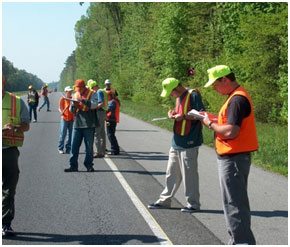
Distress Raters Evaluating Pavement Surface.
All 12 participants successfully completed the workshop. One participant, Mr. Jerry Daleiden, attended the 1991 workshop in Texas. He has the distinction of performing the first LTPP distress survey in 1988 on Texas test section 481093. Mr. Daleiden said he plans to be around to perform the last LTPP distress survey!
The August 2010 Annual Status Report by the AMRL states: “As of September 1, 2010, AMRL will officially take over the responsibility of conducting the annual FWD calibration center audits and certifications.” The transition of the Calibration Center long-term support from the FHWA to the AMRL, a joint effort of the FHWA-led Transportation Pooled Fund Study TPF-5(039) and the AMRL for nearly 2 years, is now complete.
For more information, visit the LTPP Analysis Web site - https://www.fhwa.dot.gov/pavement/ltpp/analysis.cfm or contact Larry Wiser at larry.wiser@dot.gov or (202) 493-3079.
To learn more about the LTPP program and products, visit: www.fhwa.dot.gov/pavement/ltpp/index.cfm or contact the LTPP Customer Support Service Center (CSSC) at ltppinfo@dot.gov or (202) 493-3035.





