Bottomless Culvert Scour Study: Phase II Laboratory Report
Chapter 6: Scour Calculation Examples
This section gives step-by-step instructions for calculating the maximum scour depth for unsubmerged bottomless culverts. Two different scenarios from the results section will be shown.
USING kS AS A FUNCTION OF VRA, VCL, AND F1
The first example is based on using VRA, VCL, and F1. The procedure is as follows:
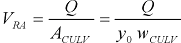
Step 1: Compute the representative velocity of the flow using the average velocity in the approach section (equation 2) as follows.
 |
(28) |
where:
- Q
- is volumetric flow through the culvert (m3/s).
- y0
- is depth of flow in the approach to the culvert before scour (m).
- wCULV
- is width of the culvert inlet (m).
Step 2: Express the critical velocity computed by Laursen’s method (equation 5) in terms of y2 as follows.
 |
(29) |
where:
- y2
- is equilibrium flow depth (m).
- D50
- is sediment size (m).
Step 3: Everything in the previous two equations should be known except for y2. Now we can substitute the previous two equations into equation 1 as follows.
 |
(30) |
This expression can now be rearranged to calculate y2 as follows.
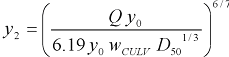 |
(31) |
Step 4: Now use the scour equations from the first entry (ks) in table 2 to calculate the maximum scour, recalling that only the intercept of these equations should be used.
Without wingwalls, the maximum scour is computed with the following equation.
 |
(32) |
Alternatively, the equation for the maximum scour with wingwalls is as follows.
 |
(33) |
USING ks AS A FUNCTION OF VRM, VCN, AND Qblocked
The second example is based on using VRM, VCN, and Qblocked. The procedure is as follows:
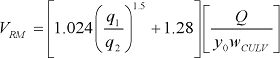
Step 1: Compute representative velocity of the flow using the calibrated velocity in the culvert inlet (equation 22) as follows.
 |
(34) |
where:
- Q
- is volumetric flow through the culvert (ft3/s or m3/s).
- y0
- is depth of flow in the approach to the culvert before scour (ft or m).
- wCULV
- is width of the culvert inlet (ft or m).
- q1
- is unit discharge in the approach section (ft2/s or m2/s).
- q2
- is unit discharge in the contracted section (ft2/s or m2/s).
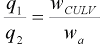
Note that the unit discharge ratio of q1 divided by q2 can be computed from a width ratio as follows.
 |
(35) |
where:
- wCULV
- is width of the bottomless culvert inlet (m).
- wa
- is width of the approach section to the culvert (m).
Step 2: Express the critical velocity computed by Neill’s method (equations 6, 7, and 8, or 9) in terms of y2. For example, for D50 sediment size greater than 0.0003 m (0.001 ft) but less than 0.03 m (0.1 ft), the equation for Neill’s critical velocity is given as follows.
 |
(36) |
The exponent, x, is calculated using equation 37:
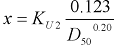 |
(37) |
where:
- y2
- is equilibrium flow depth, m or ft.
- D50
- is sediment size, m or ft.
- KU1
- is 0.3048(0.65-x) for SI units, or 1.0 for U.S. customary units.
- x
- is the exponent from equation 8.
- KU2
- is 0.788 for SI units, or 1.0 for U.S. customary units.
Step 3: Everything in the previous three equations should be known except for y2. Now we can substitute the previous two equations into equation 1 as follows.
 |
(38) |
This expression can now be rearranged to calculate y2 as follows.
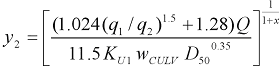 |
(39) |
Step 4: Now use the scour equations from the first entry (ks) in table 2 to calculate the maximum scour.
Without wingwalls, the maximum scour is computed with the following equation.
 |
(40) |
Alternatively, the equation for the maximum scour with wingwalls is as follows.
 |
(41) |
Previous | Contents | Next
| 





