
Moving Americans into the 21st Century
|
|
TEA-21 - Transportation Equity Act for the 21st Century Moving Americans into the 21st Century |
|
| |
| TEA-21 Home | DOT Home |
Message from the Secretary
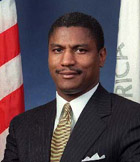 The Transportation Equity Act for the 21st Century (TEA-21) builds on the successful implementation of the Intermodal Surface Transportation Efficiency Act of 1991 (ISTEA), including many of President Clinton's and Vice President Gore's priorities for a transportation system for the 21st century. TEA-21provides record-level investment in our nation’s transportation infrastructure while balancing the budget and honoring other critical national priorities. The Act also retains ISTEA's proven core structure of highway, bridge and transit programs and our strategic investment in advanced technologies while protecting and enhancing safety and the environment.
TEA-21 will shape America's future by ensuring accessible, integrated, and efficient transportation. It will advance America's economic growth and competitiveness, domestically and internationally, and it will protect and enhance communities and the natural environment. It expands opportunity through a continued strong disadvantaged business enterprise program and a new program to help those making the transition from welfare rolls to payrolls. It establishes border crossing and trade corridor programs crucial for international commerce.
We have just now completed the Departmental outreach to our city, State, and community transportation partners. Please be assured that we will continue to work with you to implement these important programs as quickly as possible. We look forward to our continued work together as we vigilantly move America into the new millennium.

Rodney E. Slater
Secretary of Transportation
Outreach
We are committed to applying the broad-based communication approach we used in developing NEXTEA to the implementation of TEA-21. As a team, the Department has pledged to establish opportunities to listen to our partners and customers explicitly about TEA-21 before developing final guidance.
USDOT has conducted a series of TEA-21 Outreach Sessions to consult with its partners and customers before the implementation of the majority of TEA-21. This program consisted of six National listening sessions around the country, conducted by USDOT leadership and covering a broad range of issues and concerns related to TEA-21. Six One-DOT Conferences solicited input on a more topical basis concerning new program initiatives and /or major revisions in ISTEA programs. Further information on all of these sessions is posted on the TEA-21 website. In chronological order, the major Outreach Sessions were:
| Date | Type/Topic | Place |
| 7/20 | Listening Session | Portland, OR |
| 8/3 | Listening Session | Lakewood, CO |
| 8/25 | One-DOT Conference: Borders & Corridors | San Diego, CA |
| 8/27 | One-DOT Conference: Borders & Corridors | Detroit, MI |
| 9/8 | Listening Session | Harrisburg, PA |
| 9/15 | Listening Session | New Orleans, LA |
| 9/18 | One-DOT Conference: Safety | Fairfax, VA |
| 10/6 | Listening Session | New York, NY |
| 10/8 | One-DOT Conference: Borders & Corridors | Houston, TX |
| 10/22 | One-DOT Conference: Access to Jobs | Chicago, IL |
| 10/20 | Listening Session | Minneapolis, MN |
| 11/6 | One-DOT Conference: Planning & Environment | Providence, RI |
Communicating TEA-21
Maximizing flexibility and minimizing unnecessary regulation
The Administration is committed to investing in transportation while protecting our commitments to a balanced budget and to the President's other vital priorities, including education, child care, and Social Security. We are pleased that our State and local partners across the Nation are assured of a guaranteed level of Federal funds -- at least $198 billion -- for surface transportation through FY 2003. We also are pleased that the Congress enacted a FY 1999 budget consistent with TEA-21, which provides guaranteed funding levels of $26.622B for FHWA and NHTSA, $5.365B for FTA, plus an additional $25 million to support the Job Access and Reverse Commute Program.
Release of formula funds Release of Federal-highway obligation ceiling Release of discretionary funds
Having recognized the commitment to customer outreach, the Department has taken actions to assure the use of the funds provided under TEA-21. Our first priority was to make available the funds for the remainder of FY 1998 while providing information on funding and programs from the Act. We made highway, safety, and transit formula apportionments immediately after TEA-21 was signed and subsequently made modifications when the technical corrections bill was enacted. Apportionments of FY 1999 contract authorizations for Federal-aid highways were made on October 1. NHTSA State and Community formula funds for FY 1999 were apportioned on October 29, 1998; incentive grants for .08 BAC and Drunk Driving Prevention were distributed in FY 1998, and for Seat Belt incentives in FY 1999. (A list of safety incentive grants can be found on page 18.) On October 29, FTA issued its Federal Register Notice of FY 1999 Apportionments, Allocations and Program Information. (A list of basic apportionments for FY 1998 and FY 1999 can be found on pages 20-21.)
In addition to releasing formula apportionments, FHWA also released the FY 1998 obligation ceiling for the Federal-aid highway program immediately following the signing of TEA-21. With passage of the Omnibus Appropriations Act for FY 1999 (which includes the FY 1999 DOT Appropriations Act), the release of obligation ceiling took on the highest priority. In order to minimize delay while the details of the extensive Omnibus Appropriations Act for FY 1999, signed into law on October 21, were analyzed, a partial distribution of FY 1999 obligational authority was provided to the States. The final distribution of the full FY 1999 obligation ceiling was completed on November 2. Under TEA-21, obligational authority for allocated programs in FY 1999 will be about 88 percent of the authorized contract authority levels.
On November 2, 1998, allocations were made for continuing highway programs such as the discretionary aspects of Interstate construction, Interstate maintenance, bridge, ferry boats, public lands, scenic byways, and innovative bridge technology deployment. (A list of completed discretionary allocations can be found page 19.) FTA has made available the New Starts and Bus discretionary funds made available in FY 1998 and FY 1999. For FY 1998, Bus Discretionary funds totaled $400 million, for FY 1999, $501.4 million. New Start discretionary funds totaled $800 million in FY 1998 and $902.8 million in FY 1999. All of these funds were earmarked in the appropriations process. (New discretionary programs are discussed below in the context of their developmental stages.)
Transportation safety continues to be our number one priority. Although transportation is safer today than it was 30 years ago, it still takes a terrible toll. Lives lost in transportation crashes and accidents account for almost half of all accidental deaths and place a huge burden on our economy -- an estimated $150 billion annually. We are committed to improving safety, recognizing that we will continue to face rapid growth in travel as well as changing demographics that affect safety such as the increase in older drivers and the dispersion of housing, shopping and other services that are not well-served by traditional transit. The Administration proposed strong safety programs that focus on three key areas: driver behavior, road design, and vehicle standards.
Driver and Vehicle Safety Programs
TEA-21 expands and strengthens successful highway safety programs. The highway death rate fell to a record low in 1997, to 1.6 deaths per 100 million vehicle-miles traveled, with the help of programs like the NHTSA State and Community Highway Safety Grant Program, the highway safety research and development programs, and the Drunk Driving Prevention Incentive Grant Program. Alcohol-related traffic fatalities also dropped to a record low. The funding and incentive grants provided in TEA-21 present the challenge, and the opportunity, to continue to reduce the drain that highway crashes place on the economy and families.
Seat Belt and Occupant Protection Programs
State Highway Safety Data Improvement Incentive Grants
Highway Safety Research and Development
National Driver Register
Automobile Safety and Information
Railway-Highway Crossings— Behavioral
Infrastructure Safety
Motor Carrier Safety
Information Systems
Strengthening Safety Enforcement and New Approaches to Compliance
TEA-21 requires the development of an implementation plan to identify the procedures that would be followed if Congress subsequently provided authority over shippers. The Study plan has been completed and the contractor has been selected.
A driver hotline to report safety violations was established in August. A toll-free number is now operating (1-888-DOT-SAFT).
Recreational Boating Safety One-call Notification
FY 1999 State Recreational Boating Safety grant funds allocations will be issued in November. The solicitation for discretionary grants to national nonprofit organizations was published in the Federal Register on October 7, 1998. New mandatory funding to the Coast Guard will be used to improve oversight of manufacturer compliance with safety standards; conduct national boating surveys to identify boating safety problems/ issues; increase outreach efforts; and implement technology innovations and productivity improvements (e.g., enhance Coast Guard Infoline and the Boating Safety web site -- www.uscgboating.org)
This new program seeks to reduce unintentional damage to underground facilities, along with attendant risks to the public and the environment during excavation. It encourages States to establish or improve existing one-call notification systems. Such systems receive notification from excavators of their intent to excavate in a certain area and notify underground facility operators so that they may mark their lines to prevent damage. DOT established a wide-ranging team shortly after the passage of TEA-21, to identify and evaluate practices used to prevent damage to underground facilities during excavation. The team’s report will be completed in the spring of 1999. TEA-21 also establishes a new 2-year program under which States may apply for grants to enhance one-call systems; and authorizations are provided, subject to appropriation, for grants in FYs 2000 and 2001.
The U.S. transportation system supports over 4 trillion miles of passenger travel and close to 4 trillion ton-miles of goods movement. It is our vast and efficient transportation network that provides this unprecedented mobility and allows us to compete effectively in the global marketplace. This Administration is committed to continuing to maintain and improve the system, not only to retain our standard of living, but to continue to compete effectively in the global marketplace.
Disadvantaged Business Enterprises Highway Programs
TEA-21 continued the Disadvantaged Business Enterprises program to preserve affirmative action.
TEA-21 extended the DBE Program and mandated the General Accounting Office to conduct a nationwide study comparing program impacts on DBE and non-DBE firms. In order to improve the effectiveness of the DBE program, a draft final rule for the DBE Program has been sent to the White House and the Department of Justice for final comments. The proposed rule responds to the ‘strict scrutiny’ and ‘narrow tailoring’ standards articulated by the 1995 Supreme Court decision in Adarand Constructors v. Peña.
TEA-21 continued the core highway infrastructure programs which include Interstate Maintenance, National Highway System, Surface Transportation Program and Bridge Replacement and Rehabilitation. Authorizations for these programs were increased 40% over ISTEA levels. In addition to increasing investment in these areas, TEA-21 modified program features, many of which will enhance flexibility. Guidance on important changes in program administration has already been issued. Included are implementing instructions on: combining authorization of work and execution of the project agreement for a Federal-aid project into a single action; engineering cost reimbursement; project oversight; transfers among programs; metric conversion; and toll credits for non-Federal share.
Federal Lands Highways
On November 2, 1998, the discretionary Public Lands Highway funds were allocated. Total funding was $97.3 million. Consistent with First Lady Hillary Rodham Clinton's Millennium Initiative, $4 million will be used to fund projects for the New National Millennium Trails Initiative.
Emergency Relief National Corridor Planning and Border Infrastructure Programs Appalachian Development Highway System Value Pricing Pilot Program (VPPP) Highway Use Tax Evasion Projects Interstate Toll Pilot Program Woodrow Wilson Memorial Bridge
FHWA allocated approximately $500 million in emergency relief (ER) funds in FY 1998, and an additional $170 million to date in FY 1999 to States, territories and Federal agencies for repair and reconstruction of Federal-aid highways and roads on Federal lands damaged as a result of natural disasters or catastrophic failures. The funds were provided to continue relief for previously approveddisasters, as well as for 23 new disasters occurring in FY 1998 spread over 19 States. These 23 new disasters include the January 1998 icestorms in the Northeast, February 1998 rainstorms and flooding in California, Spring 1998 Devil’s Lake Basin flooding in North Dakota and Basin flooding in South Dakota, March 1998 flooding in Alabama and Georgia, and June 1998 flooding in Vermont.
Three outreach sessions in Michigan, California, and Texas to solicit suggestions and recommendations on how to implement these new programs were well-attended by elected officials and the general public, confirming the overwhelming support and the fact that needs and requests for funding will far exceed the new funding. This reality, as well as many specific suggestions concerning project priorities and selection criteria, have demonstrated the challenge faced in determining the best approach to administering this program to result in the best use of program funds. As this document was going to print, FHWA had sent the notice to the Federal Register for publication to request grant applications for FY 1999 corridor/ border program funds. Applications will be due in January, and selections will be made in March.
FHWA and the Appalachian Regional Commission are working on a memorandum of understanding and implementation guidance for the 13 States.
A September value pricing outreach meeting provided public input to the development of program guidance and project solicitations that were issued in an October 5, 1998 Federal Register notice. Many States have expressed an interest in the VPPP. A number of States are developing proposals for program participation. Project awards are expected to be made throughout the year. Additional outreach sessions are planned over the next few years to continue to solicit interest in the VPPP. The next outreach session is tentatively scheduled for Spring, 1999.
Under TEA-21, most of the funds for this program will now be dedicated to the Internal Revenue Service (IRS) for development of an automated fuel tracking system. States are also authorized to use up to 1/4 of one percent of apportioned Surface Transportation Program funds for efforts to stem motor fuel tax evasion. Revised procedures for allocating funds and for the approval and administration of projects have been published in the Federal Register for comment, and partial funding has been provided to IRS to begin the project.
TEA-21 established an Interstate toll pilot program that will allow the States the flexibility of converting up to three free Interstate highways to toll facilities in conjunction with reconstruction or rehabilitation of the Interstate highway. Candidates will be solicited from the States later in 1998. The solicitation process will be in two phases with the first phase seeking general information on possible candidates for which more detailed information will be requested in a second phase.
Work progresses on preliminary steps to the replacement of the Woodrow Wilson Memorial Bridge. TEA-21 permits use of the total of $900 million authorized for FYs 1998-2003 for continued maintenance and rehabilitation of the existing bridge, design of the overall project and right of way acquisition. However an agreement defining ownership of the new structure and setting forth adetailed financial plan and schedule for the project is required before any of these funds can be used for construction. The Administration is working with the States to apply innovative financing techniques reinforced in TEA-21 to close the gap between this authorization, the use of regular Federal-aid funding and the estimated $1.89 billion required to complete the project as defined in the final environmental impact statement (FEIS).
On-the-Job Training/ Supportive Services (OJT/SS)
In FY 1998, under the authorization of TEA-21, the FHWA obligated $8.9 million for OJT/SS Programs in 24 states to address the needs of Federal-aid highway construction contractors, apprentices and trainees with a focus on welfare to work, retention of women in highway construction, and a diverse transportation workforce. Four Minority Institutions of Higher Education, in partnership with State DOTs, have additional projects such as the development of a transportation technology curriculum and a National Summer Transportation Institute graduate program. In a cooperative effort with the U.S. Department of Health and Human Services (HHS), FHWA funded HHS Job Opportunities for Low Income Programs through State DOTs in Montana, Washington and Kentucky. Other major projects include a National Urban Sustainable Employment in Transportation initiative and the National Summer Transportation Institute. In FY 1999, up to $10 million may be available for OJT/SS Programs. By January 1999, the FHWA will enter into a cooperative agreement with a college or university for the administration of the National Summer Transportation Institute (NSTI). The solicitation for NSTI proposals will be announced in the Commerce Business Daily.
Transit Programs
Revised Program Guidance Circulars
Formula Grants
The OTRB program in TEA-21 authorizes FTA to make grants to operators of OTRBs to finance the incremental capital and training costs of complying with the final rule. A total of$2 million is apportioned for intercity fixed route operators in FY 99. FTA is exploring various approaches for implementation of the capital portion of the program and will issue further guidance and application instructions in FY 99.
Capital Investment Grants
Transit Benefits
Preventive Maintenance
Rail Programs
Magnetic Levitation Transportation Technology Deployment Program (MAGLEV)
High Speed Rail Development
Highway-Rail Crossing Hazard Elimination in High Speed Rail Corridors
Railroad Rehabilitation and Improvement Financing
Multimodal Programs
Innovative Finance
Ferry Boats
High Priority Projects
Major national legislation has been enacted to protect our air and water as well as the vast cultural, historic, and natural resources important to our quality of life. Transportation's impact on air, water and noise pollution are well known, as are the potential impacts on wildlife habitat and ecosystems. It is essential that we continue to account for the costs of transportation decisions that affect these non-renewable resources and provide assistance, where possible, to mitigate adverse effects on our communities and their environment. Effective transportation planning, that considers a wide range of options and examines the consequences of our choices, is the key to shaping sound investment decisions.
Congestion Mitigation and Air Quality Improvement Transportation Enhancements * Recreational Trails Program *
FHWA issued interim implementation guidance for the Congestion Mitigation and Air Quality Improvement Program (CMAQ) on August 14, 1998, describing modifications to the funding formula and eligibility provisions in TEA-21 and providing preliminary implementation quidance under the reauthorized program. Four information exchange meetings were held to solicit input into the development of the final guidance and to allow our stakeholders an opportunity to give us their insight to the changes under TEA-21; further input on program implementation was solicited by Federal Register notice dated October 26, 1998. Comprehensive final guidance on the reauthorized CMAQ program is expected to be issued in December.
During September and October, there have been four information exchange meetings on transportation enhancements in Kansas City, MO; Oakland, CA; Washington, DC; and Savannah, GA. The meetings have gathered suggestions and recommendations from Federal, State, and local governmental officials as well as a range of public groups interested in the different types of eligible enhancement activities. The discussions have brought together the different interests for stimulating discussions which will provide much useful information as we begin to implement the legislative changes in this area.
Program funds have been distributed to the State agencies administering the program. Input on TEA-21 implementation has been solicited from these State agencies. On November 13 at the meeting of the State Trail Administrators, the proposed content of the program guidance will be discussed.
* Youth Conservation Corps -- The next issue of the FHWA "Corps Connection" newsletter, which features urban youth corps projects around the country, will highlight TEA-21 language which encourage the use of "youth conservation or service corps to perform appropriate transportation enhancement activities" and "construction and maintenance of recreational trails." The January 1999 issue, normally distributed throughout FHWA and to State DOTs, will also be distributed to State Recreational Trail contacts and Transportation Enhancement coordinators.
National Scenic Byways Program
Bicycle Transportation and Pedestrian Walkways
Transportation & Community & System Preservation Pilot
Planning
Rail
Streamlining
President Clinton's Transportation Science and Technology Strategy notes that our "ability to harness the power and promise of leading-edge advances in technology will determine, in large measure, our national prosperity, security, and global influence, and with them the standard of living and quality of life of our people." Technology offers particular promise for transportation, where it can improve the performance of our system and increase capacity, especially in our major cities where new construction may be too expensive or environmentally unsound. Innovations in transportation, such as advanced collision avoidance systems, have the potential to save hundreds of lives. Technology also offers the promise of speeding travel and freight movement. We are pleased that TEA-21 establishes a strategic planning process that will allow us to develop national priorities for surface transportation and measure the results and impacts.
Research and Technology
Surface Transportation-Environment Cooperative Research Program
Highways
Technology deployment
Training and Education
In addition TEA-21 provides funding for the National Summer Transportation Institute for Secondary Students (NSTISS) which cultivates young people’s awareness of and interest in transportation-related careers.
Finally, the emphasis on training and education in TEA-21 provides additional support for such corporate management and crosscutting issues as the Garrett A. Morgan Initiatives (see page 17).
International Highway Transportation Outreach Program
TEA-21 included a specific authorized amount for this program. However, because this funding level is substantially lower than previous levels appropriated by Congress, efforts have been undertaken to increase the share of co-funding of activities by external partners. One example is a jointly sponsored international technology scanning program being established with AASHTO. A new provision in TEA-21 gives the States additional flexibility by allowing the use of State Planning and Research funds for any of the activities under this program.
Transit
Joint Partnership Program
International Mass Transportation program
TEA-21 established the international mass transportation program to support such activities as advocacy of American transit products and services overseas and cooperation with foreign public sector entities on research. FTA is developing guidance for implementation of this program in FY 99.
Rail
High-Speed Locomotive
Test Track Upgraded
Alaska Railroad
Advanced Vehicle Technologies Program
University Transportation Centers
Intelligent Transportation Systems (ITS)
TEA-21 requires that all ITS projects using funds from the Highway Trust Fund conform with the National ITS Architecture and Standards. Interim guidance was issued on October 2, 1998 in a joint memo from the FHWA and FTA Administrators, reflecting input received from Federal, State, local and private sector stakeholders. The intent of the interim guidance is to foster integration, encourage incorporation of ITS into the transportation planning process, and focus on near-term projects of regional significance. It is effective immediately and is expected to be in effect for 1 year while a final policy is developed through formal rulemaking.
The ITS Deployment Incentive Program was established in TEA-21 to support metropolitan and rural integration and implementation of the Commercial Vehicle Information Systems and Networks (CVISN). The recent FY 99 Appropriations Act allocated the funds for this program among 67 State and local jurisdictions and specified that the funds are to be used in accordance with project selection criteria established in TEA-21. Guidance on the implementation of this program is being developed and will be distributed to FHWA Division Offices and FTA Regional Offices in November.
TEA-21 requires that the USDOT submit a report to Congress by June 1, 1999 establishing a list of critical ITS standards. A proposed set of criteria and the resulting list of standards has been developed and will be published in the Federal Register for comment in November. A series of outreach efforts will be conducted to obtain input from public and private sector organizations. A Critical Standards Advice Group has been convened through ITS America to provide a formal recommendation regarding the criteria and standards.
Year 2000 (Y2K) Garrett A. Morgan Initiatives FHWA Field and Headquarters Restructuring and Reorganization Project Labor Agreements
Since June, the Department-wide ITS Y2K Working Group has developed a strategy to help develop, coordinate, and monitor the efforts undertaken by our partners who operate surface transportation systems to resolve the Y2K problem that, unmet, could pose risks to safety and disrupt the flow of commerce. Our Awareness-to-Action Summit for ITS Y2K, held in July 1998, attracted more than 180 public sector and industry participants and resulted in our publication recommending steps for action. On September 15, tofacilitate information exchange, the web-based AITS Cooperative Deployment Network -Y2K Forum@ began (www.nawgits.com/Y2Kforum). A guidance memo was issued on September 29, 1998 to address Federal-aid program eligibility and process streamlining for EIS, conformity, and procurement and to facilitate rapid Y2K action by State and local recipients of Federal funds. Throughout 1998-99, via information exchange (Internet, articles, videos, presentations, case studies), guidance, technical assistance and outreach, DOT is making every effort to ensure a safe, smooth transition into the next century.
The Garrett A. Morgan Technology and Transportation Futures Program seeks to interest students of all ages in transportation careers and to ensure that they have the knowledge and skills to pursue them. Through the Morgan Education Roundtable, an informal coalition of transportation organizations, educational and non-profit institutions, we have built a nationwide entity committed to developing a skilled transportation workforce. Together we have established a school to work pilot project that will integrate transportation examples into kindergarten through 12th grade curriculum, creating a model to be used nationwide; developed speaking and informational materials for transportation professionals to use when speaking to students in classrooms and at career fairs; created a website that highlights transportation careers in age appropriate language, as well as listing sources for transportation education program information; mobilized DOT employees across the country to speak to students in schools and on campuses whenever possible . Secretary Slater’s goal for the program is to reach one million students by the end of the year 2000. We are well on our way to achieving that goal.
FHWA has made significant progress in completing an ongoing evaluation of its field and headquarters organization to provide a structure to meet the streamlining goals of the National Partnership for Reinventing Government and the challenges of the 21st Century. On October 1, implementation of a restructured field organization was initiated, to be completed the latter part of FY 2000. A plan for a restructured headquarters organization is being developed, and will be implemented in early January 1999; transition will be completed before the end of the fiscal year.
On April 22, 1998, the Secretary (in order to implement a June 5, 1997, memorandum from the President) issued a memorandum encouraging each operating administration to authorize and promote the use of Project Labor Agreements by its financial assistance recipients for DOT-assisted construction projects. FHWA and the Department have received input from various sectors of the highway industry, including the AFL-CIO’s Building and Construction Trades Department and the Associated General Contractors, and plans to provide written guidance later this fall after the receipt of more guidance from the Department.