



ENVIRONMENTAL STEWARDSHIP
DOT Performance Goal: Reduction in pollution and other adverse environmental effects from transportation and transportation facilities.
This funding request contributes to the DOT Environmental Stewardship strategic objective and the performance outcome goal to reduce pollution and other adverse environmental effects from transportation and transportation facilities.
| 2001 | 2002 | 2003 | 2004 | 2005 | 2006 | 2007 | 2008 | 2009 | |
|---|---|---|---|---|---|---|---|---|---|
| Target | N/A | 6.0 | 6.0 | 6.0 | 6.0 | 6.0 | 6.0 | 6.0 | 6.0 |
| Actual | 6.0 | 6.0 | 6.0(r) | 6.3(r) | 5.8(r) | 1.3 | 0.0 |
| 2002 | 2003 | 2004 | 2005 | 2006 | 2007 | |
|---|---|---|---|---|---|---|
| Target | N/A | 8 | 10 | 17 | 24 | 50 |
| Actual | 5 | 8 | 15 | 23 | 43 | 50 |
| 2007 | 2008 | 2009 | |
|---|---|---|---|
| Target | 5 | 10 | 15 |
| Actual | 8 |
| STRATEGIC GOALS &OUTCOMES by Performance Measure |
FY 2007 ENACTED | FY 2008 ENACTED | FY 2009 REQUEST |
|---|---|---|---|
| ENVIRONMENTAL STEWARDSHIP STRATEGIC GOAL | |||
| Reduction in Pollution | |||
| a. Number of exemplary ecosystem initatives. | 1,745,654 | 2,103,073 | 2,0028,851 |
| b. Number of exemplary human environment initatives. | 1,745,654 | 2,103,073 | 2,0028,851 |
| c. Number of areas in conformity lapse. | 1,745,654 | 2,103,073 | 2,0028,851 |
| c. Other. | ----- | ----- | ----- |
| Subttal, Performance Outcome | 5,236,961 | 6,309,220 | 6,086,553 |
This request will allow the FHWA to fund transportation improvement projects in states to help reduce mobile source emissions and adverse environmental effects. Funds will also be used for research, technical assistance, and public education initiatives to improve air quality.
The number of Exemplary Ecosystem Initiatives (EEIs) undertaken will be replaced after 2007 with Exemplary Human Environment Initiatives (EHEIs) as the primary measure demonstrating accomplishment in environmental and social stewardship. Examples of EEIs will continue to be solicited and recognized. This request will also allow FHWA and the States to continue to protect and enhance the Nation’s wetlands and aquatic resources and help the FHWA achieve its goal of conservation of natural habitats and ecosystems.
Performance Issue
The National Ambient Air Quality Standards (NAAQS) address six criteria pollutants that are among the most serious airborne threats to human health. Transportation is a major contributor for some of these pollutants, particularly ozone, carbon monoxide, and particulate matter. Over the past 20 years, contributions of emissions from on road mobile sources to all emissions have been rapidly declining. For example, on road mobile source emissions decreased 68, 36, 57, and 59 percent, respectively, for Volatile Organic Compounds (VOC), Nitrogen Oxides (NOx), Particulate Matter (PM) and Carbon Monoxide (CO) between 1980 and 2003. The downward trend in on-road emissions from mobile sources is expected to continue through 2030 as a result of the introduction of cleaner engines and fuels.
Though solid progress has been made to reduce airborne threats, more needs to be done to improve air quality. Areas exceeding or maintaining the NAAQS are required to meet transportation conformity requirements in the Clean Air Act. During the past eight years, the percent of nonattainment and maintenance metropolitan areas that met their emissions goals has increased and the number of metropolitan areas meeting their emissions goals is expected to increase.
At the end of FY 2007, there were no areas in a conformity lapse. The number of conformity lapses was maintained at zero or a very low number during most of FY 2007.
A number of changes to the conformity provisions were implemented throughout FY 2006 and FY 2007 to address new requirements of new air quality standards and to streamline and provide more flexibility to the conformity process. In the implementation of the changes, the FHWA and U.S. Environmental Protection Agency (EPA) conducted numerous workshops, trainings, and other outreach activities to raise awareness of and to prepare State DOTs, air agencies, and MPOs to meet the requirements. In addition, guidance documents were issued by both agencies to ensure that the new conformity requirements were transitioned smoothly. State and local agencies took the initiative to coordinate the process well in advance of conformity determinations. Because of the advanced preparations, most nonattainment and maintenance areas were able to meet the Clean Air Act goals thus enabling projects to proceed.
The measure of Exemplary Ecosystem Initiatives (EEIs) undertaken was the primary measure demonstrating accomplishment in environmental stewardship. An EEI is an action or measure that will help sustain or restore natural ecosystems and their functions and values, using an ecosystem or landscape approach. Examples include mitigation projects that support wildlife movement and habitat connectivity, maintain ecosystem integrity, implement watershed-based environmental assessment and mitigation approaches, and encourage the use of wetland and habitat banking and the use of special measures to prevent invasive species along highway rights-of-way. The FHWA recognized 20 new EEIs in 2006, exceeding by thirteen the target of designating seven additional initiatives and bringing the total number that the FHWA has designated to 43. Therefore, the target for FY 2007 was raised to total 50. In 2007, an additional 7 EEIs were recognized, which meets the target of 50 EEIs.
In FY 2008, the FHWA is replacing the EEI goal with a new initiative, Exemplary Human Environment Initiatives (EHEIs) which focuses on community and cultural resources that were not included as part of the EEI criteria. The FHWA is replacing the EEI measure because the EEI targets have been substantially exceeded. This indicates that that the use of the EEI measure has achieved the desired effect of promoting consideration of ecosystems into development of transportation projects and in creating a broad array of model projects on which project sponsors could draw. The FHWA determined, however, that more effort in the area of human environment would be helpful in promoting environmental stewardship, and has developed the EHEI program as a way to improve performance in this area. The measure of the EHEIs is the number of projects or programs chosen for national recognition. An EHEI is a transportation project or program that either creates or improves conditions for human activities. The six categories of eligible activities are: encouraging nonmotorized transportation; enhancing the environment for human activities; process improvements; educational and training programs; product development; and others meeting the eligibility criteria. In 2007, there were 38 submittals to the EHEI program, and eight were selected for recognition. The selected projects were in Arkansas, New York, Georgia, South Carolina, Oregon, Colorado, Kansas, and Mississippi.
Anticipated FY 2008 Accomplishments
- The FHWA expects that the FY 2008 target of six or less areas in conformity lapse will be met. EPA will continue to review and revise the NAAQS to protect human health. Anticipating the implementation of more stringent standards for ozone and fine particulate matter, the FHWA will continue to address the impact of the regulatory changes and to maintain area transportation conformity lapses at current low levels during FY 2008.
- The FHWA will continue to work closely with States, MPOs, FTA, and EPA to reduce on-road mobile source emissions. Through improved integrated transportation and air quality planning, the transportation conformity process is designed to ensure that emissions from an area’s transportation system are consistent with Clean Air Act goals.
- SAFETEA-LU required EPA to revise the conformity regulation to reflect all transportation conformity changes by August 2007. The FHWA will continue to work with EPA and FTA in the rulemaking process. The final rule is expected to be released in early 2008.
- The FHWA will continue to work with our State and local partners to implement the new provisions under the CMAQ program and evaluate funded projects.
- The FHWA will continue to implement its evaluation of the CMAQ Program as required by SAFETEA-LU to assess a sample of CMAQ projects for their impacts on system performance. The evaluation is being conducted in cooperation with FTA and EPA in 2 phases. A final report will include data where practicable on the emissions, congestion benefits of projects and their relative cost-effectiveness
- The FHWA will continue outreach for the Eco-logical handbook, seek to advance pilot projects that implement Eco-logical approaches, develop training for new assessment tools, and implement the results of the NAS report through development of a rapid ecosystem assessment methodology.
- The FHWA has completed the Wildlife Vehicle Collision Study mandated in SAFETEA-LU, and has submitted the report to Congress. Work has begun on the design manual and training course that were also required by SAFETEA-LU.
- In 2008 the FHWA will increase the number of EHEIs to at least 10 that will be selected from the projects and programs submitted for consideration. This is an increase of 100 percent from the FY 2007 target of 5 EHEIs.
- FLH will publish and promote a comprehensive report titled, Roadside Revegetation: An Integrated Approach to Establishing Native Plants. The report is intended for field level practitioners and designed to help fill current information and technology gaps, share strategies and techniques, facilitate collaborative processes through interagency and interdisciplinary coordination and help readers through the process of successfully establishing native plant communities on roadsides. By successfully establishing native plant communities, the spread of invasive species can be better controlled.
|
FHWA National Performance Objectives Advance Context Sensitive Solutions Implementation by States and FLH Divisions. Advance and showcase Exemplary Human Environment initiatives. Minimize the number of areas not meeting State Implementation Plan (SIP) mobile source emissions budgets. |
 |
DOT Performance Goals Reduction in pollution and other adverse environmental effects from transportation and transportation facilities. |
| Figure 9. Relationship between Environment Program Objectives and Outcomes. | ||
Safety, System Performance and 21st Century Solutions
Evaluation of the CMAQ program - The FHWA is conducting an evaluation of the CMAQ Program as required by SAFETEA-LU. This effort is to assess a sample of CMAQ projects for their impacts on system performance by examining about 100 projects in detail, developing data on the project’s impacts on emissions and congestion and also examining cost-effectiveness. The evaluation will be conducted in cooperation with FTA and EPA in 2 phases. Phase 1 is expected to be finished in FY 2008. A final report will include data where practicable on the emissions, congestion benefits of projects and their relative cost-effectiveness.
Issue Broad Agency Announcement (BAA) for Exploratory Advanced Research – In FY 2008, funds will be used to issue a second BAA. The expected outcome is the competitive selection of research proposals with the potential for transformational improvements to the durability, efficiency, environmental impact, productivity and safety aspects of the highway and intermodal transportation system. The initial selection of projects from the second BAA is expected byJuly 2008.
Create a new process and methodology for developing, conducting, and delivering high-risk, breakthrough research within the agency’s R&T program – In FY 2008, funds will be used to continue the implementation of the Scanning and Convening Plan developed in FY 2007. The breakthrough innovations and technologies identified in FY 2007 will determine FHWA research proposals to be competed for further investigation and possible application to advance transformational change. The expected completion date for the FHWA competition is December 2008.
FY 2009 Performance Budget Request
Federal-aid Highway Program
Since its inception in 1992, the CMAQ program has funded more than $1 billion annually in transportation projects, targeting improvements in air quality. More recently investment levels have exceeded $1.5 billion annually. In 2009, the program will continue to help States with nonattainment and maintenance areas to implement specific initiatives for reducing transportation-related emissions. More cost-effective measures focusing on diesel emissions from freight are anticipated stemming from the new SAFETEA-LU provisions.
A major evaluation and assessment effort is being undertaken largely in FY 2007-FY 2008 and will conclude in FY 2009 to gauge the air quality impact of CMAQ projects. The assessment program also includes the development of a CMAQ database to track and help ensure the effective implementation of the program.
NHS and STP funds will be used to support projects that reduce the social and environmental impact of system infrastructure improvements. FAHP funds apportioned to States and metropolitan areas will be used for planning activities, including the development of transportation plans that meet necessary conformity requirements.
The States will use FAHP funds apportioned for the NHS, STP, and Bridge programs to support various programs, including wetland and natural habitat mitigation, to reduce the environmental impacts to the larger watershed areas of transportation projects.
In FY 2009, the FHWA will continue to encourage States to use STP and NHS funds for projects to control invasive species and encourage adoption of native plants on projects, for pollution abatement and environmental restoration projects, and brown field site remediation efforts. These actions will contribute to minimizing the environmental impacts of federally assisted transportation projects. Continued and new training and coordination activities will help implement the principles embodied in Eco-logical and development and implementation of the rapid ecosystem impact methodology for NEPA will improve efforts to streamline environmental and natural resource coordination and compliance measures.
The FHWA will increase the number of EHEIs to at least 15, which will be selected from the projects and programs submitted for consideration. This is an increase of five EHEIs from the FY 2008 target of 10.
Federal Lands Highway
FLH will continue to develop projects that meet the criteria for Exemplary Human Environment Initiatives and nominate these projects for national recognition.
FLH will continue working with its program partners, resource and regulatory agencies to promote collaboration and a broader landscape approach to program management and project delivery. This includes the development and use of tools such as Wildlife Action Plans and Wildlife Habitat Linkages.
FLH will continue to revegetate roadsides with native plants. Best practices will be documented and promoted through publications and training courses.
FLH will sponsor and conduct a national Dust Management Practices and Future Needs Conference. The conference will address the environmental issues associated with road dust and the tools used to control dust and stabilize road surfaces.
Research and ITS
The FHWA will continue to undertake research on particulates, air toxics, the health effects of transportation emissions, energy and global climate change, CMAQ effectiveness, and evaluation of emissions models. Support for air quality and climate research will advance understanding of the relationship of surface transportation to the emerging areas of fine particulate emissions, toxic air emissions, and regional haze. The results will help the transportation community develop mitigation tools and technologies to reduce fine particulate emissions. The FHWA will pursue air quality research to develop analytical techniques and cost-effective mitigation strategies to reduce transportation-related emissions, disseminate such information through State and local networks, and permit development of viable transportation programs. This research is critical so that the transportation community can assist the Secretary and Congress in assessing transportation’s contribution to air quality improvement.
Based on stakeholder input, the FHWA will use Surface Transportation Environment and Planning Cooperative Research Program (STEP) funds as seed money to advance transportation environment and planning research on long-term, systems issues. The research agenda is focusing on major, multi-year research initiatives to improve knowledge and understanding of cross-cutting, complex transportation-environment topics, including: land use; ecology and natural systems; planning and performance measures; human health; environmental and socioeconomic relations; advanced technologies; and emerging critical issues.
The FHWA Exploratory Advanced Research program will explore longer-term, higher risk research with potentially dramatic breakthroughs for the next generation of transportation planning and environmental stewardship, addressing such issues as improve the data collected, systemize the data for easier use, and reduce the cost of the data collection for both the 20+ year planning activity and the 5 year programming: improve both the environmental data collected and reduce the cost of environmental data collection; develop an early prediction system that would indicate the potential for a reversal in the trend of increasing traffic based on technological change.
Imperviousness has been recognized as a key indicator of the ecological condition of a watershed. Many studies do not break down the watershed system into components that show better evaluation of methodologies to control and mitigate impacts. Funds will be used for research regarding land use, land cover, and surface data to determine the individual contributions of the various impervious surfaces to the overall storm water runoff issue. This research will help enable States to meet Clean Water Act National Pollutant Discharge Elimination Standards, Total Maximum Daily Load, and Section 404 requirements for highway projects.
Funds will also be used to research and support the development of wetland protection and enhancement, practical techniques of habitat restoration, and ecosystem analyses and characterization. Specific initiatives for which funding will be needed are:
- Continued outreach and training in concepts from Eco-Logical: An Ecosystem Approach to Developing Infrastructure Projects (a collaborative initiative which is supported by FHWA and seven other Federal agencies);
- Implementation, monitoring and reporting results for the pilot projects selected to test the benefits and identify any obstacles to using the concepts and methods in Eco-logical, and linking planning and environment;
- Improved Endangered Species Act Section 7 procedures, including the web-based Biological Assessment model;
- Enhanced outreach for research results implementation;
- Continued storm water research.
Limitation on Administrative Expenses
FTE and administrative resources associated with this strategic initiative are as follows:
351 FTE and $59.9 million
Responsible Officials:
Ms. Gloria Shepherd, Associate Administrator for Planning, Environment, and Realty
Mr. King Gee, Associate Administrator for Infrastructure
Mr. John Baxter, Associate Administrator for Federal Lands Highway
DOT Performance Goal: Streamlined environmental review of transportation infrastructure projects.
This funding request contributes to the DOT Environmental Stewardship and Streamlining strategic objective and the performance outcome goal to streamline environmental review of transportation infrastructure projects.
| 2004 | 2005 | 2006 | 2007 | 2008 | 2009 | |
|---|---|---|---|---|---|---|
| Target | 35 | 30 | 30 | 30 | 30 | TBD |
| Actual | N/A | N/A | N/A | N/A |
2001 |
2002 |
2003 |
2004 |
2005 |
2006 |
2007 |
2008 |
2009 |
|
|---|---|---|---|---|---|---|---|---|---|
| EIS Target | N/A | N/A | 51 | 48 | 45 | 40 | 36 | 36 | 36 |
| EIS Actual | 54 | 80 | 68 | 54 | 60(r) | 61(r) | 68 | ||
| EA Target | N/A | N/A | 17 | 16 | 15 | 14 | 12 | 12 | 12 |
| EA Actual | N/A | N/A | 26 | 25 | 25(r) | 34 | 20 |
| STRATEGIC GOALS &OUTCOMES by Performance Measure |
FY 2007 ENACTED | FY 2008 ENACTED | FY 2009 REQUEST |
|---|---|---|---|
| 4. ENVIRONMENTAL STEWARDSHIP STRATEGIC GOAL | |||
| Streamline Environment Review | |||
| a. Median completiontime for all Environmental Impact Statement | 47,282 | 50,620 | 48,080 |
| b. Median completiontime for all Environmental ImpactAssessments. Statement | 47,282 | 50,620 | 48,080 |
| c. Other. | ----- | ----- | ----- |
| Subtotal, Performance Outcome | 94,563 | 101,240 | 96,160 |
| Total — Environmental Stewardship Strategic Goal | 5,331,524 | 6,410,460 | 6,182,713 |
This request will enable the FHWA to implement environmental streamlining activities that encourage States and resource agencies to establish and meet timelines for all projects with an EIS or EA, use the Executive Order 13274 to resolve obstacles to environmental review early and develop new streamlined procedures, promote widespread implementation of environmental stewardship during project development through Context Sensitive Solutions (CSS), and promote processes that integrate environment and transportation decision making in more States. In addition it serves as a surrogate for measuring implementation of the SAFETEA-LU environmental process provisions.
Performance Issue
Project delays impede needed transportation system improvements. Streamlining of environmental reviews and documentation is essential to mitigating time delays and implementing highway projects on a more timely and cost effective basis. To date, progress has been slow because of the magnitude of the issues and the pipeline effect of complex projects with an EIS and EA initiated many years ago. States are responding to reductions in staffing and budgets at resource agencies by increasing the use of funding agreements for liaisons and data to support streamlining. Progress can be masked by the process delays created from responding to emerging issues, such as air toxics, climate change and changes in wetland banking and delineation rules.
As illustrated in Figure 10, the median time to complete an environmental review for all Federal-aid projects in FY 1999 was 79 months, or six-and-a-half years. Due in part to efforts to include additional longstanding projects in the inventory, the median time increased to 80 months in 2002. The median time decreased from 68 months in FY 2003 to 54 months in FY 2004, and then increased again over the next three years to 68 in 2007.
Despite this recent reversal in the trend, the FHWA will maintain the targets in FY 2009 to decrease the median completion times for all EIS and EA projects to 36 and 12 months, respectively. Working with State departments of transportation, the FHWA will strive to establish schedules for completion of all EISs and EAs and advance them on schedule. In the longer-term, these targets will be maintained and efforts will be made to cull projects with no action from the active EIS database.
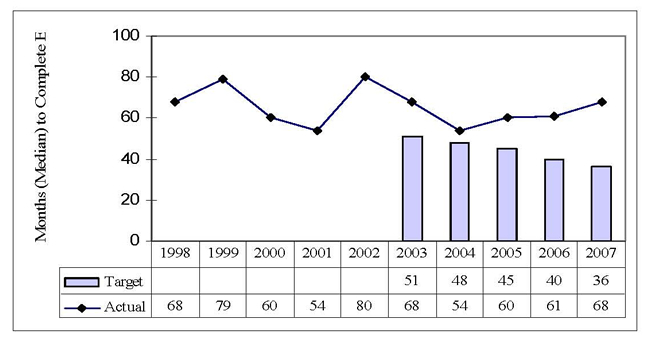
Figure 10. Median EIS Processing times, FY 1998 - 2009.
Anticipated FY 2008 Accomplishments
The FHWA will encourage States and resource agencies to establish and meet timelines for all projects with an EIS or EA. Implementation of Executive Order 13274, Environmental Stewardship and Transportation Infrastructure Project Reviews, will help resolve obstacles in the environmental review process at early stages for designated priority projects.
The FHWA will rely heavily on the use of the SAFETEA-LU Section 6002 Environmental Review Process to reduce delays and achieve a target completion rate of 90 percent for EISs that have a scheduled completion date in FY 2008. The FHWA will produce a report in FY 2008 regarding the use and effectiveness of the SAFETEA-LU Section 6002 Environmental Review Process.
Many SAFETEA-LU environmental process provisions include tracking and reporting measures that will aid states in their continuous improvement efforts and managers will be able to act on the results of the second Implementing Performance Measurement in Environmental Streamlining.
The FHWA will encourage State departments of transportation leadership to reinforce the CSS policy, facilitate saturation training in CSS, and promote visibility for State CSS projects. The FHWA continues to lead national partners in providing CSS resources to support states, building training and education capacity, raising awareness on moving toward mature implementation of CSS principles, and facilitating a CSS national dialog to promote peer exchange.
In 2007, FHWA established a baseline for two new measures aimed at tracking progress in the implementation of CSS. These measures look at sustained progress in CSS implementation by States or Federal Lands Highway Divisions. The new measures focus on accomplishing sustained progress toward implementing mature or exemplary CSS programs along with increasing the number of exemplary elements of programs and projects (i.e., commitment and/or policy, training, integration into projects and planning studies, stakeholder involvement, interdisciplinary teams). In 2007, 16 programs had achieved mature or exemplary status and 6 had exhibited exemplary elements of CSS in programs or projects. In 2008, the targets are 20 and 12, respectively.
FY 2009 Performance Budget Request
Federal-aid Highway Program
Significant environmental process changes will be made in response to SAFETEA-LU. The Planning and Project Development Process will start to reflect the implementation of new guidance, rulemaking, and delegation pilot efforts. Assessment and tracking methods will be implemented to identify trends in environmental stewardship and streamlining. Good practices to promote and opportunities for problem solving will emerge. AASHTO was awarded a three-year contract to continue the Center for Environmental Excellence, which will increase its role as a clearinghouse for practitioners.
Significant interagency partnering and co-funded initiatives will be needed to implement integrated planning and linking planning and NEPA State and regional efforts. Collaboration and coordination of resource agency research initiatives with transportation priorities will be accomplished through Executive Order 13274, Federal Liaisons, and the STEP outreach effort. Interdisciplinary teams of partners will be called on to form policy and program options that advance the Transportation Secretary’s Congestion Initiative.
Advances in geospatial and decision support technology and the training of project development practitioners in tiered and scalable reviews are needed to address the ever growing complexity of major project development. Improved impact analysis and creative mitigation approaches are dependent on good proactive responses to changes in best available science.
The path towards community and financial support for transportation improvements is based on widespread awareness and practice of context sensitive solution principals. Many public involvement tools and methods need to be updated in response to changes in innovative financing, visualization, environmental management systems and commitment tracking systems, as well as process changes to planning and project development. For FY 2009, FHWA will continue to measure progress toward implementing mature or exemplary CSS programs and projects.
Federal Lands Highway
FLH will continue to identify and implement environmental streamlining activities. This includes working with our FLMA partners to better link planning activities with the requirements of NEPA. Action plans in development will be implemented and the duration of EA and EIS documents will be tracked in EDTS.
FLH will emphasize sound project management principles to improve and streamline the entire project delivery process. FLH will continue to promote certification of its project managers through the Project Management Institute.
FLH will continue to implement a CSS approach in all aspects of its mission and will document and share its vision and successes.
Research and ITS
The FHWA will place substantial emphasis on identifying and developing time-sensitive and cost-effective techniques to redesign, integrate, and balance environmental and transportation decision-making so that the environmental review process is completed in less time. The FHWA anticipates placing substantial effort in implementing the environmental streamlining related provisions included in SAFETEA-LU. In addition, the FHWA will continue to work with other Federal agencies and State transportation departments to advance administrative measures to streamline environmental reviews. These will involve national policy initiatives with the U.S. Army Corps of Engineers, the U.S. Fish and Wildlife Service, the Forest Service, the EPA, the National Marine Fisheries Service and the Advisory Council on Historic Preservation. It will also involve providing support for State and regional measures that provide new models for environmental review efficiency.
The FHWA will maintain the Environmental Document Tracking System (EDTS) and conduct outreach on findings of the Implementing Performance Measurement in Environmental Streamlining II. All these actions are intended to improve understanding of the NEPA process and to ultimately streamline environmental processing timeframes.
Limitation on Administrative Expenses
FTE and administrative resources associated with this strategic initiative are as follows:
6 FTE and $0.9 million
Responsible Officials:
Ms. Gloria Shepherd, Associate Administrator for Planning, Environment, and Realty
Mr. King Gee, Associate Administrator for Infrastructure
Mr. John Baxter, Associate Administrator for Federal Lands Highway
