




The National Old Trails Road Part 2
See America First in 1915: Section 3 of 3
The Annual Race
The Los Angeles to Phoenix race had been held since 1908. A White steam car had won the first 418-mile race with a running time of just over 24 hours for an average speed of 17 ½ miles per hour. The route had varied over the years. In 1911, the contestants followed the Coast Road to San Diego before turning east to Phoenix. The Los Angeles contestants followed the Ocean-to-Ocean Highway in 1912, while San Diego boosters sponsored a similar race to Phoenix on the same day. In 1913, the Coast Road to San Diego had again been followed.
The 7th annual race in November 1915 would follow the National Old Trails Road from Los Angeles to Ash Fork, Arizona, before turning toward Phoenix, a total distance of 710 miles. Instead of starting the race in Los Angeles at midnight, the contestants left at daylight at 5 am. The starting point was El Monte Road at the Los Angeles city limits about 1 mile beyond Eastlake Park. The first day's run would end at Needles. The second day's run was to Prescott. According to an article in the October 1914 issue of Touring Topics, "the cars that remain in the race at this point" would leave Prescott on the morning of the third day:
The final dash into Phoenix, which is one hundred and thirty-two miles from Prescott, should furnish some racing thrills that have been lacking from the other Phoenix races, for in practically every one of these contests the leading car has finished the long grind far ahead of its nearest competitor as to rob the finish of any excitement.
The change in routing prompted the Automobile Club to deny an "unfortunate rumor" that it had diverted the race from the more southerly routes of past years. The change had been made by the organizations that sponsored the races, the Western Automobile Association and the Maricopa Automobile Club.
As a matter of absolute fact, neither the Automobile Club nor any of its representatives were consulted concerning the race course and would not have stated a preference for any one of the routes, had they been consulted . . . . The reasons for choosing the new route this year are not known to the officers of the Automobile Club and the fact that the course followed is part of a highway which the Automobile Club is sign posting is only a coincidence. The Club did not know that this route was selected or even considered except as it derived its knowledge from the daily press and it had absolutely no more voice in the selection of the course than it had in the declaration of war between France and Germany.
Seeing America on Foot
The spirit of See America First struck Edward J. Smith while he was visiting his friend Chris Fallon in Connecticut. When Fallon suggested, "how about hiking to the Exposition," Smith said he "would be there at the start with bells on." Smith explained:
My enthusiasm was awakened, for was I not to see America and all her haunts? Was I not to see all those historic places and the wonderful scenic beauty that I had read so much of at school and many times longed to see?
As explained in his account of the first half of the trip (Better Roads and Streets, October 1915), he explored maps and road guides before deciding to put the Lincoln Highway "to the test."
Fallon, as it turned out, could not made the trip "for some reason or other." Smith, therefore, advertised in the New York American for a traveling partner and chose C. N. Miller from close to 100 applicants. "I made it clear that once the get-together, work-together idea was understood by both of us, the venture was success certain."
The walk began at City Hall on July 15, the day of the Grand Canyon Convention of the National Old Trails Road Association. The Mayor and Miller's and Smith's families bid the two travelers farewell and they walked off amid the crowds of people who paid little attention to them. They carried their belongings and supplies in a rectangular box on a two-wheel handcart. Lettering on the front of the box informed passersby:
WALKING
N.Y. TO CAL.
E. J. SMITH
AND
A. MILLER
Below WALKING, Smith and Miller placed the name of the State they were passing through. On the side of the box, they had painted:
SEE AMERICA
N.Y. to CAL.
On July 16, they reached the Lincoln Highway at Elizabeth, New Jersey. In greeting the highway, "We took our hats off to it." However, the Lincoln Highway proved a disappointment:
We found people living on the highway that didn't know it was the Lincoln Highway, because of the fact that it is not sign posted in many places. Many motorists asked us whether they were on the Lincoln Highway. This did not appeal to us as being a credit to the management of the Lincoln Highway Association. The advertising done implies better things.
Traveling across New Jersey, they stopped in the State Capitol, where the Governor's secretary greeted them and urged them to be careful because of the very hot weather.
Entering Pennsylvania, they had to take a detour because the Lincoln Highway was being repaired. Walking across the State from Philadelphia to Pittsburgh, they enjoyed the many historic sites, including the battlefield at Gettysburg. West of Pittsburgh, Smith and Miller made an important decision:
We were noticing that the Lincoln Highway signs on the posts were diminishing and we thought that if this was happening to the signs, what would happen to the roads? This, together with some good pointers on the Ocean-to-Ocean transcontinental over the Old National Trails, we decided to forsake the Lincoln Highway for the Old Trails.
At Washington, Pennsylvania, they came upon the National Old Trails Road and followed it into Ohio. In Columbus, they attended the State Fair and met the Governor and Lieutenant Governor. They also met Jesse Taylor, editor of Better Roads and Streets and State Vice President of the National Old Trails Road Association.
Throughout the trip, Smith and Miller took advantage of the opportunity to speak about good roads:
In the different cities we have spoken to the people on the public square about our trip and told them the benefits of better roads. We spoke to farmers who couldn't sell their crop of potatoes for any price on account of the bad roads and the difficulty of getting their things over the roads. I think I have a case against some road in Ohio along by Morristown. The ruts and mud was a foot deep. You could not take a step without lifting an abnormal portion of the county with you. The suction of the wet and soggy mud snapped off a sole of my shoe and it was lost in the deep mire.
Smith also observed one effect of good-and bad-roads:
It was very easy for us to see the difference in the dispositions of the people along the different roads. On the good roads the people would be very pleasant and well satisfied, while along a bad road the people had a haphazard way about them and were not well disposed. The bad road keeps travelers away and keeps education at a distance. We found that the children along the good roads were more healthy than the bad-roads children because they could not get out and romp around the way the others did.
He was convinced of the value of good roads. With them, "America would be the greatest place in the world."
Smith's article was written part way through their transcontinental journey. Better Roads and Streets did not report on the remainder of the trip, but the December 1915 issue contained this notice:
The boys who are walking from New York to San Francisco, a full account of which was published in a recent issue of Better Roads and Streets, are still happy on the way, and mail addressed to "Smith and Miller" will reach them, "General Delivery, Dodge City, Kansas." They started from New York City with but five dollars, and have made their way by selling post-cards. They are "seeing America on foot," and report many interesting experiences.
The Road to the Expositions
Emily Post would become well known to later generations as an arbiter of etiquette. That would come in 1922 after she published Etiquette in Society, in Business, in Politics and At Home (later renamed Etiquette: The Blue Book of Social Usage). It went through numerous editions and resulted in a syndicated newspaper column and radio show. Her name became synonymous with "etiquette."
In 1915, Emily Post was a socialite and the daughter of a wealthy architect. She had married wealthy banker Edwin Main Post, but they had divorced after he lost his fortune in the Panic of 1901, leaving Emily to earn a living. Writing became one of her lifelong activities, including novels and magazine articles. Drake Hokanson, in his book on the Lincoln Highway, described Post and why she decided to drive across country to see the California Expositions:
Emily Post was a woman of New York society, a woman accustomed to society teas, debutante balls, and nearby servants. Her life so far had been conducted in the homes and watering places of the well-known well-to-do of New York and Europe. Although her most famous contribution to the literary work, Emily Post's Etiquette, was still seven years in the future, she had proven herself a worthy writer with the publishing of two novels. An editor and friend, Frank Crowninshield of Collier's, asked her to take this motor trip across the country and report on what she found. [Hokanson, Drake, The Lincoln Highway: Main Street Across America, University of Iowa Press, 1988, p. 23]
It seemed, she said, "the simplest sort of thing to undertake." Travel across country, write about her experiences, and go on to some other project. She had, after all, motored all over Europe. Her friends tried to discourage her, many expressing amazement that she would even consider such a trip. "Why," her New York friends asked, "do anything so dreary?" As described in her book, By Motor to the Golden Gate (D. Appleton and Company, 1916), Post was asked, "Whatever put it into your head to undertake such a trip?" She replied:
"The advertisements!" I answered promptly. They were all so optimistic, that they went to my head. "New York to San Francisco in an X-car for thirty-eight dollars!" We were not going in an X-car, but the thought of any machine's running such a distance at such a price immediately lowered the expenditure allowance for our own. "Cheapest way to go to the coast!" agreed another folder. "Travel luxuriously in your own car from your own front door over the world's greatest highway to the Pacific Shore." Could any motor enthusiasts resist such suggestions? We couldn't.
Finally, she agreed to go as far as the trip was pleasurable. She ruled out motor camping, the common travel experience in an era for before the roadside infrastructure of restaurants, hotels, motels, and gas stations had been built. And like so many wealthy motorists of the day, Emily Post had never driven a car, so she enlisted her son Ned as driver and mechanic.
The Lincoln Highway seemed to be the best choice, so a friend contacted the Lincoln Highway Association on her behalf to inquire about road conditions and hotel accommodations. The association responded by assuring her that a woman in Brooklyn had traveled the Lincoln Highway and written a glowing letter about it. Post was skeptical since even the association's travel guide made clear that in 1914 "the road was as yet not a road, and hotels along the sparsely settled districts had not been built." She concluded that perhaps the woman from Brooklyn had the "idea of a perfect motor trip [that] was independent of roads or stopping-places."
At Brentano's bookstore, she examined a map showing four routes crossing the United States. When a friend who had crossed the continent 160 times happened by, Post asked, "Can you tell me which is the best road to California?"
Without hesitation, the friend answers, "The Union Pacific."
When Post explained that she meant a motor road, her friend responded "pityingly": "Motor road to California? There isn't any."
Post pointed at the map showing "four beautiful ones" and explained that based on the literature, she found it "impossible to make a choice of the beauties and comforts of each."
Before responding, her friend "looked steadily into my face as though to force calmness to my poor deluded mind. "You! A woman like you to undertake such a trip! Why, you couldn't live through it!"
Literature still in mind, Post replied, "It can't be difficult; the Lincoln Highway goes straight across."
Her friend pointed at the map showing the Lincoln Highway, describing it as "an imaginary line like the equator!" She went on:
Once you get beyond the Mississippi the roads are trails of mud and sand. This district along here by the Platte River is wild and dangerous; full of the most terrible people, outlaws and "bad men" who would think nothing of killing you if they were drunk and felt like it. There isn't any hotel. Tell me, where do you think you are going to stop? These are not towns; they are only names on a map, or at best two shacks and a saloon! This place North Platte why, you couldn't stay in a place like that!
When Post protested that, "Hundreds of people have motored across," her friend cut her short, saying, "Hundreds and thousands of people have done things that it would kill you to do."
Finally, she consulted "a celebrated touring authority." (Post did not identify the authority.) He assured her that if she could put up with less than Ritz Hotels every few miles and an absence of Central Park roads all the way, "you can go-easy.!" He recommended the Lincoln Highway, but advised her to take a northern route and reach the highway in Chicago. Because of the construction that Smith and Miller had observed in Pennsylvania, if she insisted on following the Lincoln Highway, she would find only "bad grades and mud over your hubs!"
With the expert's help, she completed the mapping for the trip, which began in April. She, her son Ned, and cousin Alice Beadleston began their adventure. "Heaped in the Posts' car," Hokanson explained, "was an endless array of the wrong items for a long-distance motor tour." Eventually, they would ship many of the items home, including the wicker picnic basket, the tea service, and impractical clothing.
The trip went smoothly until the party left the elegant Blackstone Hotel in Chicago and found the Lincoln Highway 30 miles to the west. As they would discover, Spring 1915 in the Midwest was unusually rainy, making for a difficult trip. She summed up her disappointment:
If it were called the cross continent trail you would expect little, and be philosophical about less, but the very word "highway" suggests macadam at the least. And with such titles as "Transcontinental" and "Lincoln" put before it, you dream of a wide straight road like the Route National of France, or state roads in the East, and you wake rather unhappily to the actuality of a meandering dirt road that become mud half a foot deep after a day or two of rain!
Post almost abandoned the trip after 2 days stuck in Rochelle, Illinois, but finally the three loaded the car and turned west again on May 8. Driving west, she concluded that, although rain turned "good roads turned into mud slides in a few minutes, a few hours of sun and wind transformed them into good ones again." Still, the delays and detours disillusioned her about the Lincoln Highway. By the time they Cheyenne, Wyoming, she had had enough. They turned south and drove through Denver to Colorado Springs ("the road was uneventfully excellent all the way").
They met the National Old Trails Road (the Trailing Highway, according to Post) in Trinidad, Colorado, and followed it across Raton Pass into New Mexico. In Colorado Springs, they had met a native of Raton who warned them about what to expect after they crossed Raton pass and reached the town, "Well, I'll tell you, they have no streets, and they have no drainage, and when it rains the mud is so soft you can go out in a boat and sail from house to house." He added, "Well, they say they have fixed the road up some since I was down there but I guess the best thing you can do is to let your chauffeur take the automobile down, and you walk behind it with the wreath!" To which Post told her readers, "somehow these alarms no longer terrify!"
While in Colorado, they did not encounter another motorist until Trinidad and then they encountered two vehicles. One of the two cars carried a "Kansas City to Los Angeles" pennant. The other was bound from Lincoln, Nebraska, to San Francisco. Like many passing motorists in that era, they exchanged information about road conditions. Post's new friends were skeptical about her expensive, hand-made touring car. One asked, "Are you going to try to take that machine down the Bajada?" He added, "I'm glad I haven't the job of driving her even over the Raton!" Post and her two companions were encouraged when the other motorist said, "Don't you have no fear, mister! The stage coaches they used to go over this road to Santa Fé; if they could get over, I guess you can!" In any event, Post could not see how the "ugly, snub-nosed tin kettles" driven by these motorists could be better hill climbers than "our beautiful, big, long engine."
Her theory held true in Colorado, but as soon as they crossed into New Mexico, "our beautiful great, long, powerful machine lay down perfectly flat on its stomach and could not budge until one of these despised snub-nosed" cars pulled it out. The Post vehicle had too little clearance; the "New Mexico ruts held us fast."
The rest of the trip to Santa Fé on the National Old Trails Road was "one long wail." To be fair to the roads of New Mexico, she admitted that she had reached the State "in the very early spring after the worst of the thaw" before any repairs had been made. She also admitted that the equipment they had brought with them "could not by any possibility have been worse." The touring car was too low to the ground; great ingenuity was needed to stay out of trouble:
For instance, over deep-rutted roads we have to stay balanced on the ridges on either side, like walking a sort of double tight rope; if we slide down into the rut, we have to be jacked up and a bridge of stones put under to lift us out again. On many of the sharp corners of the mountain passes we have to back and fill two and often four times . . . .
Their "particular horror" was the two-plank ditch crossings where the planks were too narrow for the touring car. They had to build a riding surface for the alternate wheels. "Another joy to us is sliding down into and clambering out of arroyos, on the edge of which the car loves to make believe it is a seesaw." She summarized:
After three days of this sort of experience, you can't help wincing at the very sight of ruts or rocks or river beds, in exactly the same way that you wince at the close approach of the dentist's instruments.
During a sudden blizzard of rain, hail, and snow, they became lost miles from the main road. They finally reached Las Vegas, New Mexico, where the likelihood of rain made for a grim prospect. They encountered several other motorists who were pessimistic:
"What did you start so early in the season for?" we heard one driver ask another.
"Well," said the second, "I don't mind a little speculation as to what you're going to run into. If you know the road ahead of you is all fine and dandy, what's to keep your interest up?"
Sudden rain storms plagued Post, Ned, and Alice after they left Las Vegas. At one point, they came to a ford where "some Mexicans standing beside it motioned us to make a wide sweep," which landed them in deep soft sand. The bystanders hitched their horses to the car and pulled it through. The road to Santa Fé "was the worst yet," as she explained:
Washed-out roads, arroyos, rocky stretches, and nubbly hills. We just about smashed everything, cracked and broke the exhaust, lost bolts and screws, and scraped along on the pan all of the way.
All this, Post noted, and they still faced "the dread Bajada Hill, in which we are to drop nine hundred feet in one mile and long cars are warned in every guidebook of the sharp and precipitous turns." If ever they came this way again, it would be in a "very different type of car-or best of all, on the backs of little sure-footed burros!"
She was in for a surprise:
The Bajada Hill, which for days Celia [Alice] and I dreaded so much that we did not dare speak of it for fear of making E. M. [Ned] nervous, was magnificently built. There is no difficulty in going down it, even in a very long car that has to back and fill at corners; there are low stone curbs at bad elbows, and the turns are all well banked so that you feel no tendency to plunge off.
As a result, the 66 miles from Santa Fé to Albuquerque took less than 3 hours to drive, compared with the 6 hours needed to drive the 73 miles from Las Vegas to Santa Fé. The ride across Sand oval County was "an easy drive over a smooth road." Further, having had varying accommodations along the way, some dreadful, Post was happy to encounter the well-run and comfortable Harvey hotels that were one of the enticements of the National Old Trails Road.
After enjoying tourist activities in Albuquerque, the Post party intended to ship their car to California. However, the good road they had just encountered gave them incentive to continue by car so they could enjoy additional western sites, including some off the main road:
Our idea is to go, if we can, as far as Winslow. It seems rather funny that we, who nearly failed to stay intact over the well-worn Santa Fé trail, are branching into the unbeaten byway of the desert!
They visited the Enchanted Mesa and Acoma before driving to Gallup "long and tediously but without serious hindrance." They traveled through the Navajo Indian Reservation and the Painted Desert. On the way to Holbrook, Arizona, the road was "difficult in places." She added, "I'm sure we lost our way several times, a perfectly dispiriting thing to do, as it was much like being lost in a rowboat out in the middle of the ocean." The drive to Winslow was "without any adventures over a traveled road."
She was grateful for the experiences, but after the difficulties they had encountered, "no hotel ever seemed so enchanting as the Harvey" at Winslow. She realized that if the car had broken down on the way, they would have been "marooned out in a wilderness" and, without a living soul anywhere, "we might quite easily have been dust before anyone would have passed our way."
They wanted to continue by car, but had little choice in the matter:
The car was in a seriously crippled condition; any more arroyos and there really would be no more motoring for us this trip. So, all things considered, we hailed our freight car resignedly, put the motor on it and sent it ahead of us to Los Angeles, while we ourselves took the train to the Grand Canyon.
When they finally reached Los Angeles by train, Post found the excellent hotels and roads she had been accustomed to before this trip. Driving down the coast to San Diego in their repaired car, she found "one long succession of big ocean resort hotels on a boulevard that seemed too smooth and perfect to be true." She added, "We had forgotten that such road smoothness existed for our poor long-tortured engine to glide over."
San Diego did not disappoint:
The San Diego Exposition was a pure delight. Its simplicity and faultless harmony of color brought out all its values startlingly.
Returning north, Post was delighted by the "beautiful drive" to Santa Barbara north of Los Angeles. She had been on many good roads in Europe, she said, but the road to Santa Barbara was in a class by itself. "I thought I should like to live where I could drive up and down that road forever!"
The roads north to San Francisco were good, as were, of course, the accommodations in the city-an important consideration for Emily Post. The Panama-Pacific International Exposition was the primary reason for the trip, and it was all she had expected:
With merely a phrase, you can make a picture of the little fair at San Diego; cloister-like gray buildings with clumps of dense green, and a vivid stroke of blue and orange. But to visualize the Pan-American Exposition in a few sentences is impossible. You could begin its description from a hundred different points and miss the best one; you can say one thing about it and the next moment find you were quite wrong.
The entire trip, from New York City to San Francisco, had taken 26 days. At the start, her attitude had been contrary to the See America First spirit:
I had an idea that, keen though we were to undertake the journey, we would find it probably difficult, possibly tiring, and surely monotonous-to travel on and on and on over the same American road, through towns that must be more or less replicas, and hearing always the same language and seeing the same types of people doing much the same things.
Friends who had never made such a trip warned her of the "unending sameness" she would encounter, but her experience had been quite different. She exclaimed, "Sameness! Was there ever such variety?"
Still, she did not recommend such a trip for everyone:
It goes without saying that only those who love motoring should ever undertaken such a journey, nor is the crossing of our continent as smoothly easy as crossing Europe. But given good weather, and the right kind of a machine, there are no difficulties, in any sense, anywhere.
She explained one aspect of the trip that had most surprised her:
There couldn't be a worse tenderfoot than I am, there really couldn't. I'm very dependent upon comfort, have little strength, less endurance, and hate "roughing it" in every sense of the word. Yet not for a moment was I exhausted or in any way distressed, except about the unfitness of our car and its consequent injuries, a situation which others, differently equipped, would not experience.
Post concluded her book with a short chapter titled "How Far Can You Go in Comfort?" After suggesting that motorists ship their automobile by freight train to avoid the two long stretches where high-class hotels did not exist (Omaha to Cheyenne, and Albuquerque to Winslow), she explained that "some day," she would make the drive again. She would learn from experience:
When we go again, we are going in two cars-one to help the other in case of need, and, if possible, a third car to carry a camping outfit-and camp! Celia and I both hate camping, so this proves the change that can come over you as you go out into the West. I say "out into," because I don't in the least mean being tunneled through on a limited train! The steel-walled Pullman carefully preserves for you the attitude you started with. Plunging into an uninhabited land is not unlike plunging into the surf. A first shock! To which you quickly become accustomed, and find invigoratingly delicious. Why difficulties seem to disappear; and why that magic land leaves you afterwards with a persistent longing to go back, I can't explain; I only know that it is true.
In the preface, Post warned that while "insurmountable difficulties" had been eliminated from transcontinental travel by automobile, she did not want readers to misunderstand:
[If] I, who after all am a New Yorker, were to pronounce the Jackson House perfect, the City of Minesburg beautiful, the Trailing Highway splendid, everyone would naturally suppose the Jackson House a Ritz, Minesburg and upper Fifth Avenue, and the Trailing Highway a duplicate of our own state roads, to say the least!
Another Lincoln Highway Traveler
In addition to summarizing the Lincoln Highway portion of Emily Post's trip, Hokanson described a trip at about the same time by Henry Joy, A. F. Bement, and Ernie Eisenhut of the Lincoln Highway Association. Joy, President of Packard Motor Car Company, had secured a new Packard 1-35 touring car for the trip. They left Detroit on May 27, 1915, and soon encountered the rainy conditions that had delayed Post. What was normally a 3-day trip from Chicago to Cheyenne took the experienced, well-equipped Lincoln Highway veterans 11 days. "They had been," Hokanson said, "on the road, either at the end of a shovel or in the car, for twelve to eighteen hours each day." The remainder of their trip was completed "with ease." Hokanson described journey's end:
Henry Joy and his companions made a more triumphant entrance to San Francisco and the exposition. Their unkempt car was the center of attention as it crossed San Francisco Bay on the ferry, rumbled through the city, and entered the exposition grounds. Covered with mud and road grime, filled with dirty camping equipment, it was promptly placed on display in the Palace of Transportation, where it soon drew a crowd.
Those who gathered at the ropes to view the Packard couldn't help but see several states' worth of the Lincoln Highway caked and plastered to its wheels, running boards, and sides . . . . This muddy display was certainly a great testimonial for the Packard, but it was no promotion for the Lincoln Highway . . . . Some twenty-five thousand people passed through the Palace of Transportation during the two days that Joy's Packard stood there in muddy glory. Among them no doubt were many who pondered an automobile trip of their own, a trip longer than the usual Sunday drive. They stood and looked at this earth-colored car, resting as it did among flawless and polished new automobiles of every manufacturer. Certainly this exhibit convinced the faint of heart that the train was the better way to get from place to place.
The Liberty Bell
Charles Henry Davis was always in search of opportunities to promote his cause of National Highways and Good Roads Everywhere. The California expositions offered an opportunity.
The June 1915 issue of Southern Good Roads contained an editorial commenting on Davis' proposal to transport the Liberty Bell from Philadelphia to San Francisco by motor truck. Because the Liberty Bell, at that time, was owned by the city, he had asked the Mayor of Philadelphia for permission to transport the bell, offering "to safeguard the famous bell in every way possible and carry it through without expense to the city of Philadelphia." The article explained the rationale for transporting the Liberty Bell by truck:
Mr. David [sic] points out that if the Bell is carried through the nation by motor truck, it may be seen by 22,162,528 people, counting only those who live in the counties that will be traversed. Counting the people who live in adjacent counties, more than 33,000,000 will be enabled to see the bell.
The editor considered the request to transport the Liberty Bell by truck "a reasonable one" because of the comparatively small number of people who would be able to make it to Philadelphia or San Francisco:
It would be a fine thing to carry the Bell to San Francisco over the Lincoln Highway and return by way of the Southern National Highway, so that all sections of the nation might have the opportunity of seeing it.
The Liberty Bell and all that it stands for, is very dear to the hearts of all of the people.
The July 1915 issue of Dependable Highways (the magazine of the brick paving industry) reported that the Liberty Bell had arrived in San Francisco without damage "after a 3,000 mile joy ride. The brief article continued:
The National Highway Association transported the bell from Philadelphia to the fair, after the petition of a half million school children had won Mayor Blankenburg's consent to the trip. It went by truck over the route of the Lincoln Highway and will return by the Old Trails route.
Philadelphia had loaned it to several earlier expositions, including the World's Columbian Exposition in Chicago in 1893 and the Louisiana Purchase Exposition in St. Louis in 1904. Each time, the trip had been by train. (On a rail excursion to the South Carolina Inter-State and West Indian Exposition in 1902, the Liberty Bell Special had crashed in Virginia during a collision with a freight train, but the bell was not damaged.) Philadelphia officials were reluctant to send the Liberty Bell to the West Coast, which was farther than it had ever been from the city, but agreed after seeing editorial support from newspapers and receiving a petition signed by several hundred thousand school children.
Contrary to Davis' hope, however, and the report in Dependable Highways, the Liberty Bell traveled to the Panama-Pacific Exposition by train. The western trip took the Liberty Bell to the Northwest before traveling to San Francisco. On the southern return trip, the Liberty Bell reached the Panama-California Exposition in San Diego on November 12 and was displayed in the Plaza de Panama until November 14. According to Richard F. Pourade, in Gold in The Sun: The History of San Diego:
It was William Randolph Hearst, the publisher, who was instrumental in seeing that the Liberty Bell was sent to the San Diego exposition in November, as he had helped to defray the expense of bringing it to the Pacific Coast and the San Francisco fair. [The Union-Tribune Publishing Company, 1965, p. 199]
The Liberty Bell completed its 10,000-mile journey after being seen by patriotic crowds at every stop.
Photographs of the trip can be found at: http://www.ushistory.org/libertybell/essay/1915.htm
Log Rolling vs Pork Barrel
The October 1915 issue of Better Roads and Streets reprinted a speech that Judge Lowe had delivered in St. Paul, Minnesota, on November 16, 1914. The topic was "'Log Rolling' and 'Pork Barrel' Measures." With Congress likely to consider the long-awaited Federal road legislation in 1916, reproduction of the speech at this time was timely. In it, Judge Lowe continued his examination of 19th century history to support Federal road construction and demonstrate the debt the Federal Government owed to the National Road/National Old Trails Road. He also reiterated his opposition to the Federal-aid concept.
He began:
The danger we, who favor Federal activity in road building, have to meet is the same now as it always has been. But for the threat of what [President James] Monroe characterized as "local" and neighborhood roads, and therefore outside the jurisdiction and power of Congress to legislate in their favor, concurred in by [President] Andrew Jackson and [U.S. Senator] Thomas H. Benton [of Missouri]-termed "over-expansion" by Abraham Lincoln, and now popularly called "log rolling," "Pork barrel" measures-we would now have a great system of National Highways ramifying every nook and corner and reaching every part of the United States.
Backers of the National Road had to contend with this "selfish and narrow principle," which Judge Lowe said had defeated "the National campaign of 1824, when a general system of National highways to be built and maintained out of the National revenues swept the country."
In 1824, Congress considered a bill that would authorize $30,000 for the President's use in selecting and defining a system of roads that were national in character from a military, postal, or commercial point of view. As had been the case with the legislation authorizing the National Road, the bill called for the Federal Government to secure State consent to Federal construction, thereby getting around the fact that the land on which the roads would be built was owned by the States. (This same technique had been used to advance the National Road.)
Road and canals, Senator Benton had said, "belong to that class of benefits which it is the noblest ambition of the statesman to bestow upon his country." Judge Lowe explained that the Senator offered a substitute bill that followed the outline of the original bill, but differed in specifying the national roads to be included in the system. Benton thought it was unfair and wrong to give additional duties, such as identifying roads that were national in character, to the President, who "has enough under the Constitution." Moreover, local interest would lead to disappointment for all those parts of the country not included in the national system, leading to defeat of any congressional legislation to build the roads. Inevitably, some would want to divide funds on the basis of tax payments from each State, population, land area, or whichever method was best suited to increase their State's share. Senator Benton said he had a different idea:
The amendment which I have submitted adopts a rule of division different from all these; it proposes to apply the fund nationally, to make roads and canals where the national interest requires them, without regard to population, direct taxes, or the size of the States.
Benton's amendment proposed five roads, including four with a terminus in Washington, D.C. The four would be built to Florida, Maine, through Virginia to Tennessee, and to Missouri (completion of the National Road). The fifth road was from New Orleans to Columbus, Ohio. Judge Lowe explained that these roads "followed the direction of traveling, whether for business or pleasure, the direction of the great mails, and the lines upon which troops would be marched for the defense of the country."
Senator Benton estimated the cost at $25 to $30 million, but to avoid shocking the other Senators, he pointed out that the amount was not needed in a single year. It could be expended at the more reasonable rate of $2 to $3 million a year. With the States adding State and local roads to connect with the national roads, "the whole would redound to the benefit of all parts of the country, and of every individual of community."
Benton's amendment was defeated. Congress passed the original version, which President Monroe approved on April 30, 1824. He also sent a message to Congress on the subject, a message that Judge Lowe considered "one of the greatest messages ever delivered to Congress." Seeing no Constitutional objection to Federal road construction, President Monroe summarized the advantages of good roads to "very important National purposes,' such as the conduct of war and the transportation of mail. Of "still more importance" was their effect "on the bond of union itself." Although divided by many factors, a country linked by a connecting network of roads and canals "would soon become so compacted and bound together that nothing could break it."
In the presidential election of 1824, Judge Lowe said, John Quincy Adams campaigned, in part, on the issue of internal improvements of national interest. Judge Lowe indicated he did not have time in his speech to cite the new President's Inaugural Address. However, in President Adams' Inaugural Address on March 4, 1825, he summarized the accomplishments of his predecessor's 8 years in office, during which Adams had been Secretary of State. The accomplishments included progress on "the great system of internal improvements within the limits of the constitutional power of the Union" and "preparing by scientific researches and surveys for further application of our national resources to the internal improvement of our country." President Adams explained the approach of the new Administration:
To pursue to their consummation those purposes of improvement in our common condition instituted or recommended by him [referring to former President Monroe] will embrace the whole sphere of my obligations. To the topic of internal improvements, emphatically urged by him at his inauguration, I recur with peculiar satisfaction. It is that from which I am convinced that the unborn millions of our posterity who are in future ages to people this continent will derive their most fervent gratitude to the founders of the Union; that in which the beneficent action of its Government will be most deeply felt and acknowledged . . . . Some diversity of opinion has prevailed with regard to the powers of Congress for legislation upon objects of this nature. The most respectful deference is due to doubts originating in pure patriotism and sustained by venerated authority. But nearly twenty years have passed since the construction of the first national road was commenced. The authority for its construction was then questioned. To how many thousands of our countrymen has it proved a benefit? Repeated, liberal, and candid discussions in the Legislature have conciliated the sentiments and approximated the opinions of enlightened minds upon the question of constitutional power. I can not but hope that by the same process of friendly, patient, and persevering deliberation all constitutional objections will ultimately be removed. The extent and limitation of the powers of the General Government in relation to this transcendently important interest will be settled and acknowledged to the common satisfaction of all, and every speculative scruple will be solved by a practical public blessing.
Under President Adams, the commission established by the 1824 law submitted its report. Judge Lowe summarized the "disastrous report" by saying it supported "ninety roads-odds and ends of roads, having no semblance of nationality." He added:
Suffice it to say that the purposes of that selfish, sordid, narrow-minded Board of Pot-house Politicians prevailed, and thus the great, far-seeing and patriotic purposes of Gallatin, Jefferson, Calhoun, Monroe, Jackson, Clay, and Adams were destroyed.
Judge Lowe brought the story to the present:
We have proposed a bill modeled after Senator Benton's bill, providing for a system of fifty thousand miles of National highways, to be built and maintained by the general Government without levying one dollar of additional taxes. This may seem large, but it is less than two per cent of our roads and will serve sixty-six per cent of our population, and if those living in adjoining counties are included, this system will serve ninety-two per cent of our people.
Noting that 6 percent of the roads in France, generally regarded as having the best roads in the world, are national roads, he asked, "Can't we build two per cent?" As for the cost, he asked: "To what better purpose can it be applied?"
The following month, November 1915, Better Roads and Streets reported that the good roads boosters of Lexington, Missouri, proposed to erect a bronze monument to Judge Lowe "as a tribute to him for the splendid work done and being done by him in the re-building of the National Old Trails Road." Upon being informed of the proposed honor, Judge Lowe sent a letter informing the leader of the movement, "Build the road, and that will be the best monument and one in which everybody can share alike."
The magazine agreed with Judge Lowe's idea:
Better Roads and Streets believes the road boosters along the National Old Trails Road in every State should follow the example set by the Lexington, Missouri, association and erect a monument to the Judge-do it while he is yet alive and laboring for the re-building of the road, and show to the Judge himself, while he is yet alive, our appreciation of his splendid work.
The Pan-American Road Congress
Good roads advocates expected 1916 to be the year a good roads bill-whether Federal-aid or National Highways-would be enacted. They did not foresee the role the Panama-Pacific Exposition in San Francisco would play in the debate.
Each year, highway officials, contractors, and good roads boosters had to decide which good roads conventions to attend. The annual meetings of the American Highway Association (AHA) and the American Road Builders Association (ARBA), the two largest conventions, overlapped in subject matter to some extent. When topics considered during the AHA's first American Road Congress in 1911 included construction and maintenance, ARBA protested that these subjects had been its territory since its founding in 1902. The two associations tried to combine for one convention in 1912, but had been unable to reach agreement. The 1915 expositions offered an opportunity to try again to combine the two major national meetings into one, to be held in California. The key to agreement on a single convention was that both organizations agreed not to hold a separate national meeting in 1915.
On March 18, 1915, the Joint Committee of ARBA and the AHA met in Montpelier, Vermont, to plan the convention, to be called the Pan-American Road Congress in connection with the Panama-Pacific Exposition in San Francisco. The Joint Committee had been working on the plan since late 1914, with its membership consisting of two representatives from each association. During the March meeting, a fifth member, Vermont Governor Charles W. Gates, was added. Because Governor Gates, a former State Highway Commissioner, was not affiliated with either association, he was considered the tie breaker who could help the Joint Committee complete its work.
The Pan-American Road Congress was tentatively set for the week of September 6, but during a meeting of the Joint Committee on April 16 in New York City, the opening date was moved to Monday, September 13, in the Municipal Auditorium of Oakland, California. A notice in Good Roads (April 24, 1915) explained the decision:
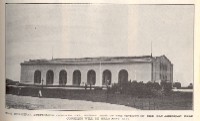 Oakland's Municipal Auditorium, shown here, was the site of the Pan-American Road Congress. Although the Congress was a failure in some respects, members of AASHO took time from the event to develop a draft bill that was the foundation for the Federal Aid Road Act of 1916, which Judge Lowe opposed. |
The date has been selected because of the advantageous arrangements that can be made for halls and meeting places, and also because it was felt that this date would enable engineers planning to attend the International Engineering Congress to attend the Pan-American Road Congress as well.
The congress would run through Friday, September 17. Exposition officials agreed to designate September 15 as "Pan-American Road Congress Day." On that day, the congress would meet in Festival Hall on the exposition grounds, with tours of the road machinery and material exhibits planned for that evening. Expectations were high for this meeting of what Good Roads referred to as "the two road organizations ranking first in importance on this continent, in their respective fields."
The August 7, 1915, issue of Good Roads explained the elaborate arrangements made for transportation to the Pan-American Road Congress:
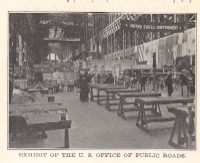 During the Panama-Pacific Exposition, the U.S. Bureau of Public Roads' exhibit (shown here) in the Machinery Palace was the most comprehensive exhibit in its history to that point. The exhibit was intended to stimulate road building and encourage better methods of construction and maintenance. |
A special train will be run from Chicago to Oakland, leaving Chicago on September 2 over the Chicago and Northwest Railway and arriving at Oakland on the morning of September 12. Stops will be made at St. Paul, Minn., Banff and Lake Louise, Canada, Seattle, Wash., and Portland, Ore . . . .
A return tour through Los Angeles, San Diego, the Grand Canyon of Arizona, Denver and Kansas City was under consideration.
The good roads press usually described conventions in glowing terms, citing large attendance, great enthusiasm, and major importance. Each convention was the best ever. This one would be an exception. The Pan-American Road Congress holds the distinction of being one of the least successful road conventions held during the years of the Good Roads Movement. The account in Better Roads and Streets, stated:
It cannot be said that it was a huge success, particularly from the standpoint of attendance, for the attendance was smaller than that of any national congress that has been held within the limits of the memory of the writer; another thing that tended materially to detract from the success of the meeting, which should have been the greatest that has ever been held in this country, was the noticeably large number of absentees who were listed on the official program.
Chairman James H. MacDonald [Connecticut's State highway commissioner] admitted that it was one of the most trying periods of his life when, at the first session, out of the total of eight speakers who were scheduled on the official program, but one was present.
The problem, the magazine speculated, was that the construction season was underway in many parts of the country, preventing officials and contractors from leaving their duties.
One of those absent for the first session was Logan Page, Director of the U.S. Office of Public Roads and Rural Engineering (OPRRE, as OPR had been renamed on July 1, 1915) and President of the AHA. He was scheduled to read the first paper during the first business session of the Congress. (The chairman of the session, Fairfax Harrison of the AHA and president of the Southern Railway, was also absent, so the session was chaired by Dr. Joseph Hyde Pratt of North Carolina.) With only about 150 people in attendance, Major W. W. Crosby of Maryland read Page's paper, "The History and Future of Highway Improvement." The speech reflected Page's longstanding view that "the same sort of business management and business expediency that make for success in private enterprise" should be applied to road building at the State and especially the county level. However, his text read by Major Crosby provided no comment on the prospect for Federal participation in road improvement.
In addition to being widely considered unsuccessful, the Pan-American Road Congress led to a rupture between Page and ARBA later that year. In November 1915, he learned that ARBA had announced plans for its annual meeting, to be held in early 1916 in Pittsburgh, Pennsylvania. Page objected in a letter to ARBA on November 10, 1915:
The whole point and effort in bringing about the Pan-American Road Congress was that neither association should hold an independent convention this season. This was the argument used by the officials of the congress in soliciting funds to finance the convention.
It seems to me that in view of the above facts, for the Road Builders to hold their annual meeting a month or two later than is the usual custom, so as to have the date fall just within another calendar year, constitutes a breach of faith. The present plan for holding this convention will simply mean that the Road Builders will have given up no annual convention, but merely deferred the usual convention a month of two.
In view of this breach of faith, Page submitted his resignation as a member of ARBA's Board of Directors. (When the American Association of State Highway Officials (AASHO) held its annual meeting at the LaSalle Hotel in Chicago on December 7 and 8, 1915, the members adopted a resolution urging ARBA and the AHA to "amalgamate into one organization, or . . . at least arrange to hold jointly one annual road congress." The resolution urged member State highway agencies not to send representatives to any National Road Congress held before December 1, 1916.)
Despite the poor attendance at the Pan-American Road Congress and the breach it caused between Page and ARBA, the congress served an important purpose prior to the 1916 congressional debate on a good roads bill. This result occurred because key members of AASHO attended the Congress.
When AASHO had formed in December 1914 as a voice for State highway officials, its members directed the Executive Committee to prepare and present a bill to Congress representing AASHO's plan for Federal cooperation. The committee, dominated by members from heavily populated States with well-developed highway networks, collaborated with AAA's president, A. G. Batchelder, on the draft of a Federal-aid bill that called for a national system of highways. The draft was sent to Congress.
Midwestern members of AASHO, many from States with less developed networks, objected to the plan and the fact that they had not been consulted before the AASHO proposal was submitted to Congress. To settle the dispute, AASHO's Executive Committee met in Oakland on September 11, 1915, just before the Pan-American Road Congress. The committee consisted of:
George P. Coleman, Chairman, Virginia.
W. D. Sohier, Massachusetts.
Thomas H. MacDonald, Iowa.
E. A. Stevens, New Jersey.
Lamar Cobb, Arizona.
Joseph Hyde Pratt, North Carolina
Henry G. Shirley, Maryland (President of AASHO).
MacDonald took the lead in drafting a proposal that would be consistent with Page's ideas of a Federal-aid program based on a Federal-State partnership rather than Federal construction of national roads. (Whether Page attended this meeting is unclear.) During AASHO's annual meeting, the States adopted the new version in place of the earlier bill. The only change was elimination of the amount to be appropriated ($25 million a year); the figure was best left to the House and Senate appropriations committees. In 1916, AASHO's bill would become the foundation for the Federal-aid highway program.
Condition of the National Old Trails Road
The October 1915 issue of Touring Topics reported on the condition of transcontinental highways in California. For the National Old Trails Road, the summary stated:
Reports received daily from our construction crew enroute from Kansas City to Los Angeles, indicate that conditions are rapidly improving throughout the entire length of this road. During the early part of September, heavy rains were experienced throughout western Kansas and Colorado, but the weather has cleared and roads are again in normal condition. All cars are coming through without difficulty.
As for the Lincoln Highway, the summary reported:
The Lincoln Highway from San Francisco east . . . is in fair condition, although some very bad sections will be encountered in Nevada, Utah and south Wyoming and Nebraska. This highway has had much transcontinental travel during the present season, and although cars have been coming through without any extraordinary difficulties, very few cars pronounce it an entirely feasible transcontinental route at present. The worst spots of this road are reported as follows: The crossing of the Fallon Sink between Fallon and Eureka, the crossing of the old Salt Lake between the Nevada State Line and Salt Lake City, and the road along the North Platte River between North Platte and Omaha. During the summer's rainy season, these sections were very badly washed and practically no reconstruction work has been done.
In January 1916, Touring Topics had a more detailed report on the western end of the National Old Trails Road. The road was in "good shape as far east as Seligman in Arizona," but the magazine added that, "rains and stormy weather may change route conditions at any time." Conditions from Seligman to Los Angeles were good with exceptions. From Seligman to the Colorado River, the road was "in good shape with the exception of some rough work near Seligman." After crossing the river on the Santa Fe Railroad bridge, motorists would find the road from Needles to Cadiz "in good condition," but from Cadiz to Ludlow, motorists would find a "fair dirt road with the exception of the last six or seven miles into Cadiz which has numerous chuck holes and is very sandy."
Continuing west, the motorist would discover that the road to Barstow, particularly the last 10 miles, "has been badly rutted by heavy auto trucks." In addition to being "quite sandy," this section of the National Old Trails Road had "numerous chuck holes which necessitates slow driving." The road through Cajon Pass between Barstow and San Bernardino over Mount Vernon Avenue was "a first class road with the exception of the four miles in the Cajon Pass which is almost impassable on account of snow and mud." From San Bernardino to Los Angeles, the motorist would travel over "continuous pavement with the exception of one mile of dirt road west of Upland, which is excellently maintained."
National Old Trails Road in Ohio
In the second half of 1915, several good roads magazines covered Ohio's aggressive plan to improve the National Old Trails Road.
The August 1915 issue of Better Roads and Streets reprinted a speech by Arch W. Smith of the State Highway Department on "Ohio's Road Program." Smith had delivered the speech on June 9, 1915, before the Ohio and Michigan Association of Undertakers. It began:
Ohio's road program is a definite one, and is proving to be a very practical one. In a nutshell, it contemplates the improvement and continuous maintenance of the system of inter-county highways embracing a network of the main thoroughfares of the State totaling 9,874 miles. This system connects every county-seat with the seats of adjoining counties, and also serves directly all other important cities and villages.
After a general discussion of the State's initiative, Smith discussed the status of Ohio's three transcontinental highways, the National Old Trails Road, the Lincoln Highway, and the Dixie Highway. In doing so, he emphasized that the State had no connection to the organizations backing these highways and had not given official recognition to any of them. He added:
The department has tendered every assistance and encouragement within its proper sphere, and shall continue to do so on behalf of any movement for better roads, whether it is national in scope, or merely a township improvement.
Smith described the route of the National Old Trails Road, noting that in Ohio, it passed through Bridgeport, Cambridge, Zanesville, Columbus, London, Springfield, Dayton, and Eaton. He continued:
Its promoters claim that in 1914, $2,124,000 was expended for improvements along this route, and that Ohio furnished 22.2% of this amount, Maryland ranking second with 21.8%, and California, third, with 17.8%. It is claimed also that for 1915 moneys have been appropriated for further improvements to the amount of $2,021,000. Of this amount Ohio is credited with supplying 52%, California 22.2%, and Maryland 10.3%.
It is asserted that over one-third of the entire 3,600 miles has already been constructed. In Ohio the entire mileage has been improved with brick, concrete, water-bound macadam, bituminous-bound macadam and gravel. At the present time, out of a total of 191 miles outside of municipal limits, there are about thirty-eight miles of old improvements, made by local authorities, which are in need of reconstruction, not counting improvements which are now under way.
In Licking and Muskingum counties, the United States government is co-operating with the State and county on the improvement of a continuous stretch of twenty-four miles of this highway, of the concrete type, which leads west from Zanesville, and is to be the model concrete road of the world.
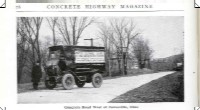 In 1915, Ohio was aggressive in building concrete pavements along the National Old Trails Road, as shown in this photo, taken west of Zanesville, showing a U.S. Mail truck on the road. |
The concrete paving project west of Zanesville was a result of the experimental post road program added to the Post Office Department Appropriation Act for Fiscal Year 1913. It had appropriated $500,000, to be used by the Secretary of Agriculture and the Postmaster General to improve selected post roads. State or local governments were to provide two-thirds of the total cost of projects, with the two Federal departments asked to report to Congress in 1 year with the results of the experimental program. As part of the drive to determine the appropriate Federal role in highway improvement, the post road program was seen as way of exploring how a Federal-aid program might work. (The same legislation also authorized creation of the Joint Committee on Federal Aid in the Construction of Post Roads, otherwise known as the Bourne Committee.) The experimental program was not successful if measured by mileage improved, but did provide valuable experience that helped Logan Page shape his views on Federal-aid. For example, it convinced him that the program should be a partnership between the OPRRE and State highway agencies because cooperating with the more than 3,000 counties would be too burdensome.
By comparison with the National Old Trails Road, Smith said of the Lincoln Highway:
The total distance across Ohio on this route is 262.4 miles, of which 224 miles are outside of municipal limits, and of this, 147 miles of road are improved with brick, macadam, and gravel. There are nineteen miles under contract uncompleted, and forty-six of new improvements are under contemplation.
Carl Fisher, who had launched the Lincoln Highway, was also the inspiration for the Dixie Highway. The idea had been to identify a road from the Lincoln Highway in Chicago, to Miami, Florida, where Fisher now lived as a developer and promoter of Miami Beach. The Dixie Highway Association was organized during a meeting in Chattanooga, Tennessee, on April 3, 1915. By the time of a meeting in Chattanooga on May 22, the routing commissioners had settled on a northern extension to Mackinaw, Michigan, and a Dixie Highway System rather than a single highway alignment. The association had solved routing disputes by incorporating rival alignments on the theory that motorists could take one route south and the other route north for variety. In Ohio, the routing was via Toledo, Lima, Dayton, and Cincinnati.
Smith informed the undertakers of the brief history of the Dixie Highway, pointing out that Ohio might benefit from a resolution adopted by the Dixie Highway Association stating that the association reserved the right to relocate any portion of the highway where a county or municipality failed to complete its link within a year. Smith stated, "This may mean that Ohio is to pull the Dixie Highway eastward." Dayton and Montgomery Counties were already near contract letting for their sections. "No doubt you will hear more of this project when the movement reaches Toledo and Detroit."
The December 1915 issue of Better Roads and Streets contained George D. Steele's description of Ohio's work on the National Old Trails Road in an article on "How Construction is Progressing on National Pike." Steele summarized the history of the National Road, pointing out that after 1838, the road had been turned over to the States "and since that time, so far as can be learned, it has never received even honorable mention in a Federal Appropriation Act." However, under the post road program, he said, $120,000 had been allotted to improve a 24-mile section of the National Road/National Old Trails Road west of Zanesville:
The improvement consists in regrading the old road to a width of thirty-four feet and reducing grades to a maximum of seven per cent, and laying a concrete pavement sixteen feet in width along the central portion of the grade.
The concrete was 8 inches thick at the center of the pavement, 6 inches at the sides, the difference providing for drainage. The project had another unique feature:
One of the novel features of the construction of this section consisted in giving the pavement a super-elevation on the curves. These elevations are computed for a velocity of thirty miles per hour, but do not exceed eight inches in any case. This feature, it was found, added very little to the cost of the work, but adds greatly to the feeling of security of automobilists going around the curves.
The State Highway Department of Ohio and the OPRRE had designed the project "with extreme care" and carried out the construction contract under joint supervision "with the same extreme care." Construction by the H. E. Culbertson Company began in May 1914, with concrete placed on a 15-mile section between June 17 and November 14, when work was halted because of unfavorable weather.
By the time of Steele's article, Culbertson had completed the work, which included five new bridges and 59 new culverts. The cost in Muskingum County had been $181,920, and in Licking County, $258,080.
Steele reported on construction in the other National Old Trails Road counties in Ohio:
- Belmont County: Under a contract awarded in May 1914, the State reconstructed a 4-mile segment with a 16-foot wide brick pavement on a concrete foundation. The State had also built four stone arch bridges. Another section, a little over 4 miles long, had been similarly repaved, with the maximum grade reduced from 13 percent to 7.88 percent. A 16-mile section had also been repaved and the grade reduced from 11 percent to 7.86 percent.
- Guernsey County: Segments totaling 14 miles had been repaved with brick, 15 feet wide, on a rolled stone foundation. Maximum grade had been reduced to 7.9 percent.
- Licking County: Beyond the post road project, three other sections of the National Old Trails Road, totaling 16 miles, had been improved. Concrete paving, 16 feet wide, was extended through the town of Hebron (.89 miles). On the succeeding two sections, the pavement was 16 feet wide, but bids were taken on concrete, tar-bound macadam and asphalt-bound macadam surfaces. The award for the second section was for a tar-bound macadam, while asphalt-bound macadam was selected for the third section.
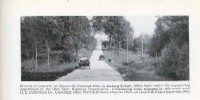 Two vehicles are shown on the concrete pavement of the National Old Trails Road in Licking County, Ohio. |
The construction in Belmont County, which is Ohio's easternmost county, was featured in an article about "The National Road" in the December 1915 issue of Dependable Highways. The article acknowledged the Nation's diversified interests and the difficulty of rallying support for a "matter, therefore, of great single national importance." It added:
In spite of all this there are in the list but few undertakings which would more greatly benefit the vast majority, in an economic, social and material way, than the improvement to a high standard of a few great thoroughfares throughout the country. The time may come when, as a matter of military preparedness, the expenditure therefore will be worth more than any other object for which an equal amount of money might be expended.
Given the National Road's continued "relative place as the most logical and important route to be improved," the article focused on the plan to pave the entire Belmont County segment of the highway with brick pavement, 16 feet wide. Henry E. Rice, county surveyor of Belmont County, was directly involved in the work:
Watchful care, direction, instruction from the grading to the finished surface, will make possible the hope of splendid construction. The engineer was caught in the act [in the accompanying photograph]. It may seem a little thing to have the sub grade prepared with exact care but the effort is worth while.
When the article was written, the work was not complete:
Several short sections are yet uncompleted in this county-the larger pieces awaiting the heavy roller to crush and smooth the broken stone base will be noticed with peculiar interest by most engineers.
The article also discussed repair of a bridge built 90 years earlier as part of the National Road:
Whether the crooks, and the turns, the bumps, the irregular lines were made to harmonize with all surrounding nature, or whether it was shaped to suit the mere whim of the builder, cannot be proved. It is a curiosity to say the least. It would scarcely be expected, however, that the fruit of some antique whim would be in keeping with the influences of the last hundred years. It required but little repair to restore this bridge to its original worth.
If the same care expended on the bridge were expended on the road, "wear and tear upon this brick road will impart no serious injury for another hundred years."
The article recommended that other counties in Ohio, as well as Indiana and Illinois, adopt brick paving for their portions of the National Old Trails Road. "It would be a great regret-waste of money-in fact a calamity if any less durable type of road improvement should be undertaken." If officials did not have "the courage to deal with at least this road as a purely business proposition," they would be "brought to stand before the bar of public opinion and receive a condemnation that will smirch them forever and justly so."
Closing the Expositions
San Francisco's Panama-Pacific Exposition, which had opened on February 20, 1915, closed on December 4. Nearly 19 million people had visited the exposition. Although the more centrally located expositions in Chicago (1893) and St. Louis (1904) had enjoyed higher attendance, the Panama-Pacific Exposition was financially successful, making a profit of $2.4 million.
The smaller Panama-California Exposition in San Diego had also been a success, counting over 2 million admissions by tickets and passes as well as a net profit of $56,570. The exposition ended on December 31, 1915, but resumed on January 1, 1916 as the Panama-California International Exposition. With additional exhibits borrowed from the San Francisco exposition, the Panama-California International Exposition continued until January 1, 1917, having attracted 1.7 million attendees. Finally, the exposition ended in the black, with profits under $50,000.
How many eastern motorists traveled to the expositions by automobile is not known. In the 1916 edition of The Complete Official Road Guide of the Lincoln Highway, the Lincoln Highway Association estimated that 1915 had seen an increase in transcontinental touring of 300 to 600 percent. The guide quoted D. E. Watkins, Secretary of the California State Automobile Association (northern California's equivalent of the Automobile Association of Southern California): "Conservatively estimated, I would say, fully 25,000 automobile parties have toured to California."