




ARCHIVED: Chapter 4. Economics Of Recycling
| << Previous | Contents | Next >> |
Introduction
Although started as a method of reusing waste materials, recycling of asphalt pavement has proved to be a cost effective method of pavement rehabilitation. When properly selected, all the different types of recycling methods are usually cheaper than the conventional rehabilitation methods, even though the relative savings will depend on the kind of recycling technique used. The primary saving in hot and cold mix recycling comes from savings in the cost of virgin asphalt cement, whereas the savings in hot in-place recycling comes by elimination of transportation cost and use of very little amount of virgin material. The major savings in the case of cold in-place recycling comes by eliminating the need for fuel or emission control system, since the process is done at ambient temperature, elimination of transportation costs, and the addition of only a small percentage of virgin asphalt binder. The objective of this session is to present the economics associated with the use of recycled asphalt materials. Expenditures and cost comparisons with the use of conventional HMA mixes are summarized from available literature.
Estimated price associated with pavement construction, reconstruction and recycling operations are presented in this chapter. These prices have been collected from available literature. Whenever possible, prices collected from literature published in or after 1990 are generally reported. It should be noted that recycling costs have changed over the years because of continual developments in the recycling technology and equipment. If costs for these operations are available from state or local agency records or from local contractors, they should be used instead since a large price variation can be expected depending on the location of the project and the time of construction.
As presented here, the pavement cost is defined as the amount of monies that a contractor must spend for labor, materials, equipment, subcontractors, and overhead to construct, rehabilitate or maintain a pavement structure.(1)
Cost And Savings Associated With Hot Mix Recycling
The cost associated with recycling can be presented on a material cost as well as construction cost basis. Although construction cost may be a more valid approach, an example of material cost comparison is also presented here. This example shows the amount of savings that can be made by using recycled asphalt pavement (RAP) instead of using virgin material.(2) Considering $5 per ton and $120 per ton as average costs of aggregate and liquid asphalt, respectively, the cost of a 100 percent virgin mix with 6 percent asphalt comes out to be $11.90 (see table 4-1). If the contractor uses a half-lane milling machine and hauls the RAP back to the HMA plant, his/her total cost for RAP is $3.70 per ton, considering $1.70 per ton for machine and labor for milling, and $2.00 per ton for trucking cost. Hence the savings, compared to using virgin material, is $8.20 per ton, as shown in table 4-1. Table 4-2 shows the savings in using different percentages of RAP. It should be noted that these savings are in first cost. Limiting life cycle costs, if any, must be considered when using excessive amounts of RAP in recycled mixes. Typical cost savings with hot mix recycling are shown in tables 4-3 and 4-4.
| Item | Cost per ton ($) | Percent used (%) | Total Cost ($) per ton |
|---|---|---|---|
| Aggregate | 5.00 | 94 | 4.70 |
| Asphalt Binder | 120.00 | 6 | 7.20 |
| Virgin Mix | 11.90 | ||
| RAP | |||
| Trucking | 2.00 | 2.00 | |
| Milling | 1.70 | 1.70 | |
| RAP Mix | 3.70 | ||
| Savings in using 1 ton of RAP instead of 1 ton of virgin mix | 8.20 |
| Percent of RAP | Cost/Ton | Savings, $/ton | Savings, % |
|---|---|---|---|
| 0% | 11.90 | ||
| 20% | 10.26 | 1.64 | 14 |
| 30% | 9.44 | 2.46 | 21 |
| 40% | 8.62 | 3.28 | 28 |
| 50% | 7.80 | 4.10 | 34 |
| Area | Total Tonnage (1000) 1984 | Average Savings Per Ton ($) | Average % Savings vs. 100% New Material(s) | Total Savings ($1000) |
|---|---|---|---|---|
| Northeast | 500 | 2.80 | 10 | 1,400 |
| Southeast | 4,000 | 5.67 | 20 | 22,300 |
| North-central | 12,000 | 5.26 | 18 | 62,600 |
| South-central | 2,000 | 5.32 | 20 | 10,000 |
| Central-western | 1,600 | 5.12 | 21 | 8,200 |
| Total | 20,000 | --- | --- | 104,500 |
| Average | --- | 4.83 | 18 | --- |
| Agency | Year(s) | % Average Savings |
|---|---|---|
| Florida DOT | 1981-1983 | 24-26 |
| Saskatchewan | 1985 | 20-30 |
| U.S. Corps of Engineers | 1986 | 16 |
| Wisconsin DOT | 1980-1985 | 39-49 |
Hot In-Place Recycling
There are three primary types of hot in-place recycling, as recognized by the Asphalt Recycling and Reclaiming Association (ARRA). These are: surface recycling, repaving, and remixing.
Surface recycling to a depth of 25 mm (1 in) and addition of a recycling agent costs approximately $1.25/m2 ($1.00/yd2).(3) A cost of approximately $2.05/m2 ($1.64/yd2) is required for an additional 25-mm (1-in) overlay. Hence the total cost of recycling and overlaying by two-pass method will be approximately $3.3/m2 ($2.64/yd2).(3) In the repaving method, placement of a 25-mm (1-in) overlay along with recycling of the top 25 mm (1 in) of an existing pavement will cost approximately $3.62/m2 ($2.90/yd2).(4,5) A maximum of 25 percent cost savings over cold milling and conventional overlaying procedure has been reported.(6) The cost of cutting 25 mm (1 in) and remixing with 10 to 20 percent of virgin aggregate is approximately $2.24/m2 ($1.79/yd2).(6) Typical remixing price in Canada is reported to be between $2.78 and $3.70/m2 for a 50-mm treatment depth (between $2.22 and $2.96/yd2 for a 2-in treatment depth).(7)
In a 101,156 m2 (121,000 yd2) repaving job in Florida, it was found that the recycling process used 2.6 trillion joules (2.5 billion BTU) less energy than that required by a conventional method. This was found equivalent to an energy savings of 32 percent.(8)
Table 4-5(6) presents a recent summary of cost and savings data and case histories. The estimated savings over conventional construction methods ranges from 17 to 50 percent.(6)
| Agency / Date Recycled | Cost Information | Description of Job | HIR Process Used | Milling Depth / Overlay Depth | Rejuvenating Agent |
|---|---|---|---|---|---|
| Mix Temperature | |||||
| Repaving Process | |||||
| FAA, Carrabelle, FL 1990 | $4.28/m2 ($3.42/yd2) |
Thompson Field Airport. 30 m x 1212m (98 ft x 696 ft) runway | Repave | 25 mm/25 mm (1 in/1 in) |
Unknown |
| Unknown | |||||
| Florida DOT 1979 | $2.99/m2 (3.39/yd2). A savings of 25% estimated |
US 41, Ft. Myers, FL 3.9 km (2.4 mile), 6-lane. ADT-39,000 |
Cutler Repave | 25mm/19mm (1 in/3/4 in) |
EA-SS-1 0.27 1/m2 (0.06 gal/yd2) |
| 79°-121°C (175°F to 250°F) | |||||
| City of Phoenix 1990 | $3.59/m2 | City collector street. 800 m2 (10,000 yd2) |
Cutler Repave | 19mm/25mm (3/4 in/1 in) |
Yes, Type and quantity Unknown |
| Unknown | |||||
| Lee County, Iowa 1990 | $3.41/m2 | Rural roads X-38 and X-48 | Cutler Repave | 19mm/25mm (3/4 in/1 in) |
Elf ETR-1 at 0.36 1/m2 (0.08 gal/yd2) |
| 105°C (221°F) | |||||
| Connecticut DOT 1981 | $4.33/m2. 16% more than control |
Rt. 15 at Westport, Connecticut 4.7 km (2.9 mile), 4-lane divided | Cutler Repave | 25mm/25mm (1 in/1 in) |
AE-300R 0.36 1/m2 |
| 250°F ± 30°F by spec. | |||||
| FAA Texarkana, Texas 1986 | 50 percent savings reported | Airport- 2011 m2 (6598 ft2) and 25 yr old | Cutler Repave | 25mm/25mm (1in/1 in) |
Type unknown 0.54 1/m2 (0.11 gal/yd2) |
| 110°C (230°F) | |||||
| Remixing Process | |||||
| Defense Construction Canada* 1989 | $3.58/m2 for the 40mm/19mm --- $4.17/m2 for conv. 50 mm overlay |
Airfield pavements at Canadian Forces Base, Edmonton, Alberta, 330,000 m2 (412,500 yd2) | Artec Remixer --- Only a small area was remixed |
40mm/50mm (1.6 in/2 in) overlaid later; or 40mm/19mm (1.6 in/0.75 in) repave |
RJO #3 at 0.4 1/m2 (0.08 gal/yd2) |
| 120°C (248°F) behind paver was targeted value | |||||
| Texas DOT 1991 | $2.15/m2 for recycling portion only | IH-10 and SH-87 near Beaumont | Wirtgen Remixer | 25mm to 31mm | ARA-1 |
| About 116°C (240°F) | |||||
| Repaving Process | |||||
| Mississippi SHD 1990 | Unknown. 40% savings reported | 55 lane-km (34 lane-mile) of IH-59 in Lauderdale County | Wirtgen Remixer | 38 mm + 15 kg/m2 of new mix | Yes, unknown |
| 110°C (230°F) | |||||
| British Columbia Ministry of Highways* 1989 | $1.70/m2 for recycling only | Trans-Canada Highway (Rt 1) near Vancouver, 126 lane-km (78 lane-mile) | Artec and Taisei Remixers | 38 mm to 63 mm (no new material added) | Unknown |
| 105°C (221°F) minimum | |||||
| Texas DOT 1987 | $3.05/m2 a savings of 34% over conventional | US 259 in Lone Star. Major arterial carrying heavy trucks | Cutler Remixer | 38 mm + 17 kg/m2 new mix | AC-5 used with new mix |
| 93°F (200°F) behind screed | |||||
| Texas DOT 1989 | $2.57/m2 including 30 kg/m2 of new mix | IH-20 from Louisiana, border to FM450, 51 km, ADT-18,000 20% Trucks | Wirtgen Remixer | 38 mm + 30 kg/m2 new mix | ARA-1 at 0 to 0.71 1/m2 |
| 110°C (230°F) | |||||
| Oregon DOT 1987 | 17% savings estimated | 82nd Ave from N.E. Wasco to S.E. Division a 5-lane major arterial | Taisei Remixer | Up to 50mm + various new mix | Non-emulsified product |
| Unknown | |||||
| Texas DOT 1981 | $1.59/m2 including recycling, rejuv. agent and admixture | US 59 near Lufkin, 20,000 ADT | Wirtgen Remixer | 50-38 mm + 20% new mix | ARA-1 at 0.1 0.45 1/m2 (0.09 gal/yd2) |
| 107°C (225°F) | |||||
| Louisiana DOT 1990 | $4.59/m2 including recycling, rejuv. agent and admixture | US 90 from LA 99 to Jennings | Wirtgen Remixer | 38 mm + 30 kg/m2 new mix | ARA-1 at 0.9 l/m2. Elf AES-300RP used in a short section |
Note:
- * Cost for jobs in Canada given in Canadian dollars.
Cold In-Place Recycling
The reported costs of cold in-place recycling are shown in Table 4-6.(8) The representative cost varies from approximately $1.71/m2 ($1.37/yd2) to $9.87/m2 ($7.90/yd2) depending upon many factors such as depth of recycling, equipment type, and thickness of overlay. The reported relative savings of using cold in-place recycling in lieu of conventional construction methods are also shown in table 4-6. The initial savings have varied from 6 to 67 percent.
| Agency | Year | Cost Difference (%)a | Cold In-Place Recycling ($) | ||
|---|---|---|---|---|---|
| Range | Rep. Value | Range | Rep. Value ($) | ||
| California | 1979-83 | 15-43 | 31 | 16.16-26.73/Mg (14.71-24.32/ton) | 22.15/Mg (20.16/ton) |
| California | 37 | 24.17/Mg (22.00/ton) | |||
| California | 1980 | 21 | 6.46/m2 (5.17/yd2) | ||
| Illinois | 1982 | 4.75/m2 (3.80/yd2) | |||
| Indiana | 1976 | 13.13-24.17/Mg (11.95-22.00/ton) | |||
| Iowa | 1988 | 67 | 7.58/Mg (6.90/ton) | ||
| Kansas | 1977 | 53 | |||
| Kansas | 1988 | ||||
| Missouri | 1978 | 50 | |||
| Montana | 1978 | 21 | 23.72/Mg (21.59/ton) | ||
| New Mexicob | 1984-86 | 1.31-2.5/m2 (1.05-2.00/yd2) | 1.75/m2 (1.40/yd2) | ||
| N. Carolinac | 1977 | 6 | 4.99/m2 (3.99/yd2) | ||
| Oklahoma | 1979 | 4.32/m2 (3.46/yd2) | |||
| Oregon | 1984 | 24 | 1.99-3.02/m2 (1.81-2.42/yd2) | 2.50/m2 (2.00/yd2) | |
| Pennsylvania | 1983 | 16 | |||
| Vermont | 1978 | 28 | 9.87/m2 (7.90/yd2) | ||
| Vermont | 1982 | 31 | 1.71/m2 (1.37/yd2) | ||
| Wisconsin | 1978 | 0.14/m2-cm (0.29/yd2-in) | |||
| FHWA | 5.9/m2 (4.72/yd2) | ||||
Notes:
- Relative to commonly used rehabilitation alternatives used by identified states.
- Personal communication with D. Hanson (1987).
- Cost increase on one project.
The mean cost from Oregon DOT cold in-place recycling projects in the 1989-1990 period was reported to be $2.51/m2 ($2.0/yd2) for a 50-mm (2-in) cold in-place recycling with a chip seal, and about $1.80/m2 ($1.44/yd2) without a chip seal.(9)
The mean cost for 48 New Mexico cold-in-place recycling projects ranged from $0.13 to $0.44/m-cm2 ($0.27 to $0.92/yd-in2), with a mean of $0.26/m-cm2 ($0.54/yd-in2).(9) Recycling cost increases with an increase in the use of virgin aggregates.
On a per square meter per cm basis cost of recycling is reduced with an increase in depth of cold in-place recycling. For the New Mexico state projects, the mean cost per square meter per centimeter have been reported to be $0.31 for 75 mm ($0.64/yd-in2 for 3 in), $0.27 for 85 mm ($0.56/yd2-in for 3.4 in), $0.25 for 10 cm ($0.52/yd2-in for 4 in), and $0.21 for 11.3 cm ($0.44/yd2-in for 4.5 in) of cold in-place recycling.(9)
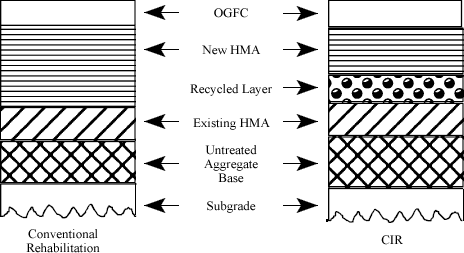
A recent study shows that the CIR savings in New Mexico amount to approximately $1.90/m2 ($1.52/yd2) in initial cost and $2.05/m2 ($1.64/yd2) on the basis of life cycle costs. Figure 4-1 shows typical sections resulting from conventional rehabilitation and recycling operations. Cost figures based on initial cost and life cycle cost are also indicated in the figure. The savings on a life cycle basis results from reduced frequency of maintenance for CIR pavements. Generally, maintenance for cracking is required after every four years for mill and overlay projects, whereas maintenance for cracking is required after eight years for CIR projects.
Figure 4-1. Typical sections for conventional and recycled pavement.
| Savings | Maximum | Minimum | Average |
|---|---|---|---|
| $/lane-km | 14,296 | 1,593 | 7,094 |
| $/square-m | 2.81 | 0.53 | 1.90 |
| Rehab. Option | Initial Costs ($) | Maintenance Cost ($) | Total Cost ($) |
|---|---|---|---|
| Mill and Overlay (total) | 8.780 | 0.314 | 9.090 |
| CIR (total) | 6.880 | 0.159 | 7.040 |
| Cost Savings with CIR | 1.900 | 0.155 | 2.050 |
Full Depth Reclamation
Cost comparisons of conventional rehabilitation technique and recycling with full depth reclamation and HMA wearing course are given in table 4-7.(10) In this case, the cost of recycling ($7.25/m2, $5.80/yd2) is less than one half of the conventional reconstruction technique ($16.12/m2, $12.90/yd2).
| Option | Cost |
|---|---|
Fully reconstruct road:
| $16.12/m2 ($12.19/yd2) |
Full Depth Reclamation:
| $7.25/m2 ($5.80/yd2) |
General Benefits Of Recycling
Apart from savings in materials, recycling saves money by avoiding transportation cost and cost of filling up landfill space. Recycling reuses non-renewable resources. Hence it should be considered even if the cost of recycling is equal to the cost of conventional rehabilitation. Also, in some cases where overlays are restricted to maintaining underpasses, or avoiding raising guard rails, recycling is a better option compared to conventional rehabilitation methods.
Summary
A review of current literature shows that savings up to 40, 50, 55 and 67 percent can be achieved by using hot mix, hot in-place, cold in-place recycling, and full depth reclamation, respectively. These savings are achieved when one of the recycling methods is used in place of conventional method or some other recycling method. In addition to the material and construction cost savings, significant amount of cost savings (in terms of user costs) can be realized by the reduced interruptions in traffic flow when compared with conventional rehabilitation techniques. Recycling can be used to rejuvenate a pavement or correct mix deficiency and conserve material and energy - options not available with the conventional paving techniques. A conventional overlay may require upgrading shoulders to maintain profile, raising guard rails to maintain the minimum safety standard, and restrict overlays below the bridges to maintain underpass height. On the other hand, recycling can effectively be used to maintain the highway geometry and thus resulting in substantial overall savings as well.
References
- Pavement Recycling Guidelines for Local Governments - Reference Manual, Report No. FHWA-TS-87-230, FHWA, U.S. Department of Transportation, Washington, DC, 1987.
- J. D. Brock. Milling and Recycling, Technical Paper T-127, ASTEC, Chattanooga, TN. Undated.
- J.E. Shoenberger and T.W. Voller. Hot In-Place Recycling of Asphalt Pavements, Technical Report GL-90-22. Department of the Army Waterways Experiment Station, Corps of Engineers, Vicksburg, MS, 1990.
- J.R. Rathburn. "One-Step Repaving Speeds Country Work," Roads and Bridges, March, 1990.
- G.M. Perry. "Repaving...One More Time," Southwest Contractor, June, 1990.
- J. Button, D.N. Little, and C.K. Estakhri. Hot In-Place Recycling of Asphalt Concrete, In NCHRP Synthesis of Highway Practice 193, TRB, National Research Council, Washington, DC, 1994.
- Personal communication with L. Dunn, Pavement Recycling Technologies Inc. (PR7) Alberta, Canada, 1997.
- J.A. Epps. Cold Recycled Bituminous Concrete, In NCHRP Synthesis of Highway Practice 160, TRB, National Research Council, Washington, DC, 1990.
- G.R. Hicks and D.F. Rogge. "States Gain Cold-Cash Saving Using Cold In-Place Recycling," Roads and Bridges, October, 1995.
- "Pavement Recycling," Maine Local Roads News. January, 1993.
| << Previous | Contents | Next >> |