




ARCHIVED: Chapter 7. Hot Mix Asphalt Recycling (Materials And Mix Design)
| << Previous | Contents | Next >> |
Introduction
Hot mix recycling is the process in which reclaimed asphalt pavement materials are combined with new materials, sometimes along with a recycling agent, to produce hot mix asphalt mixtures. Just as in the case of conventional HMA, recycled mixtures must be designed properly to ensure proper performance. When properly designed, recycled mixtures can have properties similar to those of new conventional hot mix asphalt mixtures.(1)
There are four components in hot mix recycling: the reclaimed asphalt pavement (RAP), the virgin aggregate, the virgin asphalt binder and in some cases, a recycling agent. The two steps in the mix design procedure are material evaluation and mix design. The objective of the material evaluation process is to determine the important properties of the component materials to come up with an optimum blend of materials to meet the mix requirements. The objective of the mix design step is to determine the type and percentage of asphalt binder with the help of results from compacted test mixes. The specific steps of the material evaluation and mix design process are as follows.(2)
- Obtain representative field samples of the reclaimed material.
- Perform laboratory analysis:
- determine composition and properties of the RAP
- determine the proper amounts of virgin aggregates to be added
- select the type and amount of the virgin asphalt binder
- mix, compact and test trial mixes.
- Select the optimum combination of mix components that meet the mix design criteria.
Material Evaluation
The material evaluation process consists of sampling and evaluation of the RAP, and the recycling agent, if any, to be used in the recycled mix. The RAP to be used in the recycled mix may come from different layers of HMA with different compositions or stockpiles built with materials from different sources. Hence, representative samples must be obtained from existing pavements, RAP conveying trucks or RAP stockpiles, to evaluate any variation in the different important properties, such as gradation and asphalt content.
Sampling of RAP
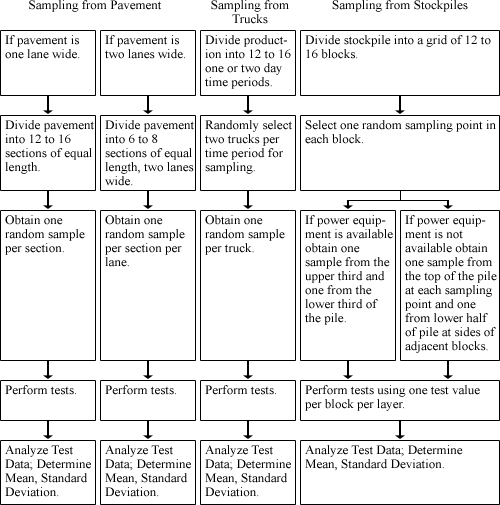
Sampling from Existing Pavements: Some highway agencies like to conduct a preliminary sampling and evaluation program for including some important properties such as gradation, asphalt content, penetration and viscosity, of the in-place mix in the Plans, Specification and Estimates package.(3) Historical data such as construction plans, past condition surveys and maintenance record may be utilized to delineate substantial differences in pavement section, surface distresses, or increased structural capacity. These differences can be used to separate the project into units of different construction materials or different depths of milling. A random sampling plan should be used to obtain preliminary samples from each of the units in the pavement. The following procedure for preliminary sampling is recommended. The pavement is to be separated into construction units of similar composition by using historical records. Each construction unit should be divided into six to eight sections of equal length. One sample should be selected randomly from each section. Each sample should be of sufficient size (6.8 kg, 15 lb, minimum) for extraction, recovery and testing of asphalt binder. Each of the samples should be tested individually. Table 7-1(3) shows sampling frequency and sample size for those state highway agencies that perform evaluations during the project development stage. A minimum of one sample (consisting of 3 cores) per 1.6 lane-km (1 lane-mile) is recommended. Although most of the agencies core to the full depth of the pavements, after visual examinations, the cores are trimmed off to the proposed depth of removal. For detailed sampling plan the flow chart shown in figure 7-1(2) can be used for evaluating any significant difference in properties of the RAP material. Emphasis should be placed on the random sampling method since this procedure is based on statistical principles and both cost and work may be reduced by this method of sampling.(4) AASHTO T168 Sampling Bituminous Paving Mixtures (pertaining to samples from roadway) can be used as a guidance to obtain HMA pavement cores. After running tests on these samples (as discussed later), the results should be analyzed to determine the mean and standard deviation, and outliers, if any, should be detected. Pavement sections corresponding to the outlier results should be treated separately.
Sampling from RAP Hauling Trucks: RAP samples can be obtained from the trucks hauling RAP from the milling site to the HMA plant for stockpiling. Random sampling is done as shown in the flow chart (figure 7-1). AASHTO T2, sampling aggregates, (pertaining to the samples from a hauling vehicle) can be used as a guidance for sampling RAP from trucks.
Sampling from RAP Stockpiles: To obtain representative samples from RAP stockpiles, 10 samples from different locations in the stockpile should be obtained, and to minimize the effect of segregation, at least 150 mm (6 in) of the material from the surface of the stockpile should be removed before sampling.(5) Samples are scalped off and the material retained on the 50 mm (2 in) sieve is discarded. It is recommended that the sample size should be at least 5 kg (11 lb) after sampling, of which one half should be used for mix composition testing and the other half used for mix design. Individual samples should be used for extraction for aggregate gradation and asphalt content.(6) Five samples are recommended for conducting Abson recovery and determining asphalt binder properties. AASHTO T2 Sampling Aggregates (pertaining to the samples from a stockpile) can be used as a guidance for sampling RAP from the RAP stockpiles. Since the crushing or milling of reclaimed asphalt pavement may alter the gradation of the aggregate portion, Samples from RAP cold feed stockpiles at the plant site should be tested.(4) In addition to the guidelines available in several references, engineering judgement should always be used to develop an effective sampling plan. Once a RAP stockpile is built at a HMA plant, some highway agencies assign it a number such as 96-3 (Stockpile No. 3 of year 1996) which is then referenced in the recycled mix design for that stockpile. No further RAP material is allowed to be added to that stockpile once the final sampling is made for the mix design. As in the case of sampling from existing roadway, test results from RAP stockpiles should be analyzed to identify any outlier. Material from stockpiles corresponding to the outliers should not be included in mix design.
| State | Sample Frequency | Sample Size |
|---|---|---|
| Arizona | 3 cores/1.6 lane-km | 150 mm diameter for the full depth of structure |
| Florida | 1 set of 3 cores/1.6 lane-km. Minimum 2 sets of 3 cores per lane. | 150 mm diameter for the full depth of structure |
| Kansas | 3 Cores/1.6 lane-km Minimum 30 cores. | 100 mm diameter for the full depth of structure |
| Nevada | 1 core/750 lane-m | 100 mm diameter for the full depth of structure |
| Texas | 10 cores/project | 150 mm diameter for the full depth of structure |
| Wisconsin | 1 core/800 m | Surface area minimum of 230 cm2 |
| Wyoming | 2 cores/km | 150 mm diameter for the full depth of structure |
Figure 7-1. Flow chart of sampling plans.(modified from 2)
Evaluation of RAP
The RAP material needs to be evaluated before the actual mix design. This is because with aging and oxidation certain significant changes occur in the HMA. For the binder, this includes loss of the lighter fractions and a corresponding increase in the proportions of the asphaltenes, hardening (increase in viscosity), and loss of ductility. The gradation of the aggregate may change due to degradation caused by traffic loads and the environment. Hence the composition of the RAP must be determined at the beginning. Most agencies determine aggregate gradation, asphalt content, and asphalt viscosity at 60°C for the reclaimed asphalt pavement. The aged asphalt binder must be extracted from a representative sample of the RAP to determine these properties. The following guidelines are suggested for aggregate and binder evaluation.(4)
Aggregate Evaluation: AASHTO T30, Mechanical Analysis of Extracted Aggregate, or AASHTO T27, Sieve Analysis of Fine and Coarse Aggregates, should be used to perform a sieve analysis of the aggregate extracted from the RAP. Any deficiency can be corrected by blending appropriate sieve fractions of virgin and/or reclaimed aggregate with reclaimed asphalt pavement aggregate. It is also recommended to examine the angularity of both coarse and fine aggregates. Extraction: AASHTO T 164, Quantitative Extraction of Bitumen from Bituminous Paving Mixtures should be used to quantitatively extract the asphalt binder from RAP if the extracted binder is to be recovered and tested for further evaluation. The National Center for Asphalt Technology's (NCAT's) ignition test can be used to determine the RAP composition (asphalt content and aggregate gradation) if the asphalt binder is not intended to be recovered.
Asphalt Binder Evaluation: The extracted asphalt is recovered from the solution by AASHTO T 170. Recovery of Asphalt from Solution by Abson Method. SHRP has developed an improved method of recovering asphalt binder from solution: SHRP Designation B-006 Extraction and Recovery of Asphalt Cement for Rheological Testing. This method is preferable to AASHTO T170. AASHTO T 202 should then be used to check the consistency of the recovered asphalt binder by measuring its viscosity at 60°C, to estimate the amount and grade of virgin asphalt binder required in the recycled mix. Some agencies also test the penetration at 25°C of the recovered asphalt binder.
If no more than 15-20 percent RAP is used in the recycled mix, testing of the extracted asphalt is not required by many highway agencies and the grade of the virgin asphalt binder is kept the same as that of the conventional mix.
Recycling Agents
There are four basic purposes for using recycling agents.(7) These are:
- to restore the aged asphalt binder characteristics to a consistency level appropriate for construction purposes and end use of the mix;
- restore the recycled HMA mix to its optimum characteristics for durability;
- provide sufficient additional binder to coat any virgin aggregate added to the recycled mix; and
- provide sufficient additional binder to satisfy mix design requirements.
Recycling agents have been defined as organic materials with chemical and physical characteristics selected to restore aged asphalt to desired specifications.(4) In selecting the recycling agent, the viscosity characteristics of the combined aged asphalt binder and the recycling agent are the determining factors. These agents are also known as softening agents, reclaiming agents, modifiers, fluxing oils, extender oils, and aromatic oils.(7) The Pacific Coast User-Producer Group has defined recycling agent as a hydrocarbon product with physical characteristics selected to restore aged asphalt binder to requirements of current asphalt binder specifications. Under this definition, softer asphalt and specialty products can be classified as recycling agents.(7) Asphalt cements can be used when an increase in total binder content of the recycled mix is required and the specific grade can be blended with the aged asphalt binder in the RAP to yield an asphalt binder meeting the desired specifications. Generally, AC-10, AC-5 or AC 2.5 (85-100, 120-150 or 200-300 pen; AR-4000, AR-2000 or AR-1000) asphalt cements are used for this purpose.(4) Use of such soft grades of asphalt binder in hot mix recycling is more prevalent in the U.S. compared to the use of commercial recycling agents. If the aged asphalt binder has a very high viscosity (or low penetration) or the percentage of RAP in the recycled HMA is much greater than 50 percent, a relatively small amount of a commercial recycling agent can be used to modify the aged asphalt binder without altering the desired binder content. Then, if additional binder is required, the normal grade of asphalt for a virgin mix can be added, though this necessitates that the plant be capable of adding two binder materials.(8) Recycling agents in emulsion form have the potential advantages of improved fluxing, mixing and temperature control to prevent localized overheating in drum mixers. Furthermore, the formulation of the emulsion can be adjusted to provide the design end result viscosity of the binder in the recycled HMA mix. A disadvantage is that additional heat is required to remove the 30 to 35 percent water contained in the emulsion.(9) To ensure the proper function of the modifiers, the following properties are suggested for specification purposes:(7)
- Be easy to disperse in recycled mixture.
- Capable of altering the viscosity of aged asphalt binder in the RAP to the desired level.
- Be compatible with the aged asphalt binder to ensure that syneresis (exudation of paraffins from asphalts) will not occur.
- Have the ability to redisperse the asphaltenes in the aged asphalt binder.
- Improve the life expectancy of the recycled HMA mix.
- Be uniform in properties from batch to batch.
- Be resistant to smoking and flashing.
Several tests have been investigated by various agencies for evaluation of recycling agents. Table 7-2 shows the physical properties of hot mix recycling agents contained in ASTM Standard Practice D4552 Classifying Hot-Mix Recycling Agents.(10) The important properties mentioned are as follows:
- Viscosity at 60°C is used to measure asphalt binder consistency to grade materials and ensure uniformity.
- Flash point is an important guide for evaluating the presence of volatile organic compounds or contaminants in the recycling agent. This is important for safety during shipping, handling, and storage of the recycling agent.
- Weight percentage of saturates is specified to ensure compatibility.
- Weight loss must be evaluated to minimize smoke generation and volatile loss during hot mix production.
- Aging tests are needed to minimize excessive hardening of the agent during hot mixing and to ensure durability.
| TEST | ASTM Test Method | RA 1 | RA 5 | RA 25 | RA 75 | RA 250 | RA 500 | ||||||
|---|---|---|---|---|---|---|---|---|---|---|---|---|---|
| Min | Max | Min | Max | Min | Max | Min | Max | Min | Max | Min | Max | ||
| Viscosity at 140°F, cSt | D 2170 or D 2171 | 50 | 175 | 176 | 900 | 901 | 4500 | 4501 | 12500 | 12501 | 37500 | 37501 | 60000 |
| Flash point, COC, °F | D92 | 425 | ... | 425 | ... | 425 | ... | 425 | ... | 425 | ... | 425 | ... |
| Saturates, wt% | D 2007 | ... | 30 | ... | 30 | ... | 30 | ... | 30 | ... | 30 | ... | 30 |
| Tests on residue from RTFO or TFO oven 325 °F | D 2872 or D 1754 | ||||||||||||
| Viscosity ratioA | - | ... | 3 | ... | 3 | ... | 3 | ... | 3 | ... | 3 | ... | 3 |
| Wt change ± % | - | ... | 4 | ... | 4 | ... | 3 | ... | 3 | ... | 3 | ... | 3 |
| Specific gravity | D 70 or D 1298 | Report | Report | Report | Report | Report | Report | ||||||
The choice of Recycling Agent (RA) grade will depend on the amount and hardness of the asphalt in the aged pavement. In general, the lower viscosity RA types can be used to restore aged asphalts of high viscosity and vice versa.
Additionally, grades RA 1, RA 5, RA 25 and RA 75(10) will generally be most appropriate for hot mix recycling of salvaged asphalt concrete when no more than 30 percent virgin aggregate is added, while grades RA 250 and RA 500 will generally be most appropriate when more than 30 percent virgin aggregate is incorporated into the mix.(10) Specifications for emulsified recycling agents are normally based on the specifications for recycling agents with additional tests that are identical or similar to those for asphalt emulsions (table 7-3). ASTM D5505 Standard Practice for Classifying Emulsified Recycling Agents can be used to select an appropriate emulsified recycling agent. The choice of emulsified recycling agent will be determined by the consistency of the binder in the aged pavement, the methods of recycling planned, the amount, if any, of new aggregates, and other design needs.(10)
| TESTS | Test Method | ER-1 | ER-2 | ER-35 | |||
|---|---|---|---|---|---|---|---|
| Min | Max | Min | Max | Min | Max | ||
| On emulsion | |||||||
| Viscosity, 50°C, SSF | D 244 | 100 | 20 | 450 | 20 | 450 | |
| Sieve, % | D 244 | 0.1 | 0.1 | 0.1 | |||
| Storage stability, 24 h, % | D 244 | 1.5 | 1.5 | 1.5 | |||
| Residue, by distillation, % | D 244 | 65 | 65 | 65 | |||
| Dilution | reportA | ||||||
| Specific gravity | D 70 | report | report | report | |||
| CompactibilityB | varies | report | report | report | |||
| On residue from distillation | |||||||
| Viscosity, 60°C, cSt | D 2170 | 50 | 200 | 30 | 30 | ||
| Saturates, % | D 2007 | 30 | |||||
| Solubility in trichloroethylene | D 2042 | 97.5 | 97.5 | 97.5 | |||
| On residue from distillation after RTFOC | |||||||
| Penetration, 4°C, 50 g 5 s | D 5 | 75 | 200 | 5 | 75 | ||
| RTFO, weight change, % | D 2872 | 4 | 4 | 4 | |||
Notes:
- ER-1 shall be certified for dilution with potable water.
- This specification allows a variety of emulsions, including high-float and cationic emulsions. The engineer should take the steps necessary to keep incompatible materials from co-mingling in tanks or other vessels. It would be prudent to have the chemical nature (flat test for high float emulsions, particle charge test for cationic emulsions, or other tests as necessary) certified by the supplier.
- RTFO shall be the standard. When approved by the engineer the Thin Film Oven Test (Test Method D 1754) may be substituted for compliance testing.
Mix Design Procedures
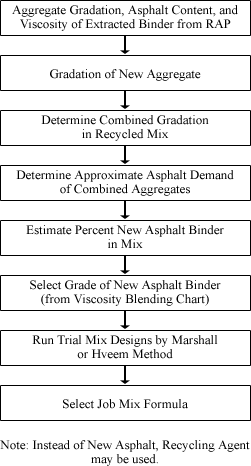
Figure 7-2 shows the flow chart recommended for the different steps in mix design of recycled mixes.(4) Conventional recycled mix design will be presented first followed by the Superpave recycled mix design.
Figure 7-2. Flow chart for mix design procedure.
| For Asphalt Content | |||||||||||||
|---|---|---|---|---|---|---|---|---|---|---|---|---|---|
| by weight of total mix | by weight of aggregate | ||||||||||||
| % New Asphalt, Pnb |
|
|
|||||||||||
| % RAP, Psm |
|
|
|||||||||||
| % New Aggregate, Pns | ![r minus [(r P-sub-b) divided by 100]](images/e0705.gif) | r | |||||||||||
| TOTAL | 100 | 100 + Pb | |||||||||||
| % New Asphalt to Total Asphalt Content, R |  | | |||||||||||
Notes:
| Psm | = | Percent salvaged mix (RAP) in recycled mix |
| Pb | = | Asphalt content of recycled mix, % |
| Psb | = | Asphalt content of salvaged mix (RAP), % |
| Pnb | = | Additional asphalt and/or recycled agent in recycled mix, % |
| Pns | = | Percent additional aggregate (new aggregate material) |
| r | = | Percent new aggregate material to total aggregate in recycled mix |
| R | = | Percent new asphalt and/or recycling agent to total asphalt in recycled mix |
- Combined Aggregates in the Recycled Mixture - Using the gradation of the aggregate from the reclaimed asphalt pavement and new aggregate, a combined gradation meeting the desired specification requirements is calculated. After the blend of aggregate (aggregate in the RAP and new aggregates) have been established, the amount of new aggregate is expressed as r, in percent. For example, suppose the following blend was established for a recycled mix:
75 percent new aggregate
25 percent RAP aggregate
100 percent totalThe amount of new aggregate is 75 percent. Hence, r = 75. Table 7-4(4) contains formulas for proportioning materials for recycled HMA mixes where the blend of aggregates in the mix is kept constant.
- Approximate Asphalt Binder Demand of the Combined Aggregates - The most practical approach is to assume the asphalt demand of the combined aggregates in the proposed recycled HMA to be equal to the optimum asphalt content of 100 percent virgin HMA (without any RAP). Therefore, the following procedure of determining the approximate asphalt demand may not be necessary unless no mix design is available for 100 percent virgin mix.
The approximate asphalt demand of the combined aggregates may be determined by the Centrifuge Kerosene Equivalent (CKE) test included in the Asphalt Institute Hveem Method of Mix Design, or calculated by the following empirical formula:
P = 0.035a + 0.045b + Kc + F
where:
P = approximate total asphalt demand of recycled mix, percent by weight of mix a = percent of mineral aggregate retained on 2.36 mm sieve, expressed as a whole number b = percent of mineral aggregate passing the 2.36 mm sieve and retained on the 75 µm sieve, expressed as a whole number c = percent of mineral aggregate passing the 75µm sieve K = 0.15 for 11-15 percent passing 75 µm sieve, 0.18 for 6-10 percent passing 75µm sieve, and 0.20 for 5 percent or less passing 75 µm sieve F = 0 to 2.0 percent. Based on absorption of light or heavy aggregate. In the absence of other data, a value of 0.7 is suggested With an approximate asphalt demand established, this will provide a basis for a series of trial mixes for a mix design. Trial mixes will vary in asphalt contents in 0.5 increments on either side of the calculated approximate asphalt demand.
For example, suppose that the approximate asphalt demand was calculated to be 6.2 percent. A series of trial mixes then range from 5.0 to 7.0 percent or from 5.5 to 7.5 percent.
- Estimated Percent of New Binder Asphalt in HMA Mixture - The quantity of new asphalt binder to be added to the trial mixes of the recycled HMA mixture, expressed as percent by weight of total mix is calculated by the following formula:
Pnb = ( 1002 - r Psb ) Pb - ( 100 - r ) Psb 100 ( 100 - Psb ) 100 - Psb where:
Pnb = Percent of new asphalt binder in recycled mix (plus recycling agent, if used), expressed as whole number r = new aggregate expressed as a percent of the total aggregate in the recycled mix expressed as a whole number Pb = percent, estimated asphalt content of recycled mix (assumed to be the same as that of 100 percent virgin HMA mix or determined as an approximate asphalt demand of combined aggregates in the preceding step) Psb = percent, asphalt content of reclaimed asphalt pavement (RAP) (plus recycling agent, if used) For example, suppose the asphalt content, Psb of the RAP is 4.7 percent and r = 75 percent, then
Pnb = ( 1002 - 75 X 4.7 ) Pb - ( 100 - 75 ) 4.7 = 1.01 Pb - 1.23 100 ( 100 - 4.7 ) 100 - 4.7 The percentages of new asphalt binder for any asphalt content may now be readily determined. The formula above is for asphalt content expressed as percent by weight of total mix. If asphalt contents are expressed as percent by weight of aggregate the formula for calculating quantity of new asphalt binder is:
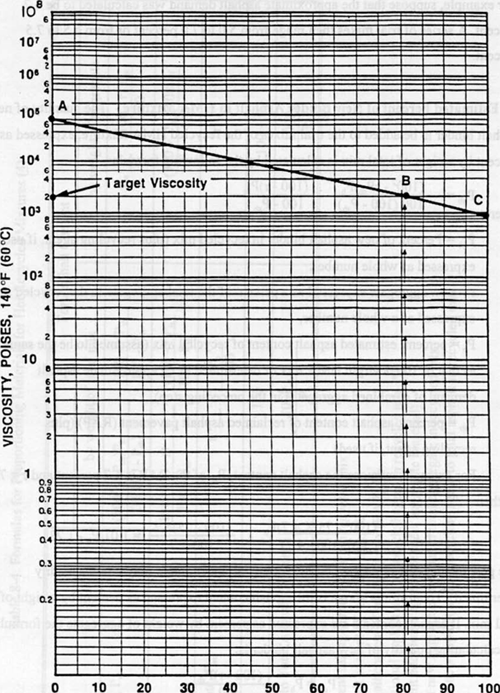
Pnb = Pb - ( 100 - r ) Psb 100 - Select Grade of New Asphalt Binder - Using figure 7-3,(4) a target viscosity of the asphalt blend is selected. A commonly selected target point is the viscosity at the mid-range of the specified viscosity-graded asphalt binder. For example, the target for an AC-20 asphalt binder would be 2,000 poises.
Figure 7-3. Asphalt viscosity blending chart.(4)
The percent of the new asphalt, Pnb, to the total asphalt content, Pb, is expressed by the following formula:
R = 100 Pnb Pb For example, suppose the mix described in Step (3) is to have an estimated total asphalt content of 6.2 percent. The amount of new asphalt to be added (from Step 3) is:
Pnb = 1.01 X 6.2 - 1.23 = 5.0 percent
Then:
R = 100 ( 5.0 ) = 81 6.2 The grade of new asphalt binder (and/or recycling agent) is determined using a log-log viscosity versus percent new asphalt binder blending chart such as figure 7-3.(4) A target viscosity for the blend of recovered asphalt and the new asphalt (and/or recycling agent) is selected. As mentioned earlier, the target viscosity is usually the viscosity of the mid range of the grade of asphalt binder normally used depending on type of construction, climatic conditions, amount and nature of traffic.
Plot the viscosity of the aged asphalt in the RAP on the left hand vertical scale, Point A, as illustrated in figure 7-3. Draw a vertical line representing the percentage of new asphalt binder, R, calculated above and determine its intersection with the horizontal line representing the target viscosity (2,000 poises in this example), Point B. Then draw a straight line from Point A, through Point B and extend it to intersect the right hand scale, Point C. Point C is the viscosity at 60°C (140°F) of the new asphalt binder (and/or recycling agent) required to blend with the asphalt binder in the reclaimed asphalt pavement (RAP) to obtain the target viscosity in the blend. Select the grade of new asphalt binder that has a viscosity range that includes or is closest to the viscosity at Point C. To plot a point using the vertical scale, consider expressing the viscosity using 10 raised to some power. For example, 75,000 poises would be 7.5 X 10⁴. To plot the point on the vertical scale, 7.5 would be interpolated on the scale between 104 and 105. It is suggested that when selecting a grade of asphalt cement for recycling that the following guide be used:
Up to 15 percent RAP = No change in asphalt binder grade (some highway agencies use 20 percent in lieu of 15 percent) 16 percent RAP or more = Use asphalt binder one grade softer than that normally specified for 100 percent virgin HMA mix. For example, use AC-10 in lieu of AC-20. Do not change more than one viscosity grade unless the recycled HMA mix is checked for resistance to rutting. - Trial Mix Design - Trial mix designs are then made using the Marshall or Hveem method. The formulas shown in table 7-4 are used for proportioning the ingredients: new asphalt binder, Pnb, percent reclaimed asphalt pavement (RAP), Psm and new aggregate, Pns.
- Select Job-Mix Formula - The optimum asphalt content is selected based on the test data obtained in the preceding step. If the Marshall mix design procedure is used, the optimum asphalt content is selected to give 4.0 percent air void content. Two mix design examples follow.
Design Example 1: The reclaimed asphalt pavement has an asphalt content of 5.4 percent by weight of total mix. The viscosity of the asphalt binder recovered from the reclaimed asphalt pavement (RAP) is 46,000 poises at 60°C (140°F). The grade of asphalt cement normally used is AC-20, and the target viscosity at a temperature of 60°C (140°F) is 2,000 poises. Gradation of RAP and new aggregate is:
Sieve Size Percent Passing RAP Agg. New Agg. 25.0 mm (1 in) 100 100 19.0 mm (3/4 in) 98 93 9.5 mm (3/8 in) 85 53 4.75 mm (No. 4) 65 30 2.36 mm (No. 8) 52 16 300 µm (No. 50) 22 5 75 µm (No. 200) 8 1 Approximately 30 percent of RAP was selected because
- a batch plant was to be used for recycling,
- moisture content of the RAP was 5 percent and
- this is a practical range for maintaining mix productions based on percent of RAP and moisture.
Step 1 - Combined aggregates in recycling mixture Sieve Size Percent Passing 30% RAP Agg. 70% New Agg. Combination Agg. 25.0 mm (1 in) [100 × 0.3 = 30.0] [100 X 0.7 = 70.0] 100.0 19.0 mm (3/4 in) [98 × 0.3 = 29.4] [93 X 0.7 = 65.1] 94.5 9.5 mm (3/8 in) [85 × 0.3 = 25.5] [53 X 0.7 = 37.1] 62.6 4.75 mm (No. 4) [65 × 0.3 = 19.5] [30 X 0.7 = 21.0] 40.5 2.36 mm (No. 8) [52 × 0.3 = 15.6] [16 X 0.7 = 11.2] 26.8 300 µm (No. 50) [22 × 0.3 = 6.6] [5 X 0.7 = 3.5] 10.1 75 µm (No. 200) [8 × 0.3 = 2.4] [1 X 0.7 = 0.7] 3.1 Then: r = 70
The job specification for aggregate gradation (for 19 mm nominal size) is:
Sieve Size Percent Passing Max. Size % Pass Combined Agg. % Pass 25.0 mm (1 in) 100 100.0 19.0 mm (3/4 in) 90-100 94.5 9.5 mm (3/8 in) 56-80 62.6 4.75 mm (No. 4) 35-65 40.5 2.36 mm (No. 8) 23-49 26.8 300 µm (No. 50) 5-19 10.1 75 µm (No. 200) 2-8 3.1 Step 2 - Approximate asphalt demand of combined aggregates
P = 0.035a + 0.045b + Kc + F = 0.035 × 73.2 + 0.045 × 23.7 + 0.20 x 3.1 + 1.0 = 5.2 percent Step 3 - Estimated percent of new asphalt binder in mix
Pnb = ![{[(100 squared minus r P-sub-sb) P-sub-b] divided by [100(100 minus P-sub-sb)]} minus {[(100 minus r) P-sub-sb] divided by (100 minus P-sub-sb)}](images/e0712.gif)
= ![{[(100 squared minus 5.4 X 70) P-sub-b] divided by [100 (100-5.4)]} minus {[(100 minus 70) 5.4] divided by (100 minus 5.4)}](images/e0713.gif)
= 1.02 Pb - 1.71 For an approximate asphalt binder demand of 5.2 percent:
Pnb = 1.02 ( 5.2 ) - 1.71 = 3.6 percent
The percent of new asphalt binder, Pnb, to total asphalt, Pb, will then be
R = 100 ( 3.6 ) = 69 percent 5.2 Step 4 - Select grade of new asphalt binder
On figure 7-4, Point A is the viscosity of the aged asphalt binder at 46,000 poises (4.6 × 10⁴). Point B is located from a target viscosity of 2,000 poises (2.0 × 10³) and R = 69. The projected line from Point A through Point B to Point C indicated that the viscosity of the new asphalt binder is 7.0 × 10² (700).
Figure 7-4. Asphalt viscosity blending chart (design example 1).
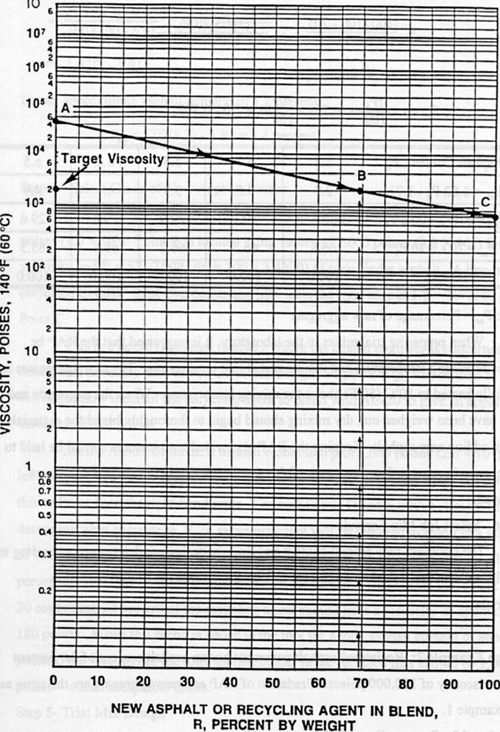
Since AC-20 is the normal grade of asphalt cement used in the area of construction, climate and traffic, an AC-10 will be chosen for this project. The AC-10 when blended with the aged asphalt binder in the RAP should result in an AC-20 within acceptable tolerances.
Step 5 - Trial mix design
Using an aggregate blend of 70 percent new aggregate and 30 percent RAP aggregate, trial mixes of different asphalt contents (varying in 0.5 percent increments on either side of the estimated asphalt demand) are prepared according to standard Marshall or Hveem mix design procedures.
The formulas in table 7-4 may be used to calculate the percentages of each ingredient in the trial mixes. Since the formula for Pnb was calculated in Step 3, the formulas for proportioning Psm and Pns are:
Psm
= ![{[100 (100 minus r)] divided by (100 minus P-sub-sb)} minus {[(100 minus r) P-sub-b] divided by (100 minus P-sub-sb)}](images/e0715.gif)
= ![{[100(100 minus 70)] divided by (100 minus 6)} minus {[(100 minus 70) P-sub-b] divided by (100 minus 6)}](images/e0716.gif)
= 31.91 - 0.32 Pb Pns = ![r minus [(r P-sub-b) divided by 100] equals 70 minus [(70 P-sub-b) divided by 100] equals 70 minus (0.70 P-sub-b)](images/e0717.gif)
Asphalt Content, Pb 4.5 5.0 5.5 6.0 6.5 Pnb = 1.02 Pb - 1.71 2.9 3.0 3.9 4.4 4.9 Psm = 31.71 - 0.32 Pb 30.3 30.1 29.9 29.8 29.6 Pns = 70 - 0.70 Pb 66.8 66.5 66.2 65.8 65.5 TOTAL 100.0 100.0 100.0 100.0 100.0 Note:
- Pns = Percentage of new aggregate
When preparing trial mixes in the laboratory, it is suggested that the RAP be heated to mixing temperature and maintained at that temperature. The new aggregates are normally heated to 10°C (50°F) above the mixing temperature. When the aggregate and RAP have been weighed out, dry mixing should begin to thoroughly blend the materials before adding new asphalt. Keeping the RAP at elevated temperatures should be held to a minimum (not more than one hour). Otherwise, normal mix design procedures are followed.
Step 6 - Select job mix formula
The optimum new asphalt content and the mix design are determined according to established standard Marshall or Hveem mix design criteria (as is used for virgin materials).
Design Example 2: Reclaimed asphalt pavement has an asphalt content of 6.0 percent with a viscosity of 100,000 poises. Gradation of RAP and new aggregate are the same as for Example 1.
Steps 1 and 2 - Same as Example 1
Step 3 - Estimate percent of new asphalt in mix
Pnb = = ![{[(100 squared minus 70 X 6.0)] divided by [100 (100 minus 6.0)]} minus {[(100 minus 70) 6.0] divided by (100 minus 6.0)}](images/e0718.gif)
= 1.02 Pb - 1.91 For an approximate asphalt demand of 5.2 percent:
Pnb = 1.02 ( 5.2 ) - 1.91 = 3.4 percent
Step 4 - Select grade of new asphalt binder
On figure 7-5, Point A is the viscosity of the aged asphalt binder at 100,000 poises (1.0 × 10⁵). Point B is located using values of 2,000 poises (2.0 X 10³) for target viscosity and R = 57, (100Pnb/Pb = 100 × 3.4/6.0) of new binder asphalt. A line is projected through these two points and intersects the right axis at 1.8 × 10² (180 poises), Point C.
Figure 7-5. Asphalt viscosity blending chart (design example 2).
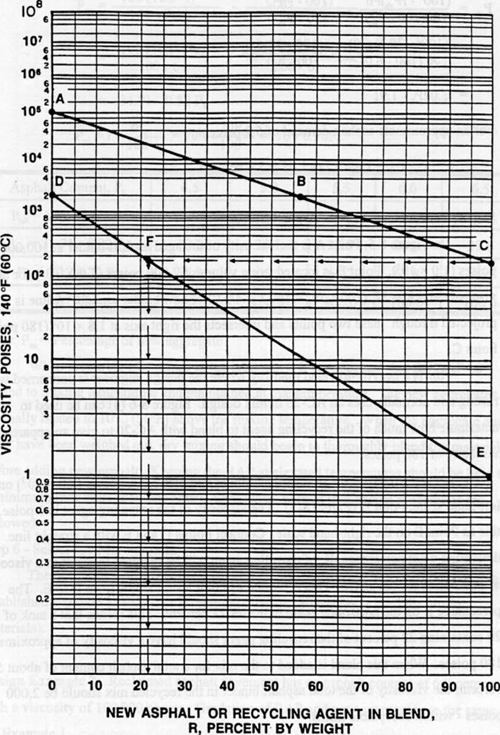
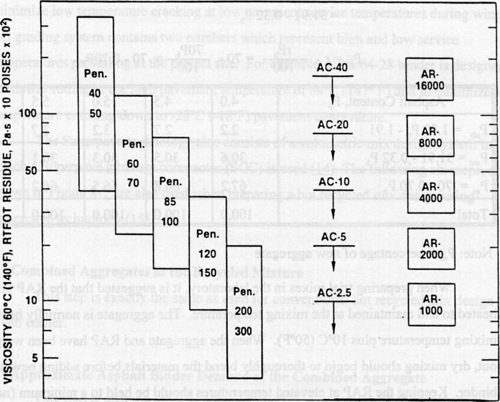
This is a heavily-traveled roadway where the design engineer is concerned with rutting and normally uses an AC-20 in mix design. Figure 7-6(4) can be used to determine how much of the recycling agent to blend with AC-20 to give an apparent viscosity of 180 poises.
Figure 7-6. Comparison of penetration grades and viscosity grades of asphalt cement (based on RTFOT residue for AR-grades and penetration grades; TFOT residue for AC- grades).
Let the AC-20 be the new asphalt binder and plot 2,000 poises (2.0 × 10³) on the left-hand scale, Point D (figure 7-5). The viscosity of the recycling agent is 1 poise. Plot this as Point E on the right-hand scale. Connect Points D and E with a straight line. Now determine what percentage, R, of recycling agent will be required to result in a viscosity of 180 poises for the blend. This is plotted as Point F on the line from D to E. The percentage R on the horizontal scale indicates 22 percent. This means that a tank of AC-20 containing 22 percent of the recycling agent should have a viscosity of approximately 180 poises. When this blend is added to the mix for a total asphalt content of about 5.2 percent, the viscosity of the total asphalt binder in the recycled mix should be 2,000 poises - within acceptable limits.
Step 5- Trial mix design
Using an aggregate blend of 70 percent new aggregate and 30 percent RAP aggregate, trial mixes of different asphalt contents (varying in 0.5 percent increments on either side of the estimated asphalt demand) are prepared according to standard Marshall or Hveem mix design procedures. The formulas in table 7-4 may be used to calculate the percentages of each ingredient in the trial mixes. Since the formula for Pnb was calculated in Step 3, the formulas for proportioning Psm and Pns are:
Psm = = = 31.91 - 0.32 Pb Pns = Asphalt Content, Pb 4.0 4.5 5.0 5.5 6.0 Pnb = 1.02 Pb - 1.91 2.2 2.7 3.2 3.7 4.2 Psm = 31.91 - 0.32 Pb 30.6 30.5 30.3 30.1 30.0 Pns = 70 - 0.70 Pb 67.2 66.8 66.5 66.2 65.8 Total 100.0 100.0 100.0 100.0 100.0 Note:
- Pns = percentage of new aggregate
When preparing trial mixes in the laboratory, it is suggested that the RAP be heated to and maintained at the mixing temperature. The aggregate is normally heated to mixing temperature plus 10°C (50°F). When the aggregate and RAP have been weighed out, dry mixing should begin to thoroughly blend the materials before adding new asphalt binder. Keeping the RAP at elevated temperatures should be held to a minimum (not more than one hour). Otherwise, normal mix design procedures are followed.
Step 6 - Select job-mix formula
The optimum new asphalt content and the mix design are determined according to established standard Marshall or Hveem mix-design criteria (as is used for virgin materials). If the Marshall mix design is used, select the optimum asphalt content which gives 4.0 percent air void content.
Hot Recycled Mix Design with Superpave Technology
Superpave technology, a part of the Strategic Highway Research Program (SHRP), developed a performance-based specification for asphalt binders.(11,12,13) The performance grade (PG) of asphalt binder is designed to improve the performance of HMA pavements at three service temperatures. The PG binder specifications consist of
- a rutting factor (G*/sinδ) to minimize rutting at high pavement temperatures during summer,
- a fatigue factor (G*sinδ) to minimize fatigue cracking at intermediate pavement service temperatures, and
- a maximum creep stiffness (S) requirement to minimize low temperature cracking at low pavement service temperatures during winter.
PG grading system contains two numbers which represent high and low service temperatures prevailing at the project site. For example, a PG 64-28 binder is designed to minimize rutting at the high pavement temperature of 64°C (147°F) and to minimize low temperature cracking down to -28°C (-18°F) pavement temperature.
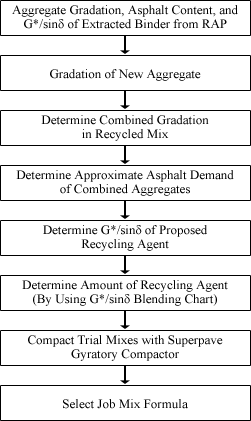
The Superpave technology also consists of a volumetric mix design system in which a Superpave gyratory compactor (SGC) is used.(14) The following six steps, as shown in figure 7-7 are also used when preparing a hot recycled mix design using Superpave technology.(15)
Figure 7-7. Steps in preparing hot recycled mix using Superpave technology.
- Combined Aggregates in the Recycled Mixture
This step is exactly the same as used for conventional hot recycled mix design given earlier.
- Approximate Asphalt Binder Demand of the Combined Aggregate
This step is also the same as conventional hot recycled mix design given earlier. An alternate method is given in the Superpave volumetric mix design method(16) which calculates estimated asphalt content based on the combined aggregate gradation. However, the procedure is very tedious. It is recommended to assume the estimated asphalt content of the recycled HMA mixture equal to that of 100 percent virgin HMA mixture.
- Estimate Percent of New Asphalt Binder in HMA Mixture
This step is also the same as conventional hot recycled mix design given earlier.
- Select Grade of New Asphalt Binder
Based on the research conducted at the National Center for Asphalt Technology,(15) the following three tier procedure is recommended to select the Superpave PG grade of the new asphalt binder:
- Tier 1 (up to 15 percent RAP): If the minimum amount of the RAP in the recycled mix is 15 percent or less, use the same PG grade as that used in 100 percent virgin HMA mixture. For example, if the highway agency specifies a PG 64-28 asphalt binder for 100 percent virgin mixtures, the same grade can be used in recycled mixtures containing up to 15 percent RAP.
- Tier 2 (16 to 25 percent RAP): If the amount of RAP in the recycled mix is more than 15 percent but equal to or less than 25 percent, the selected PG grade of the virgin asphalt binder should be one grade below (both high and low temperature grade) the Superpave specified PG grade. For example, if the Superpave specified PG grade is PG 64-22 then a PG 58-28 asphalt binder should be selected. The use of blending chart (as given in Tier 3) to select the high temperature grade of the virgin asphalt binder is optional.
- Tier 3 (26 percent or more RAP): If the amount of RAP in the recycled mix is 26 percent or more, then a specific grade blending chart shown in figure 7-8 is recommended to be used. This blending chart can be used to determine the minimum and maximum amounts of the percentages of virgin asphalt binder (and conversely the maximum and minimum amounts of RAP in the recycled mix) so that the recycled asphalt binder conforms to a specific PG grade. The X-axis in this blending chart has percen virgin asphalt binder (determined in Step 3) and Y-axis has the rutting factor G*/sinδ obtained at the high pavement service temperature for the specific PG grade. For example, if a highway agency uses a PG 64-28 binder for 100t percent virgin mixtures, G*/sinδ of the aged asphalt binder (recovered from RAP) and the proposed virgin (new) asphalt binder should be determined at 64°C (147°F) . If the highway agency uses a PG 58-28 binder, then G*/sinδ of both aged and proposed virgin binder should be determined at 58°C (136°F). The minimum and maximum amounts of virgin asphalt binder to obtain the specific PG grades are obtained from two horizontal lines corresponding to 1 kPa and 2 kPa stiffness (figure 7-8). Figure 7-9 shows an example of using the specific grade blending chart.
Figure 7-8. Recommended specific grade blending chart with 1.0 and 2.0 kPa stiffness lines.
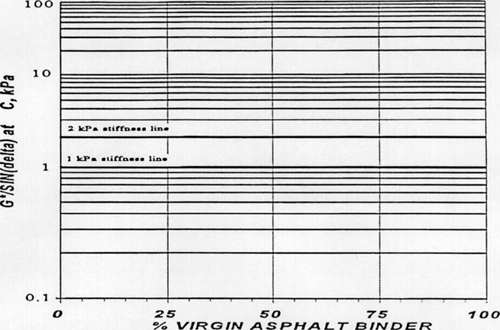
Figure 7-9. Graphical method to determine minimum and maximum amount of virgin asphalt binder in the recycled asphalt binder.(15)
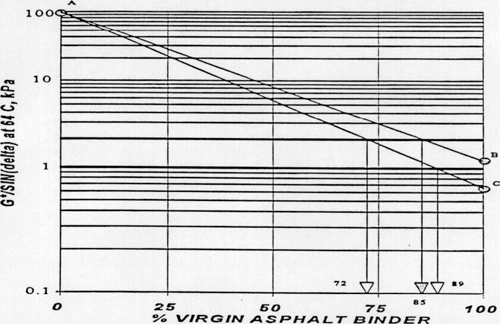
Suppose PG 64-28 was specified for a paving project. The G*/sinδ measured at 64°C of the aged and virgin asphalt binder (PG 64-28) were 100 kPa and 1.13 kPa, respectively. These values were plotted as Point A and Point B as shown in figure 7-9. The line AB intersected the 2.0 kPa stiffness line at 85 percent. Therefore, the amount of the virgin asphalt binder PG 64-28 that can be added in the recycled mix was 85 to 100 percent (or about 0 to 15 percent RAP). Suppose an asphalt binder PG 58-34 was selected as the virgin asphalt binder. The G*/sinδ as measured at 64°C for the PG 58-34 was 0.65 kPa and plotted as point C in figure 7-9. The line AC intersected the 1.0 kPa and 2.0 kPa stiffness lines at 72 percent and 89 percent, respectively. Therefore, the amount of the virgin asphalt binder PG 58-34 that can be used in the recycled mix is 72 to 89 percent (or about 11 to 28 percent RAP).
It should be noted that the low temperature grade of the selected virgin asphalt binder should always be at least one grade below the specified PG grade. For example, if the specified low temperature grade for 100 percent virgin mixtures is -28°C, then the low temperature grade of the virgin binder should be -34°C.
Note: Research is continuing at the present time (1996) to develop Superpave blending charts based on G*sinδ (fatigue factor) and low temperature properties of asphalt binder in addition to G*sinδ (rutting factor) used here.
- Trial Mix Design
Trial mix designs are made using the Superpave gyratory compactor (SGC) following the Superpave volumetric mix design procedures.(15) It may be necessary to evaluate different aggregate gradations to obtain an acceptable aggregate structure meeting the Superpave criteria. The preparation of recycled mixtures such as heating of RAP, new aggregate, and asphalt binder and mixing procedures are similar to those used in conventional recycled mix design given earlier.
- Select Job Mix Formula
The optimum asphalt content is selected based on the test data obtained in the Superpave volumetric mix design procedure (Step 5). The recycled mix must meet all criteria applicable to 100 percent virgin mixtures.
Summary
The two main steps in design of hot mix recycling are material evaluation and mix design. The materials evaluated include the RAP and the recycling agent. A random sampling plan should be devised to obtain representative samples of the RAP. The sampling plan and frequency should be decided based on historical, construction, and material data, and if needed, the pavement may be divided into different sub sections before sampling. To evaluate the RAP material, which undergoes changes with time and traffic, its gradation, asphalt content, and rheological properties of aged asphalt binder must be determined. The recycling agent should conform to the applicable AASHTO or ASTM standards. Hot recycled mix design involves the determination of the combined gradation of the aggregates and the required amount of new aggregate to meet the target gradation. Next, the amount of new (virgin) asphalt binder required in the recycled mix is estimated. Blending charts (based on viscosity or Superpave rutting factor G*/sinδ) are then used to select the grade of virgin asphalt binder. A series of trial mixes are then made with different asphalt contents. The optimum asphalt content for the recycled mix is selected based on Marshall, Hveem, or Superpave volumetric mix design procedures.
References
- J.A. Epps, D.N. Little, R.J. O'Neal, and B.M. Gallaway. Mixture Properties of Recycled Central Plant Materials, American Society for Testing and Materials (ASTM), STP 662, Philadelphia, 1977.
- Pavement Recycling Guidelines for Local Governments - Reference Manual, Report No. FHWA-TS-87-230, FHA, U.S. Department of Transportation, Washington, DC, 1987.
- Pavement Recycling Executive Summary And Report, Publication No. FHWA-SA-95060, FHA, U.S. Department of Transportation, Washington, DC, 1995.
- Asphalt Hot-Mix Recycling, The Asphalt Institute Manual Series No. 20 (MS-20), Second Edition, 1986.
- P.S. Kandhal, E.R. Brown, and S. Cross. Guidelines for Hot Mix Recycling in Georgia, Report No. FHWA-GA-89-8807, 1987.
- B.F. Kallas. Flexible Pavement Mixture Design Using Reclaimed Asphalt Concrete, Report No. FHWA/RD-84/088, Final Report, 1984.
- J.A. Epps, D.N. Little, R.J. Holmgreen, and R.L. Terrel. Guidelines for Recycling Pavement Materials, NCHRP Report No. 224, TRB, National Research Council, Washington, DC, 1980.
- Pavement Management Systems Limited. Study of Hot Mix Recycling of Asphalt Pavements, Roads and Transportation Association of Canada (RTAC), Ottawa, Ontario, 1983.
- C.F. Potts, B.E. Ruth, H.E. Schweyer, and K.H. Murphy. Asphalt Emulsion Recycling Project: Analysis and Development of Guidelines, Proceedings of the AAPT, Volume 50, 1981.
- ASTM Book of Standards, Section 4, Vol. 04.03, Road and Paving Materials, 1995.
- SHRP Asphalt Binder Test Methods: An Illustrated Overview, National Asphalt Training Center, Demonstration Project 101, Federal Highway Administration, Office of Technology Applications, Washington, DC, and Asphalt Institute Research Center, Lexington, KY, June, 1993.
- Background of Superpave Asphalt Mixture Design and Analysis, Federal Highway Administration, Report No. FHWA-SA-95-003, February, 1995.
- D. Anderson and T. Kennedy. Development of SHRP Binder Specification, Proceedings of the AAPT, Volume 62, 1993.
- T. Kennedy, J. Moulthrop, and G. Huber. Development of SHRP Mixture Specification and Design and Analysis System, Proceedings of the AAPT, Volume 62, 1993.
- P.S. Kandhal and K.Y. Foo. Hot Mix Recycling Design Using Superpave Technology, Progress of Superpave Evaluation and Implementation, ASTM STP 1322. Robert N. Jester, Ed. ASTM, 1997.
- Performance Graded Asphalt Binder Specification and Testing, Superpave Series No. 1 (SP-1), Asphalt Institute, Lexington, KY, 1994.
| << Previous | Contents | Next >> |