U.S. Department of Transportation
Federal Highway Administration
1200 New Jersey Avenue, SE
Washington, DC 20590
202-366-4000
Focus
| Accelerating Infrastructure Innovations |
Publication Number: FHWA-RD-04-020
Date: November 2003
Moving from Theory to Practice" was the theme of the Fifth National Conferences on Asset Management, which were held in Atlanta, Georgia, from September 29-30, 2003, and in Seattle, Washington, from October 21-22, 2003. The conferences each drew more than 130 participants, with attendees representing a broad spectrum of Federal, State, and local governments; universities; industry; and other private organizations.
At both conferences, State and local government speakers discussed their agencies' implementation of transportation asset management (TAM) and described the challenges they faced, along with the solutions found and the prospects for further success. TAM is a strategic approach to maximizing the benefits from resources used to operate, expand, and preserve the transportation infrastructure. The Atlanta conference featured the experiences of the Georgia, Michigan, and Pennsylvania Departments of Transportation, along with such localities as Hillsborough County, Florida, and Alcona, Kent, and Oakland counties in Michigan. The Seattle conference, meanwhile, highlighted TAM implementation by the Arizona, Michigan, and Washington State Departments of Transportation, as well as local government experiences in such places as Multnomah County, Oregon; Cole County, Missouri; and the City of Redmond, Washington. Each agency described different elements of, and strategies for, asset management implementation, including the use of analytical tools and management systems, the role of information technology, the establishment of procedures for data collection and integration, and the need for cooperation and collaboration to ensure success. "The presentations demonstrated the importance of using TAM to improve system performance and agency operations," noted David R. Geiger, Director of the Federal Highway Administration's (FHWA) Office of Asset Management.
A highlight of each conference was six interactive workshops that participants could choose from. The first workshop session focused on tools that can be used for TAM, such as life-cycle cost analysis (LCCA) and benefit-cost analysis. Panelists from FHWA described the economic concepts that underlie the trade-off analysis used in some of these tools, while representatives from Cambridge Systematics, Inc., gave an update on National Cooperative Highway Research Program (NCHRP) Project 20-57, "Analytical Tools for Asset Management," which is developing additional user-friendly TAM tools. Attendees then got to hear the real-life experiences of Oregon, Pennsylvania, and New York.
Oregon has been using its own version of FHWA's Highway Economic Requirements System (HERS) model since 1997 for Statewide transportation decisionmaking. It has proven to be a valuable transportation planning tool, such as when used to analyze different investment scenarios for an update of the State's Highway Plan. Across the country, the Pennsylvania Department of Transportation (PennDOT) has been conducting LCCA studies for all Interstate pavement projects with an estimated initial cost of more than $1 million and for all other pavement projects with an estimated cost of more than $10 million. Because of its LCCA policy, PennDOT has achieved, among other successes, improved overall performance of pavements and lower costs for new pavements and rehabilitation work. And in New York, the New York State Department of Transportation (NYSDOT) has developed a prototype TAM Tradeoff Model that uses economic tradeoff analysis to compare the dollar value of customer benefits to investment costs among competing transportation investment candidates. When the model is fully operational, NYSDOT will be able to target agency resources more productively among its pavement, bridge, safety, and mobility goal areas. More information on these State experiences can be found in a series of case studies available from FHWA's Office of Asset Management. To obtain a copy, contact FHWA at 202-366-0392.
The second workshop session looked at private sector applications of asset management, including use by General Motors and the railroad and energy industries. In workshop session three, meanwhile, FHWA provided a state-of-the-practice summary of asset management data integration among State and local agencies, and practitioners reported on their experiences in integrating different data systems to support the TAM process. For example, at the Atlanta conference, attendees heard how the South Carolina Department of Transportation evaluated a Web-based software for gathering, collating, segmenting, and distributing real-time information from multiple and disparate data sources. They also heard how the Georgia Department of Transportation developed data standards for geographic information system applications and how the Kansas Department of Transportation built an enterprise database architecture. In Seattle, presenters from the Montana, Oregon, and Washington State Departments of Transportation described their work in integrating bridge management data, developing a Web-based information portal, and establishing location referencing system and data standards, respectively.
TAM can also be used as a tool for communicating with decision makers, stakeholders, and employees, as highlighted in the fourth workshop session. For example, the Colorado Department of Transportation has used performance measures and asset management practices to communicate both internally and externally, with performance measures playing a key role in clarifying mission and purpose, aligning resources, generating feedback, focusing on results, and recognizing improvements.
|
What can HERS-ST do for you? FHWA's HERS-ST (Highway Economic Requirements System-State Version) software is an analysis tool designed to aid transportation agencies in planning and scheduling highway work, as well as determining future highway system needs. The software simulates future highway condition and performance levels and identifies deficiencies using engineering principles. The program then applies economic criteria to select the most cost-effective mix of improvements for system-wide implementation. Fourteen States are now using HERS-ST. A new version of the software will be released by the end of 2003, along with a new User's Guide and Technical Report. Over the past year, FHWA has provided free onsite briefings and workshops on HERS-ST for nine States. In 2004 that onsite assistance will be expanded to include implementation support for States seeking help in setting up and running HERS-ST. This support can include help in putting together the program input data, adjusting the software's various parameters and controls, understanding the output generated, and creating customized reports. A HERS-ST User's Group Meeting will be held at the Transportation Research Board (TRB) Annual Meeting in January 2004 in Washington, DC. The new version of the software and the updated documentation will be available at the TRB Annual Meeting. To learn more about HERS-ST, visit www.fhwa.dot.gov/infrastructure/asstmgmt/hersindex.cfm. The Web site hosts a HERS-ST community of practice, where visitors can post questions and comments. The new software and User's Guide will also be posted on the Web site upon release. For additional information, contact David Winter, HERS-ST Program Manager at FHWA, 202-366-4631 (email: david.winter@fhwa.dot.gov). |
The fifth workshop session looked at local government experiences in implementing TAM. The Atlanta conference featured case studies on the implementation of a comprehensive benefit-cost based TAM system in Hillsborough County, Florida, and the integration of pavement management systems into the decisionmaking processes of three counties of different sizes in Michigan (Alcona, Kent, and Oakland). The Seattle conference, meanwhile, covered lessons learned by the Association of Oregon Counties and Multnomah County regarding the use of TAM in Oregon. For example, the Oregon counties learned that for management systems and other TAM tools to be successful, balance must be maintained between the systems' desired features and ease of use. Another lesson learned is that users must control the data collection for the systems.
State and local governments looking for guidance on how to take the first steps in starting a TAM program found information on successful tools and techniques at the sixth workshop session. At the Atlanta conference, for example, the Florida Department of Transportation described its Turnpike Enterprise Asset Management System, which is a comprehensive Web-based system used to inventory and manage the maintenance and replacement of $3.6 billion in capital assets.
A closing plenary session at each conference looked at what agencies have learned in implementing the Governmental Accounting Standards Board's Statement 34 (GASB 34), which calls for State and local transportation agencies to include the costs of infrastructure assets in their financial statements. An NCHRP study shows that the majority of States find using the modified approach to infrastructure reporting, which involves the cost to keep assets at desired condition levels, more helpful in making finance and management decisions than using an approach that merely depreciates the value of the assets.
Plans are already underway for the Sixth National Conference, to be held in 2005. This year's conference sponsors included the Transportation Research Board (TRB), American Association of State Highway and Transportation Officials, American Public Works Association, Midwest Regional University Transportation Center (MRUTC), FHWA, National Association of County Engineers, Georgia Institute of Technology, Georgia Department of Transportation, University of Illinois-Chicago, Midwest Transportation Consortium, and the Georgia State Road and Tollway Authority.
The conference organizing committee will be issuing a series of short papers summarizing the lessons learned from the conferences, which will be featured in a session at the TRB Annual Meeting in January 2004 in Washington, DC. For more information on the conferences, contact Ernie Wittwer at MRUTC, 608-263-3175 (email: wittwer@engr.wisc.edu) or Thomas Palmerlee at TRB, 202-334-2907 (email: tpalmerlee@nas.edu).
|
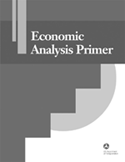
A new Economic Analysis Primer (Publication No. FHWA-IF-03-032) available from the Federal Highway Administration (FHWA) provides an introduction to the role of economic analysis in highway decisionmaking. The primer covers a range of economic issues, including such fundamental concepts as inflation and discounting, and applications of economic analysis methodology, such as life-cycle cost analysis (LCCA) and benefit-cost analysis (BCA). LCCA enables an agency to make sure the selection of a particular project design alternative to accomplish a specified objective is not based solely on the lowest initial costs, but also considers all the future costs over the project's usable life. BCA reveals whether the benefits resulting from a project justify the costs of the resources invested in it and, unlike LCCA, can be used to compare projects that differ in terms of benefits and level of service to the public. The primer also discusses economic impact analysis, which complements BCA by identifying how the direct transportation benefits and costs of a project would affect such variables as regional accessibility, jobs, tourism, land values, and economic development. A separate section on risk analysis looks at how it greatly improves the usefulness of economic analysis to decisionmakers. When used by highway agencies, all of these economic analysis tools make clearer the real-world effects of highway investments and allow agencies to target resources to their best uses. To learn more about using economic analysis in transportation decisionmaking or to obtain a printed copy of the primer, contact Eric Gabler at FHWA, 202-366-4036 (fax: 202-366-9981; email: eric.gabler@fhwa.dot. gov). The primer is available online at www.fhwa.dot.gov/infrastructure/asstmgmt/primer.htm. |





 Economic analysis is a critical component of a comprehensive project or program methodology that considers all quantitative and qualitative impacts of highway investments. Combined with planning, engineering, environmental review, and other disciplines, economic analysis can assist highway agencies in targeting limited transportation resources to their best uses. For example, it can help reveal if a planned highway project is worth undertaking, which design for the project will yield the best return, and when and how to implement the project.