Evaluation of LS-DYNA Soil Material Model 147
PDF files can be viewed with the Acrobat® Reader®
APPENDIX A. INITIAL SOIL EXPERIENCE OF USER
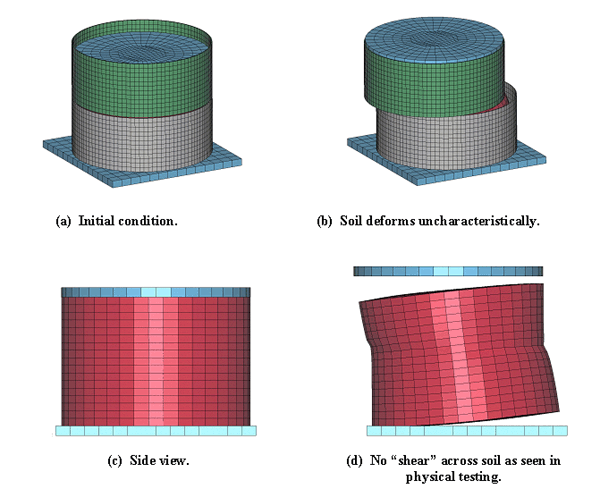
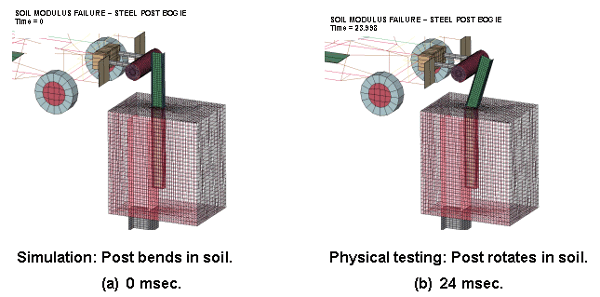
The soil material model using the Nebraska soil parameters provided by the developer do not accurately simulate the physical testing (as shown in the following figures).
Figure 24. Soil modulus failure test.
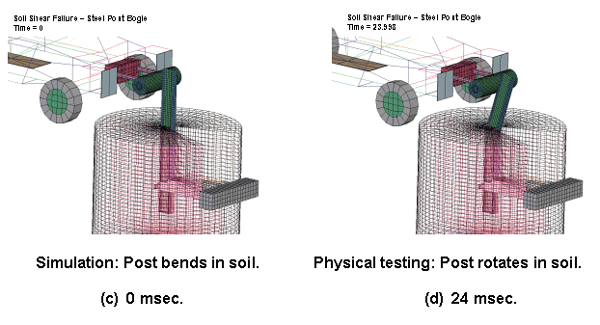
Figure 25. Soil shear failure test.
APPENDIX B. VERIFICATION OF RESULTS ON DIFFERENT COMPUTER PLATFORMS
Using different computer platforms, a comparison of three different models using the FHWA soil model in LS-DYNA is made. Results from an Intel ®-based PC (using Windows) are provided by both the developer and the user, while UNIX-based results from an SGI Octane ® (using UNIX) are provided by the user.
The user's SGI results were obtained using LS-DYNA, Version 970 Beta, Revision 1812, June 7, 2002, for an SGI Workstation IRIX64 6.5.
The developer's PC results were obtained using LS-DYNA, Version 970 Beta, Revision 1812, June 7, 2002, for a PC (Intel) Windows 2000.
Although the results are shown to be different in the latter stages of the simulations on the different computer platforms, they appear to be within an acceptable range based on previous experience with using different computers.
SINGLE ELEMENT MODELS
Two single element models were run to check the consistency between the PC (Intel)-based computers and the SGI-based computers. Specific results for each model are described below. The developer supplied only the d3plot files from these runs; thus, the comparison is limited to the information stored in those files.
The deformed geometry of the single element models appeared to be the same and, thus, are not shown.
Model hydten1: Hydrostatic Tension
The internal energy for the hydrostatic tension runs are shown in figure 26. The results are nearly identical until 35 ms. After 35 ms, the results for the SGI and PC begin to diverge. There was no discernible difference between the developer's PC and the user's PC results. The difference between the SGI and PC results after 35 ms is attributed to the significant plasticity that the element has undergone after that time. Once plasticity becomes great enough, round-off errors between the computer platforms begin to influence the results. This, however, is only conjecture.
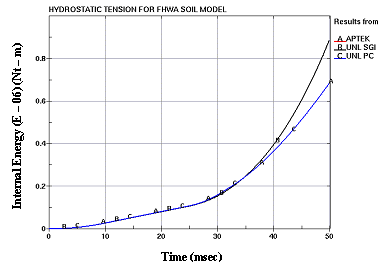
Figure 26. Hydrostatic tension: Internal energy.
Model txc3-4pr0c.k: Triaxial Compression
The internal energy and effective stress for the triaxial compression runs are shown in figures 27 and 28. The results are nearly identical, with the exception that the single element in the user's SGI run fails a few cycles before the PC runs.
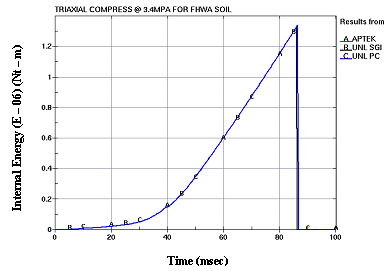
Figure 27. Triaxil compression results: Internal energy.
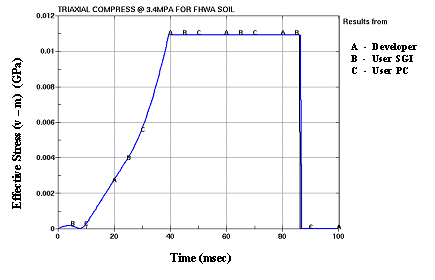
Figure 28. Triaxial compression results: Effective stress.
MULTI-ELEMENT CYLINDER: TRIAXIAL COMPRESSION TEST
This model is a multi-element cylindrical model of a triaxial compression test. The constant-stress solid element formulation is used in this model. As evidenced in figures 29 through 31, the results from the developer's computers match the results from the user's computers very well for the first 260 ms of simulation. After that time, elements begin to fail and the results start to diverge. The elements in the SGI run begin to fail and the model becomes unstable a few milliseconds before the PC results. Overall, agreement between the results appears to be acceptable.
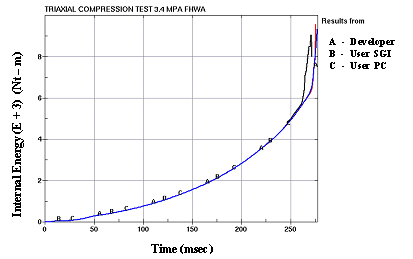
Figure 29. Internal energy.
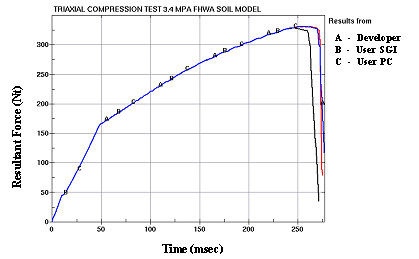
Figure 30. Cross section force through cylinder.
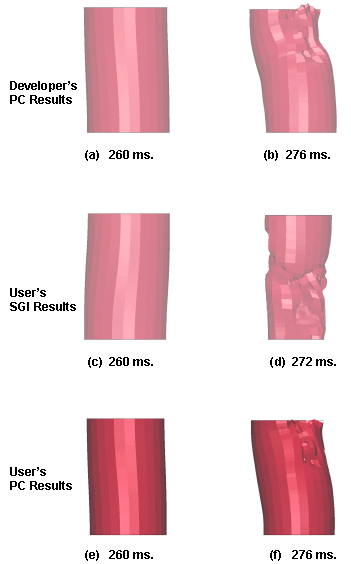
Figure 31. Deformed geometry.
REFERENCES
-
Hallquist, J.O., LS-DYNA Keyword User's Manual, Version 960, Livermore Software Technology Corporation, Livermore, CA, March 2001.
-
Lewis, B.A., Manual for LS-DYNA Soil Material Model 147, Report No. FHWA-HRT-04-095, Federal Highway Administration, November 2004.
-
Murray, Y.D., Manual for LS-DYNA Wood Material Model 143, Report No. FHWA-HRT-04-097, Federal Highway Administration, to be published in 2005
-
Murray, Y.D., and J.D. Reid, Evaluation of LS-DYNA Wood Material Model 143, Report No. FHWA-HRT-04-096, Federal Highway Administration, to be published in 2005.
-
Coon, B.A., Dynamic Testing and Simulation of Guardrail Posts in Soil, M.S. Thesis, University of Nebraska at Lincoln, 1999.
-
Coon, B.A., J.D. Reid, J.R. Rohde, and J. Herr, "A New Shear Strength Testing Device for NCHRP Report 350 Strong Soil," Transportation Research Board (TRB) Paper 01-0412, 80th Annual Meeting of the Transportation Research Board, January 2001.
-
Ross, H.E., D.E. Sicking, R.A. Zimmer, and J.D. Michie, Recommended Procedures for the Safety Performance Evaluation of Highway Features, National Cooperative Highway Research Program (NCHRP) Report No. 350, Transportation Research Board, Washington, DC, 1993.
-
Nicholson, G.A., Design of Gravity Dams and Rock Foundations: Sliding Stability Assessment by Limit Equilibrium and Selection of Shear Strength Parameters, Technical Report GL-83-13, U.S. Army Corps of Engineers Waterways Experiment Station, Vicksburg,MS, 1983.
-
U.S. Army Corps of Engineers Waterways Experiment Station, Material Properties Query (MPQ) Database, Vicksburg, MS.
-
Das, B.M., Principles of Geotechnical Engineering, Fourth Edition, PWS Publishing, Boston, MA, 1998.
-
Zeevaert, L., Free Vibration Torsion Tests to Determine the Shear Modulus of Elasticity of Soils, Universidad Nacional de México, Proceedings Third Panamerican Conference on Soil Mechanics and Foundation Engineering, Paper 1-6, Vol. I, pp. 111-129, Sociedad Venezolana de Mecánica de Suelo e Ingenieria de Fundaciones, Caracas, Venezuela, 1967.
-
Penman, A., J.A. Charles, J.K. Nash, and J.D. Humphreys, "Performance of a Culvert Under Winscar Dam," Geotechnique, Vol. 25, No. 4, 1975, pp. 713-730.
-
Trautmann, C.H., and F.H. Kulhawy, CUFAD―A Computer Program for Compress and Uplift Foundation Analysis and Design, Report EL-4540-CMM, Vol. 16, Electrical Power and Research Institute, 1987.
-
Das, B.M., Advanced Soil Mechanics, Second Edition, Taylor & Francis, Washington, DC, 1997, p. 401.
-
Fiedler, S., C. Nelson, E.F. Berkman, and A. DiMillio, "Soil Stiffness Gauge for Soil Compaction Control," Public Roads, March/April 1998.
-
Mohr, O., "Welche Umstände Bedingen die Elastizitätsgrenze und den Bruch eines Materiales? [What Conditions Affect the Yield Surface and Failure of Materials]," Zeitschrift des Vereines Deutscher Ingenieure (Journal of the Society of German Engineers), Vol. 44, 1900 pp 1524-1530 and 1572-1577.
-
Coulomb, C.A., "Essai sur une application des regles de Maximums et Minimus á quelques Problèmes de Statique, relatifs á l'Architecture [Test on an Application of Rules of Maxima and Minima for Some Problems in Statics, Relative to Architecture]," Memoires de Mathematique et de Physique, Présentés, Á l'Academie Royale des Sciences [Transactions of Mathematics and Physics, Presented at the Royal Academy of Sciences], Paris, France, Vol. 3, 1776.
-
Terzaghi, K., Theoretical Soil Mechanics, Wiley, New York, NY, 1942.
-
Heyman, J., "Coulomb's Analysis of Soil Thrust," Proceedings of the Institution of Civil Engineers, Geotechnical Engineering, Vol. 131, No. 2, April 1998, pp. 83-88.
-
Schofield, A.N., "Terzaghi's True Cohesion Error," Geotechnical News, Vol. 17, No. 4, December 1999.
-
Taylor, D.W., Fundamentals of Soil Mechanics, Wiley, New York, NY, 1948.
-
Drucker, D.C., and W. Prager, "Soil Mechanics and Plastic Analysis in Limit Design," Quarterly Applied Mathematics, Vol. 10, 1952.
-
Abbo, A.J., and S.W. Sloan, "A Smooth Hyperbolic Approximation to the Mohr-Coulomb Yield Criterion," Computers and Structures, Vol. 54, No. 1, 1995.
-
Zimmermann, T., A. Truty, A. Urbanski, S. Commend, and K. Podles, "ZSOIL.PC: A Unified Approach to Stability, Bearing Capacity, Consolidation, Creep, and Flow for Two- and Three-Dimensional Simulations in Geotechnical Practice," White Paper, ZACE Services, Ltd., Lausanne, Switzerland, 2002.
-
Klisinski, M., Degradation and Plastic Deformation of Concrete, Ph.D. Dissertation (In Polish), Polish Academy of Sciences, (Institute of Fundamental Technology Research (IFTR) Works) Report 38, 1984.
-
Klisinski, M., and Z. Mroz, "Description of Inelastic Deformation and Degradation of Concrete," International Journal of Solids and Structures, Vol. 24, No. 4, 1988, pp. 391-416.
-
Schofield, A.N., and C.P. Wroth, Critical State Soil Mechanics, McGraw Hill, London, UK, 1968.
-
LeKarp, Fredrick, U. Isacsson, and A. Dawson, "State of the Art. I: Resilient Response of Unbound Aggregates," Journal of Transportation Engineering, January/February 2000, pp. 66-75.
Previous | Table of Contents
|