



FEDERAL HIGHWAY ADMINISTRATION
FISCAL YEAR 2009 PERFORMANCE BUDGET
ADMINISTRATOR’S OVERVIEW
The FY 2009 budget request for the Federal Highway Administration (FHWA) reflects the final year of the Safe, Accountable, Flexible, Efficient Transportation Equity Act: A Legacy for Users (SAFETEA-LU) authorization. Since the enactment of SAFETEA-LU in 2005, the FHWA has implemented new programs to improve highway safety, promoted innovative solutions to reduce traffic congestion, worked with other Federal agencies and States to streamline the project approval process, enhanced program oversight and stewardship, and responded to unforeseen events such as Hurricane Katrina and the collapse of the I-35W Bridge in Minneapolis, Minnesota. As we request funding for FY 2009, the FHWA continues to strive to achieve progress in realizing the improvements to the Nation’s highway system while looking ahead to the next highway program authorization and challenges that still lie ahead.
In addition to safety, tackling congestion on our Nation’s highways remains a top priority. As demand for highway travel by Americans continues to grow, construction of new highway capacity to accommodate this growth in travel has not kept pace. Increasing highway system congestion has become a threat to our nation’s economic prosperity and quality of life. To address this problem, the FHWA is coordinating closely with the Department of Transportation to implement the National Strategy to Reduce Congestion on America’s Transportation Network (the “Congestion Initiative”). The objective of this initiative is to actually reduce congestion, not simply to slow its increase. Congestion is not an insurmountable problem, but solutions will require a smarter approach to capacity expansion and improved productivity of existing transportation assets.
FHWA has built upon the programs and authorities provided by SAFETEA-LU and is focusing on a number of high-priority efforts to help reduce congestion on the nation’s highways in support of the Congestion Initiative. These efforts include tolling and pricing, public private partnerships, real-time traveler information, traffic incident management, work zone mobility, Highways for LIFE technology, and traffic signal timing. Together, these efforts provide information that allows more informed decisions, better coordination, and quick action that help avoid and reduce traffic congestion.
Through the programs described above, SAFETEA-LU encourages the safe and efficient management and operations of integrated surface transportation systems to mitigate the impacts of traffic congestion and improve system reliability. To further build on these programs, the budget proposes $175 million to reduce congestion in metropolitan areas and along major Interstate Corridors. In addition, the budget proposes that 75% of the funds for discretionary programs will be made available for support of critical congestion relief projects. Projects that combine various road pricing, transit and technology solutions would receive priority consideration and be selected by the Department according to transparent, competitive, and merit-based criteria. These programs will help to address congestion in the short-term and will provide valuable insights for the next reauthorization.
A significant challenge as we look toward the next reauthorization of our programs is the mechanism used to finance our highway and transit programs. Action must be taken to ensure that cash balances in the Highway Account of the Highway Trust Fund remain sufficient to support highway programs. For FY 2009, the budget proposes to address a projected shortfall in the Highway Account of the Trust Fund with repayable advances from the Mass Transit Account in the event that the Highway Account cash balance is exhausted. Additional actions will be required in the longer term and will need to be considered during the next reauthorization debate.
The FHWA FY 2009 budget request supports the programs authorized in SAFETEA-LU and the Congestion Initiative in concert with other departmental initiatives as well the Agency’s top priority to make transportation safer and more secure.
Summary of FY 2009 Budget Request
The FHWA FY2009 budget totals $40.1 billion in new budgetary resources. This level includes a Federal-aid highway obligation limitation of $39.4 billion and $739 million in exempt contract authority. The obligation limitation reflects a negative adjustment of $1 billion from the base level in SAFETEA-LU in accordance with the revenue aligned budget authority (RABA) calculation, and provides the final installment to the $286.4 billion total agreement for SAFETEA-LU. This level reflects overall funding for highway, highway safety, and transit programs from FY 2004 to FY 2009 and was the level agreed to for the reauthorization of these programs when SAFETEA-LU was enacted in 2005. The request fulfills the President’s multi-year commitment without raising taxes or subsidizing transportation spending with other tax dollars. The budget also provides new flexibility to manage funds in the Highway Trust Fund so the existing tax structure can continue to support authorized funding for surface transportation programs.
Within the $40.1 billion request, the budget includes $429.8 million for research programs and a Limitation on Administrative Expenses of $394.9 million.
The request supports the Department’s goals and policy initiatives, and the Agency’s priorities of improving highway safety, minimizing project delays, reducing traffic congestion, and promoting environmental stewardship and streamlining. In FY 2009, the FHWA will continue to implement highway programs authorized in SAFETEA-LU, undertake efforts to improve financial stewardship and oversight, and carry out the President’s Management Agenda.
Performance Budget
Funding levels requested for the Federal-aid Highway Program (FAHP) provide investments in highway improvements that support the achievement of the Department’s strategic objectives.
Safety – The budget includes $9.4 billion for activities contributing to the goal to reduce transportation-related deaths and injuries. SAFETEA-LU significantly increased funding for safety programs beginning in 2006 and established several new safety programs, including the Highway Safety Improvement Program (HSIP), which is funded at approximately $1 billion annually. These increased resources will strengthen the ability of the FHWA to provide the technical assistance, training, and delivery of national safety programs requested by the States to impact the overall fatality rate, thereby improving Agency operations and saving lives.
Reduced Congestion – The budget includes $22.4 billion for activities contributing to the goals to reduce congestion and improve infrastructure in all modes. Highway funds apportioned to the States in FY 2009 will be used to increase roadway throughput by adding system capacity, and also for improvements to infrastructure on the Interstate System, rural and urban roads that are part of the NHS, bridges, and to continue the Highways for LIFE program. Research and Intelligent Transportation Systems funding will include programs to improve mobility through the development and testing of tools for integrated corridor operations and other applications. In addition, the budget proposes to redirect $175 million in unobligated balances for inactive projects authorized in the Intermodal Surface Transportation Efficiency Act (ISTEA) of 1991. The funds will be used to carry out the Department’s National Strategy to Reduce Congestion on America’s Transportation Network (the “Congestion Initiative”) and will support metropolitan area congestion reduction demonstration initiatives and the Corridors of the Future Program.
Global Connectivity – The budget includes $1.3 billion for activities contributing to the goal of more efficient movement of cargo throughout the supply chain. In FY 2009, the FHWA will continue to collaborate with State and local government agencies and the private sector to ensure more effective planning, improved data collection, modeling and analysis, and infrastructure and operational improvements. Research and ITS funds will be used to promote and facilitate a more efficient global transportation system that enables economic growth and development.
Environmental Stewardship – The budget includes $6.2 billion for activities contributing to the goals to reduce pollution and other adverse environmental effects of transportation and transportation facilities and to streamline environmental review of transportation infrastructure projects. Within this amount, $1.8 billion is requested for the Congestion Mitigation and Air Quality (CMAQ) Improvement program to help States make improvements in air quality. In addition, NHS, STP, Research, and ITS funds will be used to support projects that reduce the social and environmental impact of system infrastructure improvements.
Security – The budget includes $365.8 million for activities contributing to the goal of rapid recovery of transportation in all modes from intentional harm and natural disasters. FAHP funds will be used to support the projects and initiatives identified in State and local security plans, such as increased bridge surveillance, retrofit of existing facilities, or the enhancement of new facilities to meet current and future security needs.
Organizational Excellence – The budget reflects $496.3 million for activities contributing to the goal to achieve strategic management of human capital, competitive sourcing goals, financial performance goals, budget and performance integration goals, and e-government goals. A Limitation on Administrative Expenses (LAE) of $394.9 million is requested for FY2009 for the necessary salaries and benefits of 2,313 full-time equivalents (FTE) and on-going administrative expenses in support of the above Federal programs.
The FHWA’s FY 2009 budget submission is presented as a performance-based budget that is aligned with the Department of Transportation’s Strategic Plan, 2006-2011. Sections 2 and 3 of the submission display budget information by appropriations account, and Section 4 displays budget information by performance category and program activities. The integrated performance plan and budget reflects how resources impact the FHWA’s outcome goals and provides benefits for the people and goods traveling on the Nation’s highways.
The chart that follows illustrates the allocation of FY 2009 FHWA funds by strategic goal.
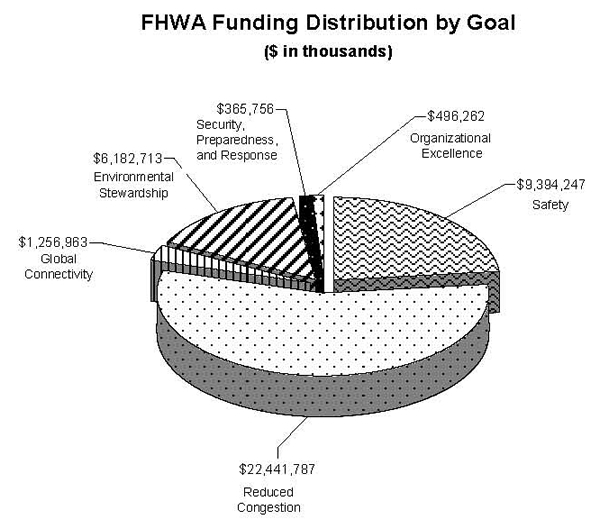
EXHIBIT I
FEDERAL HIGHWAY ADMINISTRATION ORGANIZATION CHART with AUTHORIZED FTP POSITIONS FY 2009

