




Introduction to SPMT Bridge Moves
Keep America Moving During Bridge Construction
Jugesh Kapur, P.E.
Bridge Design Engineer
Washington State DOT
SPMT - Self-Propelled Modular Transporters
Keep America Moving During Bridge Construction
AASHTO TIG SPMT Bridge Moves Lead States Team 2008
NHI Webinar
June 26, 2008
"Get in, do it right, get out, and stay out."
...has become a rallying cry for new technologies that accelerate construction, minimize negative impacts on motorists, and improve worker and motorist safety.
SPMT technology = ultimate flexibility and speed
The Federal Highway Administration (FHWA) has identified reducing construction related impacts to the traveling public as a major priority for the nation's highway program.
The use of self-propelled modular transporter (SPMT) technology provides agencies and contractors with the ultimate flexibility and speed in removing and installing bridge structures.
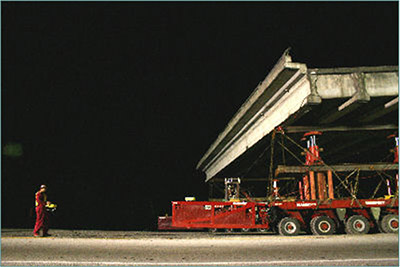
Rolling whole bridges spans in or out of place by remote control using SPMT's have many highway applications.
What is an SPMT?
- a combination of multi-axle platforms
- computer-operated
- pivots 360 degrees
- lifts, carries, sets large/heavy loads
- moves at walking speed
A Self-Propelled Modular Transporter is a combination of multi-axle platforms operated through a state-of-the-art computer-controlled system that is capable of pivoting 360 degrees as needed to lift, carry, and set very large and heavy loads of many types.
SPMTs are motorized vehicles that move at walking speed and are capable of carrying large structures, such as bridges, from offsite locations, positioning them precisely into final position.
The SPMT then exits the site, returning the area to traffic use within minutes or hours.
Why SPMT? Why Now?
- Significantly Reduce Traffic Disruption
SPMTs allow workers to remove or place whole bridge structures on busy roadways in just minutes or hours.
Most of the complex - and often hazardous - work of building or removing structures in the path of existing traffic occurs offsite.
Roadway interruptions occur only in the very brief windows of time in which a structure is being positioned for installation or carried offsite for demolition.
Why SPMT? Why Now?
- Significantly Reduce Traffic Disruption
- Open Highways To Traffic In Hours
During conventional bridge construction, traffic that travels under the bridge is typically restricted during certain types of activity to protect motorist and worker safety.
SPMTs can greatly reduce the duration of such interruptions.
Why SPMT? Why Now?
- Significantly Reduce Traffic Disruption
- Open Highways To Traffic In Hours
- Improve Work Zone Safety
SPMT technology allows the prefabrication of structures in offsite staging areas, where construction crews can perform most of their work away from traffic.
This improves the safety of the work environment and reduces the exposure of motorists to roadway work zone hazards.
Significant worker safety benefits are also derived from the ability to work during the day without interruptions and near ground level throughout the construction process.
Why SPMT? Why Now?
- Significantly Reduce Traffic Disruption
- Open Highways To Traffic In Hours
- Improve Work Zone Safety
- Improve Quality and Constructability
Since SPMTs allow bridges to be built in the controlled environment of an off-road site, the focus remains solely on construction rather than the need to accommodate traffic.
In this environment the more uniform production capability with adequate time for proper concrete curing leads to consistent overall quality and constructability of the finished product.
Why SPMT? Why Now?
- Significantly Reduce Traffic Disruption
- Open Highways To Traffic In Hours
- Improve Work Zone Safety
- Improve Quality and Constructability
- Increase Contractor and Owner Options
SPMT technology are very versatile. They can be linked together to carry varying loads and can traverse rough terrain. Lifting the structure from below and "driving" it into (or out of) place eliminates many issues related to overhead height restrictions that impact crane lifting operations, while the supported SPMT loads provide added safety assurance relative to suspended crane loads.
Offsite staging allows the contractor to work in daylight and extend work hours as needed in a safer environment. For example, onsite foundation and substructure work can occur simultaneously with superstructure fabrication, saving significant construction time. The benefits of onsite construction speed can be further increased by driving in multi-span bridges complete with substructures.
Examples of Project and User Cost Savings
- less maintenance-of-traffic
- possibility of less night work
- reduced construction time
- reduced onsite time for engineering and inspection requirements
The cost of mobilizing SPMT technology is offset by significant project savings that may include:
- fewer and shorter maintenance-of-traffic setups
- shorter hours for law enforcement officers due to fewer rolling roadblocks
- time savings from fewer shift changes for construction crews
- the elimination of temporary-detour construction and repair of long-term detours on existing roads
Examples of Project and User Cost Savings
- reduction in construction-related user costs
- lower contractor insurance premiums
- reduced labor costs (water projects)
Additional project and cost savings include:
- the use of smaller owner and contractor crews
- reduced onsite time required for owner agency engineering and inspection requirements due to accelerated construction
- a vast reduction in the myriad user costs associated with construction-related delay, detour, and congestion
- less maintenance and repair costs associated with better long-term performance of the prefabricated structure.
| Conventional Bridge Construction | ||
|---|---|---|
| Work Operation | Duration; | Traffic Control Method |
| Bridge Demolition | Duration | Detour |
| Beam Placement | 25-90 minutes per beam | Rolling roadblocks or detour |
| Form Placement | Varies | Lane shifts/ closure |
| Deck Concrete Placement | 1-2 days per span | Lane shifts/ closure |
| SPMT | ||
|---|---|---|
| Complete Span Removal or Placement | 25 minutes to a few hours | Detour or Single Rolling roadblock |
SPMT technology can reduce traffic impacts from months to minutes or a few hours. For safety reasons conventional construction techniques require lane shifts or total closure of the underlying road during certain work operations. Typical items of work include girder placement, form placement, deck casting and bridge removal. The contractors work times are typically restricted to off-peak traffic, thus affect production efficiencies. For wide bridges with many beam lines, the number of rolling road block impacts to traffic can be quite large.
How do I learn more?
https://www.fhwa.dot.gov/bridge/prefab/
For additional resources on the use of SPMTs to remove and install bridges, visit:
http://www.aashtotig.org/
https://www.fhwa.dot.gov/bridge/prefab/
There you'll find everything from technical drawings and specifications, to a copy of this presentation, to news clippings on successful SPMT projects.
Thank you very much. I'm happy to answer any questions