




| << Previous | Contents | Next >> |
Geotechnical Aspects of Pavements Reference Manual
Chapter 3.0 Geotechnical Issues In Pavement Design And Performance
3.1 Introduction
Satisfactory pavement performance depends upon the proper design and functioning of all of the key components of the pavement system. These include:
- A wearing surface that provides sufficient smoothness, friction resistance, and sealing or drainage of surface water (i.e., to minimize hydroplaning).
- Bound structural layers (i.e., asphalt or Portland cement concrete) that provide sufficient load-carrying capacity, as well as barriers to water intrusion into the underlying unbound materials.
- Unbound base and subbase layers that provide additional strength - especially for flexible pavement systems - and that are resistant to moisture-induced deterioration (including swelling and freeze/thaw) and other degradation (e.g., erodibility, intrusion of fines).
- A subgrade that provides a uniform and sufficiently stiff, strong, and stable foundation for the overlying layers.
- Drainage systems that quickly remove water from the pavement system before the water degrades the properties of the unbound layers and subgrade.
- Remedial measures, in some cases, such as soil improvement/stabilization or geosynthetics to increase strength, stiffness, and/or drainage characteristics of various layers or to provide separation between layers (e.g., to prevent fines contamination).
Traditionally, these design issues are divided among many groups within an agency. The geotechnical group is typically responsible for characterizing the foundation characteristics of the subgrade. The materials group may be responsible for designing a suitable asphalt or Portland cement concrete mix and unbound aggregate blend for use as base course. The pavement group may be responsible for the structural ("thickness") design. The construction group may be responsible for ensuring that the pavement structure is constructed as designed. Nonetheless, the overall success of the design - i.e., the satisfactory performance of the pavement over its design life - is the holistic consequence of the proper design of all of these key components.
Keeping this holistic view in mind, this chapter builds upon the introduction from Chapter 1 and expands upon the major geotechnical considerations in pavement design (i.e., the factors influencing items 3-6 above). The emphasis is on the "big picture," on identifying the key geotechnical issues and describing their potential impact on the pavement design and performance. Most of the issues introduced here are elaborated in subsequent chapters, and forward references to these later sections are given as appropriate. A brief history of the AASHTO highway pavement design techniques is also included to illustrate how geotechnical design considerations have grown in importance and prominence over time.
3.2 Basic Concepts
Pavements are layered systems designed to meet the following objectives:
- to provide a strong structure to support the applied traffic loads (structural capacity).
- to provide a smooth wearing surface (ride quality).
- to provide a skid-resistant wearing surface (safety).
Additionally, the system must have sufficient durability so that it does not deteriorate prematurely due to environmental influences (water, oxidation, temperature effects).
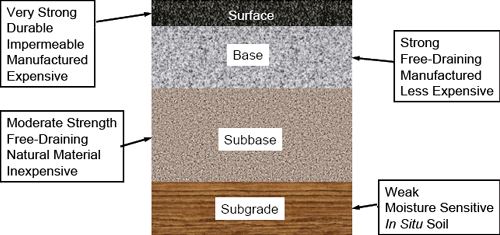
The unbound soil layers in a pavement provide a substantial part of the overall structural capacity of the system, especially for flexible pavements (often more than 50 percent). As shown in Figure 3-1, the stresses induced in a pavement system by traffic loads are highest in the upper layers and diminish with depth. Consequently, higher quality - and generally more expensive - materials are used in the more highly stressed upper layers of all pavement systems, and lower quality and less expensive materials are used for the deeper layers of the pavement (Figure 3-2). This optimization of material usage minimizes construction costs and maximizes the ability to use locally available materials. However, this approach also requires greater attention to the lower quality layers in the design (i.e., the subgrade) in order to reduce life-cycle pavement costs. Good long-term performance of lower layers means that upper layers can be maintained (rehabilitated) while avoiding the more costly total reconstruction typically associated with foundation failures.
Figure 3-1. Attenuation of load-induced stresses with depth.
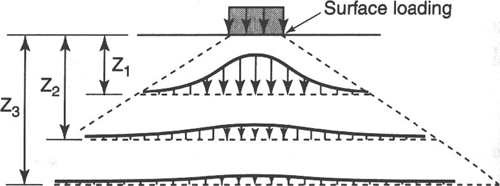
Figure 3-2. Variation of material quality with depth in a pavement system with ideal drainage characteristics.
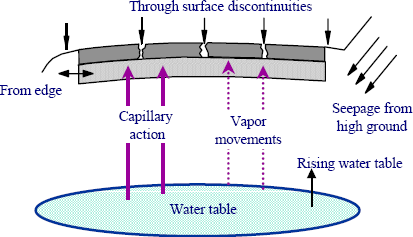
As is the case for all geotechnical structures, pavements will be strongly influenced by moisture and other environmental factors. Water migrates into the pavement structure through combinations of surface infiltration (e.g., through cracks in the surface layer), edge inflows (e.g., from inadequately drained side ditches or inadequate shoulders), and from the underlying groundwater table (e.g., via capillary potential in fine-grained foundation soils). In cold environments, the moisture may undergo seasonal freeze/thaw cycles. Moisture within the pavement system nearly always has detrimental effects on pavement performance. It reduces the strength and stiffness of the unbound pavement materials, promotes contamination of coarse granular material due to fines migration, and can cause swelling (e.g., frost heave and/or soil expansion) and subsequent consolidation. Moisture can also introduce substantial spatial variability in the pavement properties and performance, which can be manifested either as local distresses, like potholes, or more globally as excessive roughness. The design of the geotechnical aspects of pavements must consequently focus on the selection of moisture-insensitive free-draining base and subbase materials, stabilization of moisture-sensitive subgrade soils, and adequate drainage of any water that does infiltrate into the pavement system. Material selection and characterization is described more fully later in Chapter 5, and pavement drainage design is covered in Chapter 7.
3.3 Key Geotechnical Issues
The geotechnical issues in pavement design can be organized into two categories: (1) general issues that set the entire tone for the design - e.g., new versus rehabilitation design; and (2) specific technical issues - e.g., subgrade stiffness and strength determination. The geotechnical considerations in each of these categories are briefly introduced in the following subsections. Again, the intent here is to provide an overview of the broad range of geotechnical issues in pavement design. More detailed treatment of each of these issues will be provided in subsequent chapters.
3.3.1 General Issues
New Construction vs. Rehabilitation vs. Reconstruction
The first issue to be confronted in any pavement design is whether the project involves new construction, rehabilitation, or reconstruction. As defined in Chapter 1, new construction is the construction of a pavement system on a new alignment that has not been previously constructed. Rehabilitation is defined as the repair and upgrading of an existing in-service pavement. Typically, this involves repair/removal and construction of additional bound pavement layers (e.g., asphalt concrete overlays) and could include partial-depth or full-depth recycling or reclamation. Reconstruction is defined as the complete removal of an existing pavement system, typically down to and including the upper portions of the foundation soil, and the replacement with a new pavement structure. New construction has been the traditional focus of most pavement design procedures, although this focus has shifted to rehabilitation and reconstruction over recent years, as highway agencies have switched from system expansion to system maintenance and preservation.
New construction vs. rehabilitation vs. reconstruction has a significant impact on several key geotechnical aspects of pavement design. As described more fully in Chapter 4, new construction typically requires substantial "conventional" site characterization work - e.g., examination of geological and soil maps, boring programs, laboratory testing of borehole samples, geophysical subsurface exploration, etc. Little will be known in advance of the soil profiles and properties along the new alignment, so a comparatively comprehensive subsurface exploration and material characterization program is required. Exploration also usually involves evaluation of both cut and fill conditions along the alignment. Access is often limited due to adverse terrain conditions.
For rehabilitation projects, on the other hand, original design documents and as-built construction records are often available to provide substantial background information about the subsurface conditions along the project alignment. The material properties (e.g., subbase stiffness) determined during the initial design may no longer be relevant (e.g., because of contamination from subgrade fines), so new tests may be required, either from laboratory tests on samples extracted from borings through the existing pavement or from in-situ tests like the Dynamic Cone Penetrometer (DCP-see Chapter 4), again via boreholes through the existing pavement structure. Nondestructive evaluation via falling weight deflectometers (FWD-see Chapter 4) is very commonly used to determine in-place material properties for rehabilitation design. Forensic evaluation of the distresses in the existing pavement can also help identify deficiencies in the underlying unbound layers. However, since the underlying unbound layers are not exposed or removed in typical rehabilitation projects, any deficiencies in these layers must be compensated by increased structural capacity, etc., in the added surface layers.
Original design documents and as-built construction records are also often available for reconstruction projects. Information on the original subsurface profile will generally remain relevant for the reconstruction design. However, detailed material characterization from the original design documents will generally not be useful, since the original pavement materials down to and often including the upper portion of the foundation are completely removed and replaced during reconstruction. Although direct testing of the newly exposed foundation soil is theoretically possible in reconstruction projects, this will occur only once construction has begun and, thus, will be too late for design purposes. Consequently, foundation soil properties for reconstruction projects must typically be determined from original design records, borehole sampling and testing, and FWD testing, similar to rehabilitation design. The characterization of the new or recycled unbound subbase and base materials in reconstruction projects will typically be performed via laboratory tests, similar to new construction design.
The influence of new construction vs. rehabilitation vs. reconstruction on site characterization and subsurface exploration is described in detail in Chapter 4. The different methods for characterizing the geotechnical materials in these different types of projects are detailed in Chapter 5.
Natural Subgrade vs. Cut vs. Fill
Pavement construction on a natural subgrade is the classic "textbook" case for pavement design. The subsurface profile (including depth to bedrock and groundwater table) are determined directly from the subsurface exploration program, and subgrade properties needed for the design can be taken from tests on the natural foundation soil in its in-situ condition and in its compacted state, if the upper foundation layer is to be processed and recompacted or removed and replaced during construction. This issue is discussed in greater detail in Chapter 4.
However, the alignment for most highway projects does not always follow the site topography, and consequently a variety of cuts and fills will be required. The geotechnical design of the pavement will involve additional special considerations in cut and fill areas. Attention must also be given to transition zones - e.g., between a cut and an at-grade section - because of the potential for nonuniform pavement support and subsurface water flow.
The main additional concern for cut sections is drainage, as the surrounding site will be sloping toward the pavement structure and the groundwater table will generally be closer to the bottom of the pavement section in cuts. Stabilization of moisture-sensitive natural foundation soils may also be required. Stability of the cut slopes adjacent to the pavement will also be an important design issue, but one that is typically treated separately from the pavement design itself.
The embankments for fill sections are constructed from well compacted material, and, in many cases, this results in a subgrade that is of higher quality than the natural foundation soil. Drainage and groundwater issues will, in general, be less critical for pavements on embankments, although erosion of side slopes from pavement runoff may be a problem, along with long-term infiltration of water. The principal additional concerns for pavements in fill sections will be the stability of the embankment slopes and settlements, either due to compression of the embankment itself or due to consolidation of soft foundation soils beneath the embankment (again, usually evaluated by the geotechnical unit as part of the roadway embankment design).
Information on soil slope and embankment design can be found in the reference manual for FHWA NHI 132033 (FHWA NHI-01-028). Reinforced slope design (often an alternative where steep embankment slopes are required) is addressed in the reference manual for FHWA NHI 132042 (FHWA NHI-00-043). Rock slope design is covered in the FHWA NHI 132035 reference manual (FHWA NHI-99-007).
Environmental Effects
Environmental conditions have a significant effect on the performance of both flexible and rigid pavements. Specifically, moisture and temperature are the two environmentally driven variables that can significantly affect the pavement layer and subgrade properties and, thus, the performance of the pavement. Some of the effects of environment on pavement materials include the following:
- Asphalt bound materials exhibit varying modulus values depending on temperature. Modulus values can vary from 2 to 3 million psi (14,000 to 20,000 MPa) or more during cold winter months to about 100,000 psi (700 MPa) or less during hot summer months.
- Although cementitious material properties like flexural strength and modulus are not significantly affected by normal temperature changes, temperature and moisture gradients can induce significant stresses and deflections-and consequently pavement damage and distresses-in rigid pavement slabs.
- At freezing temperatures, water in soil freezes and the resilient modulus of unbound pavement materials can rise to values 20 to 120 times higher than the values before freezing.
- The freezing process may be accompanied by the formation and subsequent thawing of ice lenses. This creates zones of greatly reduced strength in the pavement structure.
- The top down thawing in spring traps water above the still frozen zone; this can greatly reduce strength of geomaterials.
- All other conditions being equal, the stiffness of unbound materials decreases as moisture content increases. Moisture has two separate effects:
- First, it can affect the state of stress through suction or pore water pressure. Coarse grained and fine-grained materials can exhibit more than a fivefold increase in modulus as they dry. The moduli of cohesive soils are affected by complex clay-water-electrolyte interactions.
- Second, it can affect the structure of the soil through destruction of the cementation between soil particles.
- Bound materials are not directly affected by the presence of moisture. However, excessive moisture can lead to stripping in asphalt mixtures or can have long-term effects on the structural integrity of cement bound materials.
- Cement bound materials may also be damaged during freeze-thaw and wet-dry cycles, which causes reduced modulus and increased deflections.
All pavement distresses are affected by environmental factors to some degree. However, it is often very difficult to include these effects in pavement design procedures.
3.3.2 Specific Issues
Material Types and Properties
The major material types encountered in pavement systems are listed in Table 3-1. The geotechnical materials that are the focus of this manual include non-stabilized granular base/subbase materials (including recycled materials), nonstabilized subgrade soils, mechanically and chemically stabilized subgrade soils, and bedrock groups.
|
Asphalt Materials
PCC Materials
Cementitiously Stabilized Materials
|
Non-Stabilized Granular Base/Subbase
Subgrade Soils
Bedrock
|
The material properties of interest in pavement design can be organized into the following categories:
- Physical properties (e.g., soil classification, density, water content)
- Stiffness and/or strength (e.g., resilient modulus, modulus of subgrade reaction, CBR)
- Thermo-hydraulic properties (e.g., drainage coefficients, permeability, coefficient of thermal expansion)
- Performance-related properties (e.g., repeated load permanent deformation characteristics)
Details of the procedures for determining the geotechnical properties required for pavement design are given in Chapter 5. Note that not all material properties will be equally important in terms of their impact on pavement design and performance, and not all properties are required in all pavement design procedures. Stiffness, usually quantified in terms of the resilient modulus (see Chapter 5), is the most important geotechnical property in pavement design and is incorporated explicitly in most current pavement design procedures (e.g., the 1993 AASHTO Pavement Design Guide). Newer mechanistic-empirical design procedures, such as developed in the recently-completed NCHRP Project 1-37A, require more information regarding material properties, particularly in relation to thermo-hydraulic behavior and performance.
Bedrock is worth a brief special mention here because its presence at shallow depths beneath the pavement structure may have a significant impact on pavement construction (Chapter 8), design (Chapters 5 and 6), and performance (Chapter 6). While the precise measurement of bedrock properties like stiffness is seldom if ever warranted, the effect of shallow (less than 3 m (10 ft) depth) bedrock on pavement analyses must be considered. This is especially true for FWD backcalculation procedures used to estimate in-situ material stiffnesses in rehabilitation design (see Chapter 4).
Drainage
As early as 1820, John McAdam noted that, regardless of the thickness of the structure, many roads in Great Britain deteriorated rapidly when the subgrade was saturated:
"The roads can never be rendered thus perfectly secure until the following principles be fully understood, admitted and acted upon: namely, that it is the native soil which really supports the weight of traffic: that while it is preserved in a dry state, it will carry any weight without sinking, and that it does in fact carry the road and the carriages also; that this native soil must previously be made quite dry, and a covering impenetrable to rain must then be placed over it, to preserve it in that dry state; that the thickness of a road should only be regulated by the quantity of material necessary to form such impervious covering, and never by any reference to its own power of carrying weight.
The erroneous opinion so long acted upon and so tenaciously adhered to, that by placing a large quantity of stone under the roads, a remedy will be found for the sinking into wet clay, or other soft soils, or in other words, that a road may be made sufficiently strong artificially, to carry heavy carriages, though the subsoil be in a wet state, and by such means to avert the inconveniences of the natural soil receiving water from rain or other causes, has produced most of the defects of the roads of Great Britain." (McAdam, 1820)
It is widely recognized today that excess moisture in pavement layers, when combined with heavy traffic and moisture-susceptible materials, can reduce service life. Freezing of this moisture often causes additional performance deterioration.
Moisture in the subgrade and pavement structure can come from many different sources (Figure 3-3). Water may seep upward from a high groundwater table, or it may flow laterally from the pavement edges and shoulder ditches. However, the most significant source of excess water in pavements is typically infiltration through the surface. Joints, cracks, shoulder edges, and various other defects in the surface provide easy access paths for water.
Figure 3-3. Sources of moisture in pavement systems (NHI 13126).
A major objective in pavement design is to prevent the base, subbase, subgrade, and other susceptible paving materials from becoming saturated or even exposed to constant high moisture levels in order to minimize moisture-related problems. The three main approaches for controlling or reducing moisture problems follow below:
- Prevent moisture from entering the pavement system. Techniques for preventing moisture from entering the pavement include providing adequate cross slopes and longitudinal slopes for rapid surface water runoff and sealing all cracks, joints, and other discontinuities to minimize surface water infiltration.
- Use materials and design features that are insensitive to the effects of moisture. Materials that are relatively insensitive to moisture effects include granular materials with few fines, cement-stabilized and lean concrete bases, and asphalt stabilized base materials1. Appropriate design features for rigid pavements include dowel bars and widened slabs to reduce faulting and inclusion of a subbase between the base and subgrade to reduce erosion and promote bottom drainage. Design features for flexible pavements include full width paving to eliminate longitudinal joints, asphalt stabilized base layers, and use of a subbase to reduce erosion and promote drainage.
- Quickly remove moisture that enters the pavement system. A variety of different drainage features are available for removing excess moisture. Features such as underdrains and ditches are designed to permanently lower the water table under the pavement, whereas other features, such as permeable bases and edge drains, are designed to remove surface infiltration water.
Pavement drainage design is described in more detail in Chapter 7. Additional detail can be found in Christopher and McGuffey (1997) and in the reference manual for FHWA NHI Course 131026 Pavement Subsurface Drainage Design.
Special Conditions
Special problem soil conditions include frost heave, swelling or expansive soils, and collapsible soils.
Freeze/thaw: The major effect is the weakening that occurs during the spring thaw period. Frost heave during the winter can also cause a severe reduction in pavement serviceability (increased roughness). The requirements for freeze/thaw conditions are (a) a frost-susceptible soil; (b) freezing temperatures; and (c) availability of water.
Swelling or expansive soils: Swelling refers to the localized volume changes in expansive roadbed soils as they absorb moisture. It is estimated that the damage to pavements caused by expansive soils is well over $1 billion each year.
Collapsible soils: Collapsible soils have metastable structures that exhibit large volume decreases when saturated. Silty loess deposits are the most common type of collapsible soil. Native subgrades of collapsible soils must be soaked with water prior to construction and rolled with heavy compaction equipment. If highway embankments are to be constructed over collapsible soils, special remedial measures may be required to prevent large-scale cracking and differential settlement.
Identification of potential problem soils is a primary objective of the pavement geotechnical design. Design approaches and mitigation measures for these special conditions are detailed in Chapter 7.
Soil Improvement
The natural soils at a project site are often unsuitable for use in the pavement structure. They may have inappropriate gradation, inadequate strength and/or stiffness, or insufficient stability against swelling. Some of these deficiencies can be addressed by blending two or more soils and/or providing adequate mechanical stabilization (compaction). Other deficiencies, particularly for subgrades, may require the mixing of stabilizing admixtures such as bituminous binders or lime, Portland cement, or other pozzolanic materials with the natural soil. Although the primary purpose of these admixtures is usually to improve the strength and stiffness of the soil, they can also be used to improve workability, reduce swelling, and provide a suitable construction platform. Geosynthetic products can also be used as soil reinforcement and as filter and drainage layers.
In extreme soft soil conditions, special ground improvement techniques may be required, such as wick drains, piled embankments, surcharge, lightweight fill (e.g., geofoam), etc. These techniques are typically evaluated by the geotechnical unit as part of the roadway design. The methods are discussed briefly in Chapter 7.
A summary of the stabilization methods most commonly used in pavements, the types of soils for which they are most appropriate, and their intended effects on soil properties is provided in Table 3-2. Design inputs for improved soils will be covered in Chapter 5 and details for selection and implementation of treatment techniques for specific problems will be covered in Chapter 7. Compaction, one of the key geotechnical issues in pavement design and construction, is covered in Chapter 5 (determination of design inputs) and Chapter 8 (construction issues).
| Method | Soil | Effect | Remarks |
|---|---|---|---|
| Blending | Moderately plastic | None | Too difficult to mix |
| Others | Improve gradation | ||
| Reduce plasticity | |||
| Reduce breakage | |||
| Lime | Plastic | Drying | Rapid |
| Immediate strength gain | Rapid | ||
| Reduce plasticity | Rapid | ||
| Coarsen texture | Rapid | ||
| Long-term pozzolanic cementing | Slow | ||
| Coarse with fines | Same as with plastic soils | Dependent on quantity of plastic fines | |
| Nonplastic | None | ||
| Cement | Plastic | Similar to lime | Less pronounced |
| Cementing of grains | Hydration of cement | ||
| Coarse | Cementing of grains | Hydration of cement | |
| Bituminous | Coarse | Strengthen/bind, waterproof | Asphalt cement or liquid asphalt |
| Some fines | Same as coarse | Liquid asphalt | |
| Fine | None | Can't mix | |
| Pozzolanic and slags | Silts and coarse | Acts as a filler | Denser and stronger |
| Cementing of grains | Slower than cement | ||
| Misc. methods | Variable | Variable | Depends on mechanism |
3.4 Sensitivity Of Pavement Design To Geotechnical Factors
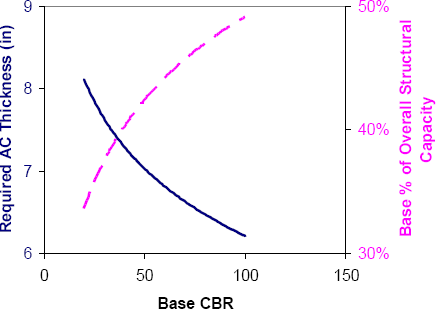
While the most significant layer for pavement performance is the surface course, the geotechnical layers are intimately intertwined in the pavement design. For example, the stiffness or strength of the subgrade soil is a direct input to most pavement design procedures, and its impact on the structural design can thus be evaluated quantitatively. Figure 3-4 shows the influence of the subgrade California Bearing Ratio (CBR-see Chapter 5) on the required thickness and structural capacity contribution for the unbound granular base layer in a flexible pavement designed according to the 1993 AASHTO procedures (see Section 3.5.2). The contribution of the granular base to the overall structural capacity varies from 50% for a low subgrade CBR value of 2 to essentially zero at a high CBR value of 50. The influence of base layer quality on the pavement structural design is similarly shown in Figure 3-5. Additional examples of the sensitivity of pavement design to various geotechnical factors are provided in Chapter 5.
Figure 3-4. Impact of subgrade strength on pavement structural design (AASHTO 93 Design Guide: W18=10M, 85% reliability, So=0.4, ΔPSI=1.7, a1=0.44, a2=0.14, m2=1).
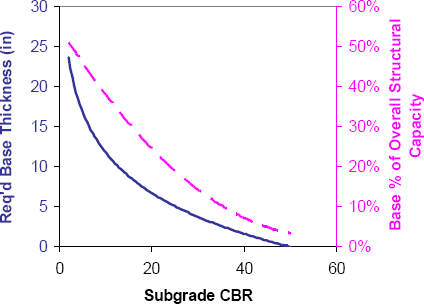
Figure 3-5. Impact of base strength on pavement structural design (AASHTO 93 Design Guide: W18=10M, 85% reliability, So=0.4, ΔPSI=1.7, a1=0.44, m2=1, subgrade CBR=4).
A good indicator of the overall sensitivity of pavement design to geotechnical inputs. is the impact of subgrade support on the cost of the pavement, as shown in Figure 3-6. For example, at a traffic loading of 10 million ESALs and a subgrade CBR of 8, the cost per 1000 square yards (850 m2) of surface area is approximately $9,800 for the asphalt layer and $3,000 dollars for the underlying base and granular borrow, for a total pavement cost of $12,800 per 1000 square yards of surface area. If the subgrade CBR value were only 4, the same area of pavement section would cost $15,600, or more than 20% more.
Figure 3-6. Approximate pavement cost for varying subgrade support conditions (B.Vandre, personal communication).
Click here for text version of image
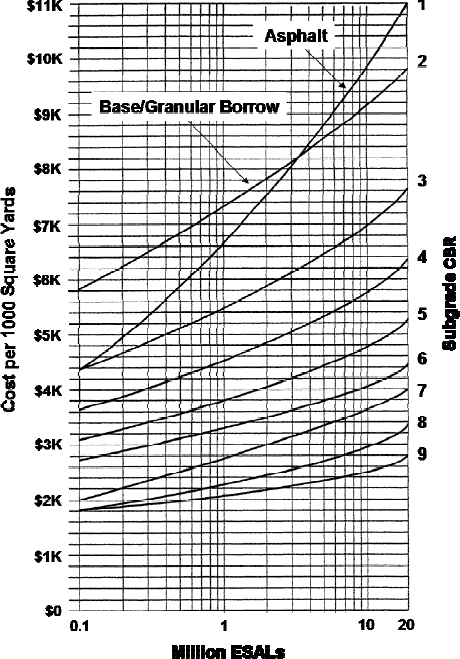
Notes:
- Assumed unit costs are: asphalt - $1.25/inch thickness; untreated base - $0.30/inch thickness; granular borrow - $0.20/inch thickness.
- Thicknesses used in cost estimating are based on 90% reliability.
- Minimum granular borrow or base thickness is 6 in.
- Thickness/cost of asphalt only varies with ESALs because base support value is constant.
- Units: 1 inch = 25 mm; 1 yd2 = 0.85 m2.
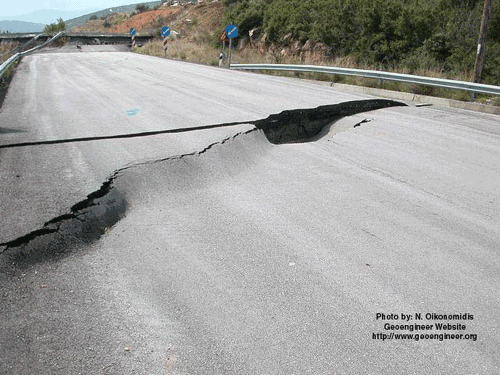
It is also important to recognize at the outset that while many of the geotechnical factors influencing pavement performance can be incorporated explicitly in the design process, other important considerations can not. For example, the potential for a slope failure beneath a pavement constructed on a side hill cut is not generally considered as part of "pavement design," even though such a failure can be much more devastating to the pavement than inadequate subgrade stiffness (see Figure 3-7).
Figure 3-7. Slope failure beneath road pavement (http://www.geoengineer.com/).
Notes
- Moisture-induced stripping of asphalt stabilized materials may be a problem for some aggregates and some asphalt cements. Return to Text
| << Previous | Contents | Next >> |