
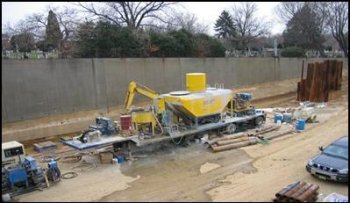
Construction noise must be considered as part of the development of any transportation facility. Roadway construction is often conducted in close proximity to residences and businesses and should be controlled and monitored in order to avoid excessive noise impacts. In addition to community issues, excessive noise can threaten a construction project's schedule. In general, a project's schedule can be maintained by balancing the type, time of day and duration of construction activities; adhering to local noise control requirements; and being proactive to community concerns.
To aid in this process, FHWA has developed a construction noise screening tool (RCNM 1.1) and a construction noise model that is included in all versions of the Traffic Noise Model (TNM) following version 3.2. Neither software is required for use on Federal-aid projects; however, they can be used for the prediction of construction noise during the project development, final design, and construction phases.
Construction noise related to transportation projects is typically addressed in the project's noise analysis report and in the project environmental document. Most projects will not require modeling or any form of analysis associated with construction-related noise. In many cases, construction noise may be adequately addressed through a narrative discussion.
Some projects may require application of a simplified manual calculation technique. For projects that require compliance with local ordinances, more detailed analysis techniques may be called for. Use of the most sophisticated and complex modeling techniques are typically required for the most complex projects such as the Big Dig in Boston, MA, or the TREX in Denver, CO. Such projects may require in-depth analysis including modeling, operation scheduling, continuous noise monitoring, and enforcement.
Regardless of the type of project, it is important that any abatement techniques developed to address construction noise consider cost-effectiveness. Also essential is that construction noise criteria are attainable, easily understood, and well communicated to contractors and the public.





