U.S. Department of Transportation
Federal Highway Administration
1200 New Jersey Avenue, SE
Washington, DC 20590
202-366-4000
States use FHWA Form 561 to provide an up-to-date number of motor vehicle registrations issued during the year. States also use FHWA Form 561 to report fees and charges associated with vehicle registration and operation (except for motor fuel taxes).
The FHWA uses State-reported data to support the annual processing, compilation, development, and certification of national datasets, which are used to perform analysis of highway system investment needs and levels of investment, highway system user activities and revenue sources, and HTF transactions, including Federal-aid Highway Program funding apportionments to States.
The FHWA also uses data from FHWA Form 561 to compile tables for the annual publication Highway Statistics publication. The FHWA analysts and other analysts at the national and State levels use the data in forecasting tax revenue, highway deterioration, and fuel consumption, and in transportation planning for determining conformance with air quality standards, multimodal design analysis, and roadway safety analysis.
State DOTs are ultimately responsible for the submission of FHWA Form 561 to FHWA. Different States have different organizational structures, but typically, the State department of motor vehicles (DMV) or equivalent is tasked with the collection of motor vehicle registration data.
If the State DOT relies on multiple offices and agencies for the data required for FHWA Form 561, it should ensure that the different processes for data collection meet the reporting requirements. Coordination among agencies to establish processes for translation or transformation of data may be necessary to meet reporting requirements.
The FHWA division office may coordinate with State agencies to identify the agencies, offices, and personnel responsible for data collection, preparation, quality control, and submission. Some division offices form user groups to encourage coordination among agencies for the preparation of data for FHWA.
Absence of coordination among State agencies may affect data quality and timeliness; staff turnover and retirement can disrupt processes and affect data quality and timeliness. State agencies are encouraged to document their procedures for data collection, analysis, and reporting to ensure the transfer of this essential knowledge when staff leave the agency. Proper documentation and knowledge transfer shorten the learning curve for new staff and reduce knowledge gaps that could lead to the reporting of erroneous data.
The State DOT should notify FHWA Office of Highway Policy Information of the contact information of the staff responsible for data preparation, including the person’s name, position title, office or agency name, email address, and phone number.
This section summarizes recent changes in reporting for FHWA Form 561. The FHWA conducted a reassessment of the motor vehicle registration program, including a review of the historic data, to determine the extent to which the data collected is used for publication. The FHWA also sought and received information from States about their reporting systems and limitations for data collection. The FHWA also surveyed other federal agencies about how they use the data in FHWA Form 561 and which data they would like FHWA to continue collecting. With this information, FHWA made the following changes to the reporting requirements for FHWA Form 561.
States may have to give special consideration to certain issues while compiling motor vehicle registration data or may have unique circumstances in the collection and reporting of motor vehicle registration data. The following provides information about how to treat some of these special considerations.
The numbers of vehicles registered in a State vary daily because of vehicle sales, migration into and out of State, and other such registration activities. As a result, the number of vehicles registered is continuously variable for a given date and time. States set their own criteria for determining the number of active registrations each year for reporting on FHWA Form 561. States should apply criteria that result in the population of active registrations each year.
Motor vehicle—any vehicle driven or drawn by mechanical power manufactured primarily for use on public highways, except any vehicle operated exclusively on a rail or rails (23 CFR 1215.3).
Vehicle registrations to be reported in FHWA Form 561 are for vehicles licensed to operate on public roads and highways.
There are four reportable vehicle categories and one non-powered category (trailers). The self-powered categories have subcategories, as follows:
In the non-powered category are trailers, which are not broken down into subcategories.

Vehicles that are not designed or licensed for highway transportation, such as all-terrain vehicles (ATVs), dirt bikes, and snowmobiles are not relevant for FHWA’s purposes. Even if a State requires off-road recreational vehicles to be registered, if the vehicles are not licensed to be operated on public highways, they should not be included in the numbers reported on FHWA Form 561. All other vehicles registered for use on public highways are reported.
All reported registration numbers are broken down into public or private.
All motor vehicles designed or licensed for highway transportation, whether owned publicly or privately, are reported on FHWA Form 561.
Many States exempt publicly registered motor vehicles from paying fees for registration, but these vehicles should nevertheless be included in the numbers reported on FHWA Form 561. Vehicles owned, rented, or leased by State, county, city, town, school district or any other political subdivision of the State are reported in the Government Registrations column.
Vehicles registered as private vehicles or for commercial use are reported in the Private Registrations column.
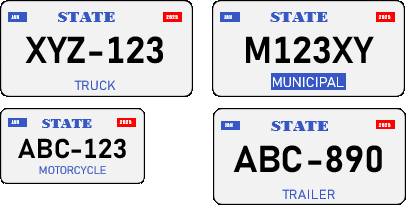
Figure 4‑2. Examples of Publicly and Privately Registered Motor Vehicle Registration Plates
The FHWA distinguishes between motorcycles on one hand and mopeds and motor bicycles on the other, although there are many similarities between the two categories.
For FHWA Form 561, a motorcycle is a vehicle with:
Motorcycles may have or may not have an enclosure for the driver or passengers.
Figure 4‑3. Motor Vehicles Classified as Motorcycles
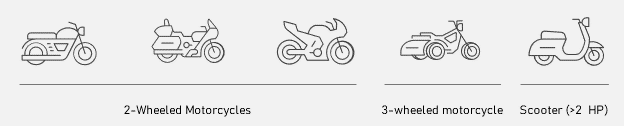
Sidecars and motorcycle trailers are not classified as vehicles. If a motorcycle has a sidecar or a trailer, the motorcycle with the sidecar or trailer is counted as one unit.
Motor bicycles and mopeds are vehicles with:
Figure 4‑4. Motor Vehicles Classified as Mopeds or Motor Bicycles
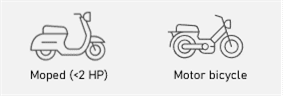
States should report passenger vehicles separately from motorcycles, mopeds, and motor bicycles, and motorcycles separately from motor bicycles and mopeds.
Buses with a capacity of 10 passengers or more that are used primarily for transporting students in grades K-12 between home and school should be counted as school buses.
Figure 4‑5. Example of Vehicle Registration Plate for a Publicly Registered School Bus

Many Federal agencies, such as General Services Administration, Department of Homeland Security, and the National Park Service, register their own motor vehicles. Vehicles registered to official foreign diplomats are another kind of federally registered vehicle. The State Department’s Diplomatic Motor Vehicle Program registers these vehicles.
Vehicles registered to the Federal Government should not be reported on FHWA Form 561.
Figure 4‑6. Examples of Vehicle Registration Plates of Federal Government Agencies


Figure 4‑7. Example of a Diplomatic Vehicle Registration Plate

In-transit registrations are provided to vehicle owners who buy a car in one State but register it in another State. Temporary registrations are provided at the sale of a motor vehicle until the vehicle is registered permanently. Such registrations are valid for a set number of days. States should not report in-transit or temporary registrations; they should report only permanent registrations.
Reporting and form submission are done through the FHWA online portal to its data-reporting software, Fuels and FASH. The form can be partially completed, and entries saved for later submission.
Explanations of each item in the form are provided in the following section.
This section is for the basic identifying information: State name, reporting date, and collecting agency.
This section is for the numbers of vehicle registrations active during the reporting period. There are four reportable vehicle categories—three self-powered groups (passenger vehicles, buses, and trucks) and one non-powered category (for trailers).
There are two columns under the Registrations tab, one for government, and one for private:
Figure 4‑8. Examples of Vehicles Included in Automobiles

Vehicles owned by the various levels of State and local governments and registered in the State are reported in the Government Registrations column. All other automobiles are reported in the Private Registrations column.
This item is for motorcycle registrations. This is the number of vehicles that meet the criteria for motorcycles that require registration in the State, including motorcycles, scooters, and trikes, for government and private registrations (see section Motorcycle? Or Moped or Motor Bicycle?).
This item is for motor bicycle and moped registrations issued to government and private entities. These do not include vehicles that were counted in the motorcycles category.
This item is the sum of passenger vehicle registrations issued to government and private entities. Fuels and FASH calculates this total automatically from items 1 to 3 on the registrations tab.
This item is for school bus registrations issued to government and private entities. This category includes buses with a 10-passenger or more capacity that are used primarily for transporting K-12 grade students between home and school.
If your State does not break down data into school and non-school bus subcategories, skip item 5 and item 6 on the registrations tab and enter the subtotal for all kinds of buses in item 7 on the registrations tab.
This item is for non-school bus registrations issued to government and private entities. This category includes buses with a capacity of 10 passengers or more that are not used primarily for transporting K-12 student to and from school.
This item is for States that do not break down bus registration data by school and non-school bus. If you did not enter data in item 5 or item 6 on the registrations tab, enter in this item the numbers of all registrations for all buses, both government owned and privately owned.
If your State provided data in items 5 and 6 on the registrations tab for school and non-school bus registrations, leave item 7 on the registrations tab blank.
Fuels and FASH calculates this total automatically from items 5 and 6 on the registrations tab.
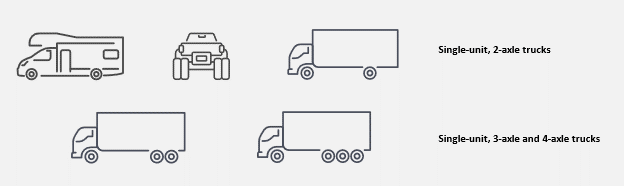
Single-unit truck—A truck, 10,000 pounds or more GVW, with a single frame supporting both the power and cargo-carrying portions of the vehicle.
This item is for recording the numbers of registrations issued for single-unit trucks of 10,000 pounds or more GVW to government and private entities. This category includes garbage collection trucks, neighborhood delivery trucks, camping and recreational vehicles, and motor homes. It also includes farm trucks that are operable on public roads. (Single-unit trucks of less than 10,000 pounds GVW are reported as passenger vehicles.)
Figure 4‑9. Single Unit Trucks
Truck tractor—A vehicle possessing only a power unit, with no cargo-carrying capacity on its frame.
This item is for the number of registrations for truck tractors, which are used to pull trailers and other vehicles. Include registrations for farm truck tractors unless your State restricts such vehicles from operating on public roads. Enter the numbers of truck tractor registrations issued to government and private entities.

If your State does not break down trucks by single-unit and truck tractors, this item is for the numbers of truck registrations issued to government and private entities. Enter the total numbers of government-owned trucks and privately owned trucks in this item.
If you enter data in item 9 for single-unit trucks and in item 10 for truck tractors on the registrations tab, leave this item blank.
Fuels and FASH calculates this item automatically from item 9 and item 10 on the registrations tab.
Trailer—a non-motorized vehicle meant to carry property or passengers that must be drawn by a motor vehicle.
This item is for the total number of trailers, including full, semi, mobile homes, and all others. Enter the numbers of all trailer registrations issued to government and private entities.
This section is for recording the fees and other receipts collected for vehicle registrations and registration-related actions. The data requested is for all registration fees collected during the reporting year.
Do not report the following types of receipts in this section:
In some States, certain items of motor vehicle revenue, such as driver license fees, highway patrol fines, and fees for periodic inspection of motor vehicles, are collected by the State highway department (in which case they are reported as motor vehicle revenue on FHWA Form 531) or by some other agency independent of the motor vehicle department. All such receipts, however, should be reported on FHWA Form 561 or FHWA Form 562, as appropriate, or on a schedule attached thereto, regardless of which agency collects them.
Some States impose special taxes that must be paid at the time of purchase, such as first registration or titling of a motor vehicle. These are generally imposed in connection with a general State sales tax. States should determine if an excise tax like this is a tax on motor vehicle users or if it is part of general State taxes.
If a tax is imposed under a separate legislative act and the law states or implies that the tax is compensation for use of highways, it is considered a special tax on the motor vehicle user. These are reported on FHWA Form 561. If the tax is imposed on motor vehicles only and is considered a user tax, even if this is not clearly stated or implied in the law, the proceeds are reported in Receipts. Item 6, Other Receipts.
Receipts from a general sales tax applied to the purchase of motor vehicles, other commodities, or to general commodities with exceptions for items such as food, are not reported on FHWA Form 561.
To learn whether receipts from a certain tax on motor vehicles are reported on or excluded from FHWA Form 561, contact FHWA Office of Highway Policy Information.
This is for the revenues collected by the State from all vehicle registrations, including for government-use and private-use vehicles. To calculate total revenues, take the fee per registration and multiply it by the number of total registrations. Enter this amount in this item.
The level of detail in the data for vehicle registrations that a State keeps determines how total registration fees are calculated.
This item is for the total revenues collected from issuing dealers’ licenses or permits. Include only fees for special dealer or garage licenses issued by the regulating agencies or agencies licensing motor vehicles, inspection, and repair. Include revenue from all dealers’ license plates, whether they are original or extra plates, and dealers’ motorcycle plates. Do not include business licenses that are required of all businesses.
This item is for the fees collected from issuing certificates of titles and/or certificates of ownership. Calculate the total revenues for all certificates of titles (sometimes called certificates of ownership) issued and enter it in this item. This includes all new titles and titles that were transferred during the period, as well as the fees associated with transferring car titles. Some States may have exceptions and may not require fees for the transfer of titles.
This item is for the fees related to motor vehicle registration violations. Include receipts from the fines and penalties collected by the motor vehicle department for infractions of motor vehicle registration laws and regulations. Receipts from fines and penalties imposed for breaking traffic laws, such as parking and moving violations, are not included. Include oversize and overweight penalties but do not include permit fees for overweight or oversize vehicles. Permit fees go in item 5. Calculate the total revenue for all motor vehicle registration violations and enter it here.
This item is for receipts from the registration of oversize and/or overweight vehicles. Calculate total receipts for all oversize and overweight permits and enter here. No other type of fee or tax should be reported on FHWA Form 561—just the registration fee.
This item covers all fees related to motor vehicle registration and operations collected by States other than those reported in itemized categories.
Calculate the total revenue for all other receipts and enter it in this item. This item covers all fees related to motor vehicle registration and operations other than those reported in Other Receipts. Other receipts may include registration fees received for vehicles with registration plates from another base jurisdiction or from States under a proration agreement such as the International Registration Plan (IRP), caravan fees, transit fees, towing fees, auto transport fees, vehicle safety inspection fees, vehicle emission test fees, title lien fees, and others. The dollar amount of other receipts should be minimal compared with itemized fees.
Also record collections and refunds for prior years.
| Include or Exclude | |
|---|---|
 |
 |
Receipts from fees for:
|
Receipts from fees accounted for in other sections:
|
Fuels and FASH calculates the total automatically from items 1 through 6.
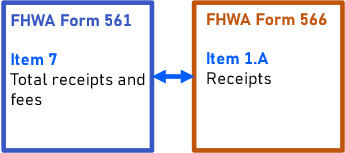 FHWA Form 561 has one relationship with another FHWA 500-Series form. FHWA Form 561, Item 7, Total Receipts and Fees should equal FHWA Form 566, item 1.A, Receipts.
Fuels and FASH conducts certain validation tests when a State submits a form. Then it generates a report showing the total percentage change over the past 3-year period and a line graph for the 3-year period. The report highlights data that shows questionable trends from one year to the next. Fuels and FASH prompts the State to view the graphs and reports and to return to the form for editing if data variances are outside of normal trends.
Using the 3-year data reports generated by Fuels and FASH, compare data with the previous year’s data, and if there is a significant increase, decrease, or other anomaly, investigate to identify the reason. If you find a legitimate reason for a large difference from the previous year’s data, add a justification for the item. Otherwise, return to the data sources to rectify the data.
After a State submits a form, an FHWA analyst reviews the form, examining the data quality report and reading all notes, justifications, and comments. The analyst may ask for more information. After this review, the analyst may accept or reject a form. The following reasons could lead to a form being rejected:
The FHWA analyst performs an in-depth review of all State forms for quality control. The FHWA staff may request additional information or corrections if the review finds erroneous data. States can go back to edit the form to explain the figures.
The FHWA analyzes all State-reported data for consistency and for adherence to reporting guidelines. Analysts may adjust or model data to improve consistency and uniformity among States (e.g., balancing or redistributing vehicles by defined vehicle type categories). The analysis and adjustment are accomplished in close consultation with the State supplying the data.
Light-duty trucks, which include pickups, vans, and SUVs, are recategorized as trucks in the MV-1 for several reasons. States typically define vehicle types by body type for registration data reporting, but this data does not always align with the vehicle classifications used in FHWA’s traffic monitoring system (TMAS). For this reason, we use the R.L Polk proprietary dataset (which the National Highway Traffic Safety Administration also uses). This data considers axle counts and spacing for vehicle type definition purposes that FHWA uses to reclassify the State-reported data. This helps FHWA data align more closely with the class data in TMAS (for example, auto VMT and truck VMT).
Generally, publicly owned vehicles include those owned by governments at the Federal, State, municipal, and county levels. States should not report Federal fleet registrations. The FHWA receives its data about publicly owned federally owned vehicles from the General Services Administration.
To mitigate the effects of poor data quality, FHWA makes checks to data. If State-submitted data raises questions about its accuracy, the State is contacted and asked to give the reasoning behind the questionable data and to correct and resubmit the data if possible. If the State cannot provide corrected data, the FHWA analyst adjusts the data. Previous-year data is adjusted using US Census population and government employment figures. Automobile and truck data are also adjusted to match proportional distributions found in the proprietary R.L. Polk dataset, which provides a national profile of all passenger vehicles registered in compliance with State requirements. The data is composed of a census of all registered passenger cars, light-duty trucks, and heavy trucks in the United Sates and provides indicators for new vehicle registration.
| << Prev | Contents | Next >> |





