U.S. Department of Transportation
Federal Highway Administration
1200 New Jersey Avenue, SE
Washington, DC 20590
202-366-4000
To improve quality of WIM data collection, Arizona DOT has developed and implemented the following procedure for routine (i.e., periodic) WIM equipment calibration.
For Weigh-in-Motion (WIM), calibration is the process of evaluating the measured weight and distance values reported by the WIM system against the known weights and distances and making necessary adjustments to the WIM system operating parameters to compensate for those errors. WIM calibration is performed to ensure that the data accuracy remains consistent and within the performance specification. As a result of the calibration, the mean error in WIM measurements should be reduced to as close to zero as possible. The WIM system calibration shall be performed by a qualified WIM technician in accordance with the manufacturer's specifications and requirements/guidelines set in ASTM E1318-09.
The ASTM E1318-09 performance specifications for Type I and Type II WIM Systems are provided in Table D-1.
TABLE D-1. FUNCTIONAL PERFORMANCE REQUIREMENTS FOR WIM SYSTEMS PER ASTM E1318-09
Function |
Tolerance for 95 % Compliance |
|
|---|---|---|
Type I |
Type II |
|
Wheel Load |
25% |
N/A |
Axle Load |
20% |
30% |
Axle-Group Load |
15% |
20% |
Gross Vehicle Weight |
10% |
15% |
Speed |
1 mph (2 km/h) |
|
Axle-Spacing and Wheelbase |
0.5 ft (0.15 m) |
|
Available reference sources for WIM System calibration include:
The Arizona DOT should develop a WIM Calibration Form to be used by WIM technician to record information about WIM site, static weights, and length measurements for the test trucks, data collected for the test truck runs, operational characteristics of the on-site equipment, pavement assessments, existing and new WIM compensation factors, classification study data, and photograph logs.
In addition, preventive maintenance forms should be provided to record test data from the pre-calibration WIM system electronic and electrical checks.
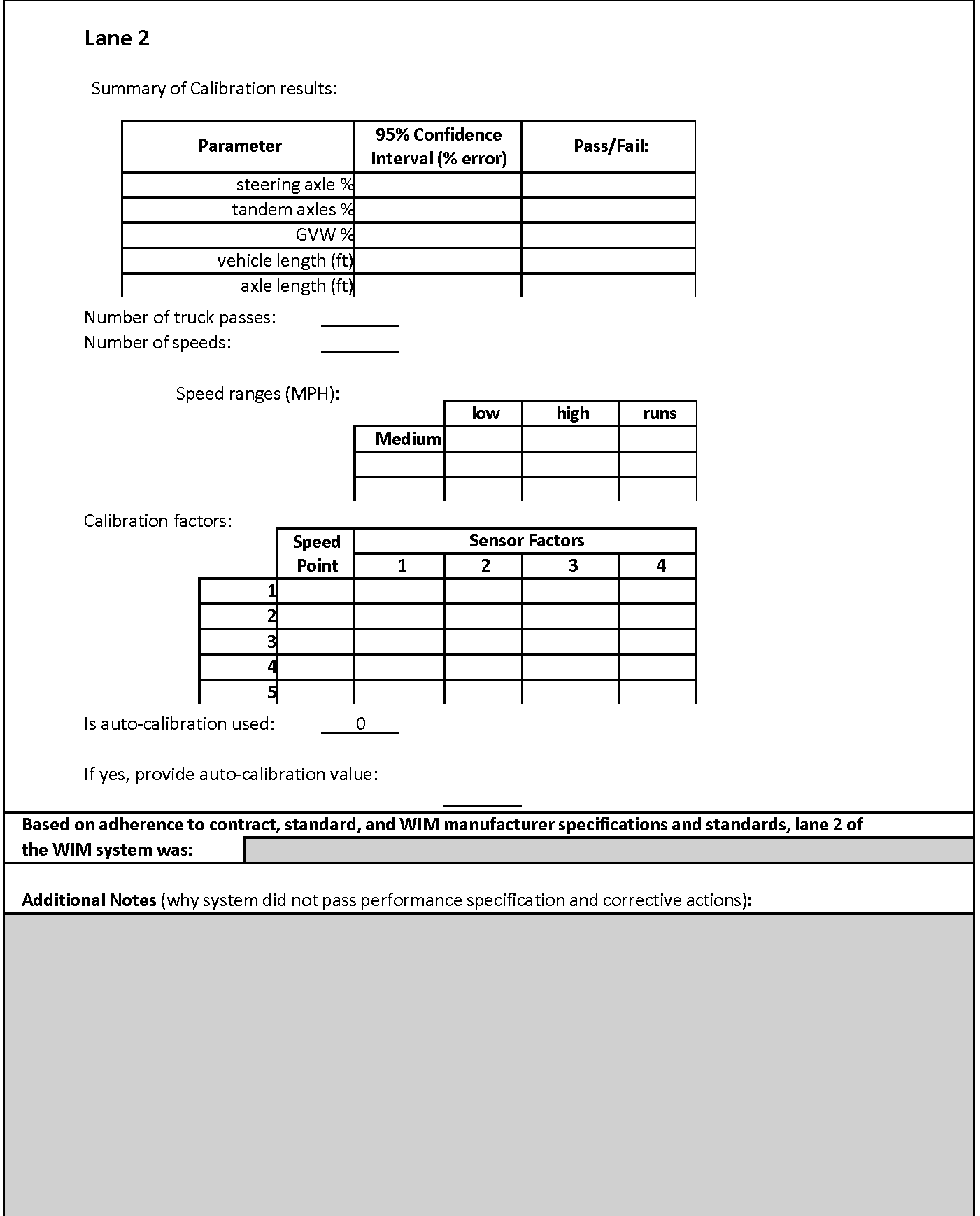
A template or content requirements for the WIM Calibration Summary Report should be developed by ADOT and used by WIM personnel for all WIM site calibrations for consistency in the reporting and to keep a historic record of WIM site performance. A sample WIM Calibration Summary Report from VDOT is provided in Appendix B.
If vehicle classification accuracy testing is desired during WIM calibration visits, ADOT vehicle classification algorithm implemented at the WIM site should be provided to the calibration field crew.
In order to maintain consistent WIM accuracy, and therefore uniform data quality throughout the year, it is important to periodically check WIM system performance and use WIM calibration activities to systematically compensate for the WIM system bias that tend to develop over time.
WIM systems using piezo-quartz sensors should be calibrated every 12 to 18 months, however, the frequency of calibrations may be affected by factors, such as:
Systems with piezo-polymer sensors that are used for collection of axle weight data, should be calibrated seasonally or have other means for consistent compensation of temperature effect on weigh measurement accuracy. If seasonal calibrations cannot be scheduled due to some constraints, users should be informed about seasonal deviations in weight measurement accuracy. If seasonal calibrations are not feasible, calibrate every 12 month during the season that has daily temperature as close to the annual average temperature as possible to avoid introduction of extreme bias, as could be in the case of calibrating during the seasons with either extremely cold or extremely hot temperatures.
The data processing and/or quality assurance personnel can provide inputs on when a WIM site needs to be calibrated based on the comparison analysis of the loading statistics based on the recently downloaded WIM data against the statistics based on the comparison data set. As stated earlier, for sites that have other contributing factors that lead to changes in "typical" truck weights observed at the site, such as seasonal crop or other commodity movement, these factors must be accounted for during data checks to determine if the data are "typical" or unexpected deviations have occurred.
The calibration of each WIM systems includes three parts: pre-visit, on-site, and post-visit activities. Combined, the WIM calibration process can be presented using the following roadmap.
The activities performed prior to the on-site visit are aimed to provide the field team with the information needed to establish the requirements for the test truck vehicles, including type, weight and speed. A pre-visit data analysis provides information on the current operational status of the WIM system and possible deviations in weight and length measurements from the values recorded in the comparison data set (CDS).
Step 1 – Pre-Visit WIM Data Analysis. Prior to the site visit, collect a recent data sample (2-4 weeks) from the WIM system and analyze the data to determine the current site characteristics that will be used to determine the types of trucks, loads and speeds for the calibration. From the pre-visit data analysis, annotate the following information on the WIM Calibration Form:
Criteria: the range of the test truck speeds should represent a 10 to 20 mph range of typical truck speeds that includes the 85th percentile speed for trucks at the site. Testing at three different speed points is recommended to minimize error dependency on speed.
Test truck body type, suspension, axle spacing, and loads should be representative of the trucks observed at the site.
Compare the expected traffic flow characteristics developed based on the data collected immediately after the most recent validation/calibration (the comparison data set – CDS) with the traffic characteristics based on the recently collected WIM data. Use the results to assess likelihood of calibration effort and to establish the likely range of compensation factors to be applied in the field. Annotate the following information on the WIM Calibration Form:
If available, analyze the most recent profile data (i.e. IRI data) from the WIM site location.
Criteria: When all values are less than the lower Smoothness Index threshold, it is unlikely that pavement conditions will significantly influence sensor output. Values between the Smoothness Index threshold values may or may not influence the accuracy of the sensor output and values above the upper Smoothness Index threshold would lead to sensor output that would preclude achieving the research quality loading data.
Table D-2. Recommended WIM Smoothness Index Thresholds
Index |
Lower Threshold (m/km) |
Upper Threshold (m/km) |
|---|---|---|
Long Range Index (LRI) |
0.50 |
2.1 |
Short Range Index (SRI) |
0.50 |
2.1 |
Peak LRI |
0.50 |
2.1 |
Peak SRI |
0.75 |
2.9 |
Step 2 – Selection of Test Trucks. When calibrating a WIM site, it is very important to accurately represent the population of the dominant heavy trucks (i.e. trucks in vehicle classes 4, 6-13) for that particular site. For instance, if the most frequently observed vehicles in the heavy truck categories are Class 9 and Class 10 trucks, it is vital that a Class 9 and a Class 10 truck be used for the calibration. Additionally, if 40% of the trucks at the site are fully loaded Class 9 trucks, and 35% are partially loaded Class 9 trucks, both types of loadings must be represented during the calibration. Lastly, if the dominant speed for trucks is 65 mph at a particular site, it is important that the test trucks make several runs at this speed or as close to this speed as possible without exceeding the speed limit.
Criteria: The truck configuration is an important consideration. The type of truck body, the load and its placement and suspension must be inspected to ensure that they will not induce adverse truck dynamics into the test. The load must be evenly distributed along the trailer, must be firmly secured to prevent sliding or shifting and must be covered to prevent the introduction of moisture in rainy weather conditions. The suspension must be closely inspected to ensure that airbags are not leaking, springs are not cracked or broken.
The test truck tandem axle spacing for the primary (heavily loaded) truck must be standard – typically 4.0 feet to 4.4 feet apart for the truck and trailer. The tandem spacing for secondary (partially loaded) truck must be standard for the truck, however, the trailer tandem may be split if it represents a large percentage of the truck population for the site. It is important to remember, however, that the split tandem configuration on the trailer may induce different dynamic effects and its behavior is different from that observed for a group of axles; thus, making the calibration more difficult.
The on-site activities include verification of the WIM system operation, measuring and evaluating the weight and distance measurement accuracies of the WIM system, and calibration.
Step 1 – Site Assessment. Perform the site assessment to determine the possible effect of pavement, equipment and site conditions on the accuracy of WIM weight and distance measurements.
Pavement Inspection
Vehicle-Pavement Interaction
Observe several trucks while they pass over the site to determine if truck traffic is showing adverse characteristics such as bouncing, swerving, braking, or accelerating within one hundred thirty-five feet (forty meters) of the sensors.
If feasible, determine whether the truck tires are in full contact with the sensors.
Document observed truck dynamics on the WIM Calibration Form, noting any adverse movements that are within the WIM scale approach area and that may affect the measurement accuracy of the WIM system. Include location from the WIM scale area.
Equipment Inspection
Criteria: If any discrepancies or deficiencies exist that will affect the measurement accuracies and cannot be remedied on-site, postpone the calibration.
Step 2 – Measurement of Test Trucks. This activity involves use of certified static scales. Certified scales should have been tested by the relevant agency within the past three years. Axle weight scales are preferred to platform scales.
Step 3 – Verify Communications with Test Truck Driver. Review the calibration procedures with the truck driver, including proper speeds and turnarounds. Review safety procedures.
Criteria: The truck cannot accelerate or decelerate in the WIM scale area and must travel down the center of the travel lane.
Step 4 – Pre-Calibration Test Runs. Pre-calibration test runs are conducted to quantify any potential system bias and overall measurement errors and consist of ten or more test truck runs over the range of speeds determined during the pre-visit analysis. After initial pre-calibration test truck runs, the system should be calibrated to minimize bias, and then the same number of post-calibration test truck runs should be performed to validate the system and quantify measurement data accuracy.
Criteria: The test truck runs must be conducted at the widest possible ranges of speeds and temperatures observed at the site. A sufficient number of pre-calibration runs should be performed to quantify WIM measurement error percent): at least ten test runs per truck, per lane.
Pavement Temperature
If WIM system shows measurement accuracy dependency on speed, it is important to collect the test truck data over the greatest range of temperatures as possible in order to minimize temperature-induced measurement bias. Although it is anticipated that all of the pre- or post-calibration test truck data will be collected in one day, due to cloudy or rainy weather conditions, it may be necessary to collect the test truck run data over the course of two days. The best times to do this would be in the early afternoon of the first day, and then as early as possible on the second day.
Criteria: A 30 degree Fahrenheit minimum pavement temperature range is the target for calibrating WIM performance under varying pavement temperatures. For systems that are using temperature compensation, the function should remain on.
It is recommended that for WIM sites that utilize the piezo-polymer sensor for weight measurement, and any other WIM sites that demonstrate measurement error dependency on temperature, that a review of prior calibration be performed to assist in determining the proper calibration of the WIM system based on seasonal temperatures. Data collected over seasons can eventually be used to fine tune the WIM systems temperature compensation curve, typically performed by the manufacturer.
Test Truck Runs
The number of test truck runs depends on the data variability observed at given WIM site. Sites that have consistent data errors (i.e. low variability of error) require less test runs that sites that have high error variability to collect a representative sample. Generally, this requires:
Data Collection and Recording
For each pass of test truck, obtain the WIM system's output for axle weights and axle spacings.
Step 5 – Test Truck Run Data Analysis to Evaluate WIM Performance. Once the data have been collected in the field, statistics must be computed to determine whether the WIM site meets the required accuracy parameters stated in WIM performance specification, which is typically the ASTM E1318-09 specification. The WIM system performance parameters can be evaluated using one of the two methods described below.
LTPP Method
The basic statistic required for this test is the error expressed as a percentage of the known value. The percentage of error calculated from the data collected for each run is then used to compute a series of summary statistics. These summary statistics are used to determine whether the scale is the acceptable quality data using the following procedure.
ASTM E1318-09 Method
The test method for determining compliance with these requirements under prevailing site conditions is:
Step 6 – System Calibration. Generally, the purpose of WIM calibration is to reduce the WIM system's dependency on speed, temperature, or in the case where multiple test trucks are used, truck type. However, the primary focus of calibration should be on reducing the dependency of error on speed under temperature conditions observed on the day of calibration. The dependency of error on temperature changes beyond those observed during calibration visit typically cannot addressed during routine calibration visit, as this requires access to the temperature compensation algorithm embedded in the WIM system's firmware which is not usually available to WIM operator without manufacturer assistance or specialized training. Also, unless multiple test trucks are used, the WIM systems accuracy as a function of type of truck cannot be effectively improved.
For weight: New Factor = (Old Factor * Static Weight)/WIM Weight For spacing: New Factor = (Old Factor * WIM Measure)/Static Measure
Step 7 – Post-Calibration Test Runs and Evaluation. Repeat Step 4-6, until WIM system performance parameters are within tolerances specified in Table D-1, up to 3 times if needed. The minimum of ten post-validation test truck runs may be performed if the system does not demonstrate the following:
If a particular site demonstrates a dependency on temperature, up to 20 runs per test truck spread over longer period of time may be required to accurately determine WIM measurements and confirm that calibration worked as expected.
Step 8 – Speed and Classification Accuracy Validation. To determine whether the equipment is classifying vehicles correctly at the site, use a sample of vehicles to compare the classifications based on the visual observations to the WIM classifier output. This sample should include a minimum of one hundred heavy vehicles (FHWA classes 4-13) unless such a sample would require more than three hours of collection effort (use 3-hour sample in the latter case).
Criteria: The number of classification errors involving truck classifications in vehicle classes 6 and higher should be less than 2% of the truck volume for the same set of vehicles. The percentage of "unclassified" vehicles should be no greater than 2%.
The post-visit activities include a data comparison analysis between the data samples from just prior to and immediately following the calibration. It is conducted to evaluate the effectiveness of the calibration. Then, the post-calibration sample is used to develop benchmark values for future data evaluation.
Step 1 – Post-Visit Data Analysis. For this analysis, a traffic data sample from the 14 days (30 days for low truck volume roads) immediately following the calibration is collected and compared with the CDS from the previous calibration event and the pre-visit data sample. These data are used to compare weight and distance measurements collected after calibration with the measurements based on the data from the previous CDS and the pre-visit data sample. The post-visit analyses is used to evaluate/confirm the effectiveness of the calibration. To conduct post-visit analyses, follow these steps:
Step 2 – Comparison Data Set Development. The data used for the post-visit analysis and statistics computed based on these data are considered the Data Comparison Set. These data and statistics could be used to periodically (bi-weekly or once a month) to compare with the statistics based on current data and prior to scheduling calibration visits. Depending on the analysis results (i.e. changes in average weight and length measurement values or shifts in the weight distributions over 5 percent), site calibration schedule may be accelerated or postponed.
Step 3 – Reporting of Results. Prepare a WIM Calibration Summary Report as shown below within two weeks after site calibration visit, including the following information: