U.S. Department of Transportation
Federal Highway Administration
1200 New Jersey Avenue, SE
Washington, DC 20590
202-366-4000
The FHWA's comprehensive highway information collection effort began when Congress recognized the need for information to support highway policy development. As early as 1904, the Federal Government began requesting data from States on their highway taxation, sources of revenue for highways and highway expenditures.
The establishment of the Department of Transportation brought together Federal programs for varying modes of transportation into a single, Cabinet-level organization. The Secretary of Transportation was charged to promote and undertake development, collection, and dissemination of technological, statistical, economic data, and other information concerning the following:
The FHWA needs specific data to meet its responsibilities to Congress and the pubic including “information required for: preparing proposed legislation and reports to Congress; evaluating the extent, performance, condition, and use of the Nation’s transportation systems; analyzing existing and proposed Federal-aid funding methods and levels and the assignment of user-cost responsibility; maintaining a critical information base on fuel availability, use, and revenues generated; and calculating apportionment factors” (23 CFR 420.105(b)). The FHWA recognized that many State planners and analysts who complete reporting forms are responsible for several reporting areas and need to understand how the different reports interrelate, why certain forms require reconciliation, and how to reconcile these forms. A broad understanding of the national reporting system is also needed to ensure effective coordination between State and local agencies involved in compiling highway statistics. The forms and instructions in this 500-Series Data Reporting Guidebook are designed to address this data collection need.
For the various FHWA reporting forms, data is collected from several State agencies and departments, and from many local units of government. It is recommended that a central location within a State DOT be charged with ensuring the consistency, accuracy, and comprehensiveness of the data by coordinating the State’s data reporting efforts. The planning division of the State DOT often assumes the role of clearinghouse for highway statistics on a statewide basis to serve its own data needs and those of the Governor, State legislature, and other State agencies. The FHWA suggests that the unit responsible for coordinating highway-related data within the State also be responsible for coordinating data reporting to FHWA.
To assist with the cost of obtaining and reporting statistical information to FHWA, State Planning and Research (SPR) Program funding is available to all States. The FHWA strongly encourages States to include the data collection and reporting activities of the 500-Series Data Reporting Guidebook in their annual SPR programs (23 CFR 420.105(a)).
The FHWA uses the data for recording historical information for developing datasets, which are used to perform analysis of highway investment needs, highway deterioration, and Highway Transportation Fund monitoring, including Federal-aid Highway Program funding apportionment to States. FHWA also uses data from the 500-Series forms to compile tables for the annual Highway Statistics Series publication. The FHWA analysts and other analysts at the national and State levels use the data in multiple ways. Some of the uses of this data include but are not limited to forecasting tax revenue, highway deterioration, and fuel consumption, transportation planning, determining conformance with air quality standards, multimodal design analysis, and roadway safety analysis. Various external users including members of academia, researchers, and insurance agencies use the 500-Series Forms data.
The Office of Highway Policy Information (HPPI) is the sole collector of data gathered through the 500-Series forms. The HPPI performs preliminary analysis of the data provided by States and accepts or rejects a form. If the HPPI data analyst rejects a form, they will ask the State to make corrections. After accepting a form for preliminary analysis, HPPI performs an in-depth review of all State forms for quality control.
The HPPI also conducts FHWA business functions such as HTF monitoring and attribution of HTF funds, conducting of highway investment needs analysis, reviewing technical assistance requests, responding to data requests from Congress, and disseminating data through publications such as Highway Statistics Series.
The 500-Series program covers four program areas:
The objective of this guidebook is to develop a consistent, coordinated, and comprehensive national overview of specific aspects of State and local transportation. For FHWA report forms, data often comes from several State agencies and departments and many local units of government. A central location in a State DOT can ensure data consistency, accuracy, and comprehensiveness by coordinating the State's data reporting efforts. Although data may be collected by various agencies, the State DOT is responsible for assembling and submitting data to FHWA.
The FHWA suggests that the unit in the State DOT responsible for coordinating highway-related data also be responsible for coordinating the reporting of such data with FHWA. When the data for a form is assembled, the State DOT should verify its accuracy and coordinate with the agency responsible for the collection of the data to verify the correctness of the data.
In coordination with the State DOTs, FHWA developed the 500-Series forms to facilitate submission of the data required by State DOTs to be submitted to FHWA annually in accordance with 23 CFR. 420.105. The State DOTs submit all the 500-Series forms using Fuels and Financial Analysis System for Highways (FASH). The table below lists 500-Series forms by program area (see Appendix C).
*Beginning in 2025, the FHWA Form 536 is to be submitted biennially for even-numbered data years (i.e., States’ 2024 data is required to be submitted in 2025); reporting for odd-numbered years is optional. Although submitted every other year, the form covers only a 1-year period. FHWA interpolates data for even-numbered years.
The FHWA on occasion finds it necessary to request supplemental statements or comments from the State to obtain a better understanding of the data, of the relationship of one report to another, or to maintain uniformity in the statistics. By comparing the requests of the prior year with the material assembled for the current year, the State highway planning division or coordinating office will be able to judge whether the current reports are sufficiently detailed and thus minimize the possibility of a repetition of requests for additional information and attendant delays.
Most forms in the 500-Series are completed and submitted annually. The FHWA has established staggered due dates for annual data submission—some States on January 1 and some States on April 1. These due dates are determined by a State’s budget cycle. For some States, the due date is determined based on the State DOT’s fiscal year, but for other States, the due date also takes into consideration the different budget cycles of the State agencies that provide the data, such as when a State DOT operates on a fiscal year, but the data-collecting agency operates on a calendar year. The staggered due dates for calendar and fiscal year reporting allow FHWA to process and analyze State data more efficiently.
The due dates are considered reasonable targets that all States can meet by using internal information systems and efficient management practices. Late submission of forms limits FHWA’s ability to review data from States and provide feedback on data quality. This in turn limits the amount of time that States need to rectify and resubmit the data to FHWA for finalization each fall.
All 500-Series forms reporting on State highway funding activities must be prepared on the same basis and for the same reporting year. If Form 531 and FHWA Form 532 are developed on a fiscal year basis, then FHWA Form 534 for State highway capital outlay and maintenance expenditures, and FHWA Form 541, and FHWA Form 542 for State transportation debt must also be prepared on the same fiscal year basis.
The FHWA Forms-556/561/562/571/566 do not need to have the same year ending cycle as each other. Although, they all must be in the same reporting year as the Forms FHWA 531/532 forms. For example, the FHWA Form 561 form year ending date can be reported on a fiscal year cycle (i.e., 6/2023 or 9/2023) but the FHWA Form 562 year ending date can be reported on a calendar year cycle (i.e., 12/2023).

State DOTs collect the data required for the 500-Series program and enter and submit the data using the 500-Series forms in the Fuels and FASH system (Fuels and FASH).
Fuels and FASH conducts certain validation tests when a State submits a form. It then generates a report showing the total percentage change over the past three years and a line graph for the three-year period. The report highlights data that shows questionable trends or large variances from one year to the next. Fuels and FASH prompts the State to view the graphs and reports and to return to the form for editing if data variances are outside of reasonable trends.
Using the 3-year data reports generated by Fuels and FASH, States should compare the current data with the previous year’s data, and if there is a significant increase, decrease, or other anomaly, the State should investigate to identify the reason. If the State finds a legitimate reason for a large difference from the previous year’s data, it should add a comment explaining the difference in the notes and comments section at the bottom of the form. Otherwise, the State should return to the data sources to rectify the issue with the data.
After a State submits a form, an FHWA analyst reviews it, examining the data quality report and reading notes, justifications, and submission comments. The FHWA analyst may ask the State for more information. After this review, the FHWA analyst may accept or reject a form. The following reasons could lead to a form being rejected:
The FHWA analyst performs an in-depth review of all State forms for quality control. The FHWA staff may request additional information or corrections if the review finds erroneous data. States can go back to edit the form to explain the figures.
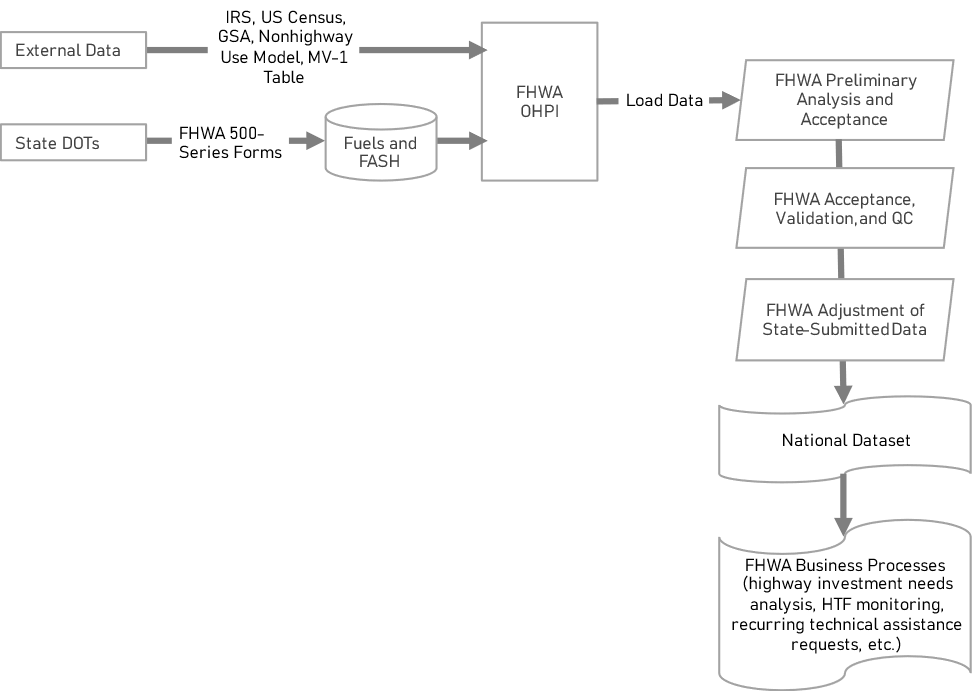
The FHWA analyzes all State-reported data for consistency and for adherence to reporting guidelines. The submitted data is used to develop a national dataset covering all the program areas. The national dataset is the official source of data to be used for various FHWA business processes such as highway investment needs analysis, Highway Trust Fund (HTF) monitoring, recurring technical assistance request and development of the annual Highway Statistics Series tables.
Figure 1-3 gives an overview of the process from collection of data to the use of the data that is compiled in a national database.
| << Prev | Contents | Next >> |





