U.S. Department of Transportation
Federal Highway Administration
1200 New Jersey Avenue, SE
Washington, DC 20590
202-366-4000
FHWA Form 566, State Motor Vehicle Registration Fees and Other Receipts: Initial Distribution by Collecting Agencies, provides FHWA with a measure of the funds flowing from collecting agencies to expending agencies. It summarizes the gross revenues collected from State taxation of motor vehicles, driver licenses, and motor carriers and reports the initial distribution of those tax receipts.
States report the initial distribution of tax revenue in FHWA Form 561, FHWA Form 562, and FHWA Form 571. The revenues reported on FHWA Form 566 should be consistent with the receipts reported on FHWA Form 561, FHWA Form 562, and FHWA Form 571, and the distributions reported on FHWA Form 531.

Completing FHWA Form 566 does not eliminate or alter the requirement to complete FHWA Form 561, FHWA Form 562, FHWA Form 571, and FHWA Form 531.
The FHWA uses State-reported data to support the annual processing, compilation, development, and certification of national datasets, which are used to perform analysis of highway system investment needs and levels of investment, highway system user activities and revenue sources, and HTF transactions, including Federal-aid Highway Program funding apportionments to States.
The FHWA also uses data from FHWA Form 566 to compile tables for the annual Highway Statistics publication. The FHWA analysts and other analysts at the national and State levels use the data in forecasting tax revenue, highway deterioration, and fuel consumption, and in transportation planning for determining conformance with air quality standards, multimodal design analysis, and roadway safety analysis.
State DOTs are ultimately responsible for the submission of FHWA Form 566 to FHWA. Different States have different organizational structures but FHWA Form 566 should be prepared using the records of the agencies that are responsible for the collection and distribution of funds from the taxation of motor vehicles, drivers, motor carriers, and other vehicles for hire. This often includes the State department of motor vehicles or State public utilities commission. Different agencies may collect the data required for FHWA Form 566—in some States, a different agency for each form that feeds into FHWA Form 566 (which are FHWA Form 561, FHWA Form 562, and FHWA Form 571). When the collecting agency is not the distributing agency and is only a conduit for transferring funds to the distributing agency, the State office or agency that maintains the most complete records of funds and distributions, such as the treasurer, comptroller, or auditor, should complete FHWA Form 566.
The FHWA division office should coordinate with State agencies to identify the agencies, offices, and personnel responsible for data collection, preparation, and quality control. Some division offices form user groups to encourage coordination among agencies for the preparation of data for FHWA.
If the State DOT relies on other offices and agencies for the data required for FHWA Form 566, it should ensure that their processes for data collection meet FHWA’s reporting requirements. Coordination among agencies to establish processes for translation or transformation of data may be necessary to meet reporting requirements.
Absence of coordination among State agencies may affect data quality and timeliness; staff turnover and retirement can disrupt established processes and affect data quality and timeliness. State agencies should document their procedures for data collection, analysis, and reporting to ensure the transfer of this essential knowledge when staff leave an agency. Proper documentation and knowledge transfer flatten the learning curve for new staff and reduce knowledge gaps that could lead to the reporting of erroneous data.
The State DOT should notify FHWA Office of Highway Policy Information of the contact information of the staff responsible for data preparation, including the person’s name, position title, office or agency name, email address, and phone number.
This section summarizes the recent changes in requirements for completing FHWA Form 566. The FHWA conducted a reassessment of the motor vehicle and motor-carrier revenue program, including a review of the historic data, to determine the extent to which the data collected is used for publication. The FHWA also sought and received information from States about their reporting systems and limitations for data collection. The FHWA also surveyed other Federal agencies about how they use the data in FHWA Form 566 and which data they would like FHWA to continue collecting. With this information, FHWA made the following changes to the reporting requirements for FHWA Form 566.
States may have to give special consideration to certain issues while compiling data on motor vehicle and motor carrier revenue or may have unique circumstances in the collection and reporting of the data. The following provides information about how to treat some of these special considerations.
FHWA Form 566 must be completed after FHWA Form 561, FHWA Form 562, and FHWA Form 571 are completed. The other three forms must be completed before data is entered in FHWA Form 566 because data from these forms is used in FHWA Form 566.
FHWA Form 566 has a section—from item 1.D to item 1.F—for reconciling data that can be used in a variety of ways. The following uses are common:
This is not an exhaustive list of ways to use items 1.D, 1.E, and 1.F but an illustrative sample.
Explanations of each item in the form and how to determine what data from FHWA Form 561, FHWA Form 562, and FHWA Form 571 goes in the form are provided in this section. FHWA Form 561, FHWA Form 562, and FHWA Form 571 should be completed before FHWA Form 566 is completed.
= FHWA Form 561, Item 7, Total Receipts and Fees
This item is for reporting vehicle registration receipts collected during the reporting year, including registration fees, title fees, and dealer licenses. This should be the same value that is on FHWA Form 561 item 7, Total Receipts and Fees.
If the reporting periods for FHWA Form 561 and FHWA Form 566 are different, inquire with the agencies responsible for providing the data to obtain the correct data for the months corresponding to the reporting period for FHWA Form 566.
= FHWA Form 562, Item F, Total Collections
This item is for the total funds collected from the issuance of driver licenses during the reporting period. This should be the same value as that in FHWA Form 562, item F, Total Collections.
The reporting periods for FHWA Form 562 and FHWA Form 566 should be the same. If the reporting periods of the data collecting agency (such as the DMV) and the DOT are different, inquire with the data collecting agency for data on the months corresponding to the reporting period.
= FHWA Form 571, Item 9, Column 7, Total Motor-Carrier Taxes Paid
This item is for the total funds collected from motor carrier taxes during the reporting period. This includes gross receipt, distance, and weight/capacity taxes; flat-rate fees; certificate or permit fees; and other miscellaneous fees and taxes. Enter the amount of these receipts for the reporting period. This should be the same value as that in FHWA Form 571, item 9 (Total Carriers) and column 7 (Total Motor-Carrier Taxes Paid).
The reporting period for FHWA Form 571 and FHWA Form 566 should be the same. If the reporting periods of the data collecting agency (such as the DMV) and the DOT are different, inquire with the data collecting agency for data on the months corresponding to the reporting period.
This item includes information to reconcile data between various forms. Refer to Special Considerations for examples of conditions for which these items can be used to reconcile receipts reported in FHWA Form 561, FHWA Form 562, and FHWA Form 571.
See the example in Exhibit 6-1.
A State submits FHWA Form 566 on a calendar year basis.
The State collects the data it needs for this form from three other FHWA 500-Series forms:
In this State, the Department of Transportation provides the data for FHWA Form 562 and FHWA Form 571, and the Department of Motor Vehicles collects the data for FHWA Form 561. But the two reporting agencies report data on different schedules, as the next table shows.
| Form | Reporting Agency | Time Period Reported |
|---|---|---|
| FHWA Form 561 | Department of Motor Vehicles | Calendar year: January 1, 2021-December 31, 2021 |
| FHWA Form 562 | Department of Transportation | Fiscal year: October 1, 2020-September 30, 2021 |
| FHWA Form 571 | Department of Transportation | Fiscal year: October 1, 2020-September 30, 2021 |
The data released by the DMV for FHWA Form 561 aligns with the schedule for FHWA Form 566 and does not need adjusting.
But the DOT schedule does not align, and the State must adjust the data from FHWA Form 562 and FHWA Form 571.
To complete FHWA Form 566, the State adjusts the data from FHWA Form 562 and FHWA Form 571. It
This item is the sum of total funds collected from all fees in items 1.A to 1.F. during the reporting period.
Fuels and FASH calculates this total automatically from data entered in items 1.A, 1.B, 1.C, and any data in optional items 1.D, 1.E, and 1.F.
This item is for the amount either retained by or paid to county and other local governments for their expenses in collecting motor vehicle and driver license fees, administering motor vehicle registration laws, issuing driver licenses, and providing other services normally associated with a State department of motor vehicles.
Enter the total funds retained by or paid to county and other local governments during the reporting period for
This item is for any deduction or expense for services at the county or other local government level not reported on item 2.A. during the reporting year. Enter the amount of any other funds retained by or paid to the county or other local government not entered in item 2.A. If you enter an amount in item 2.B, add a note explaining the amount entered.
These deductions are expenses incurred at the county or local level that are covered by the fees collected. For example, salaries for employees that work at the county or local level or administrative expenses belong in this item.
Do not deduct amounts paid to local governments for highway or other purposes in item 2.B. Such State-to-local transfers are reported in item 8.
This item reports the total funds retained by or paid to county and other local governments.
Fuels and FASH calculates this total automatically from data entered in items 2.A (Collection and Administrative Expense) and 2.B (Other Deductions).
Fuels and FASH calculates this total automatically from data entered in items 1.G (Total Receipts) and 2.C (Total).
This item reports total deductions by the State collecting agency used for operation and administration for expenses associated with the administration of motor vehicle, driver license, and motor carrier taxation before the funds are deposited in the State treasury or are otherwise disposed. If actual collection expenses are unavailable, they should be estimated.
Depending on the way the State deposits the collections from its motor vehicle, driver license, and motor carrier taxation programs, one of the following two scenarios could arise:
This is for amounts expended by the State department of motor vehicles or other collecting agency. For most States, this item equals the collecting agency deductions reported in item 4.
For items 4.A to 4.D, enter State collecting-agency expenditures on highway law enforcement and safety activities. Highway law enforcement and safety activities include:
For detailed definitions of these items, see section 2.1, Receipts and Expenditures of State Highway Agencies, instructions for FHWA Form 532, item A.5.
Do not include expenditures made by other State agencies for highway law enforcement and safety activities. Enter such amounts on FHWA Form 532, item A.5.
For items 4.E to 4.G, enter the collecting agency expenses for the administration of motor vehicle, driver-license, and motor-carrier taxation.
For item 4.H, enter and identify expenditures of the State collecting agency included in item 4 that do not fit in the categories for items 4.A to 4.G. Item 4.H must have a deduction explanation entered.
To avoid duplication, do not report on FHWA Form 566, item 4, any amount reported on FHWA Form 532.
If the collection expenses reported in item 4 represent appropriations rather than actual expenditures, there may be differences between items 4 and 10. If the collecting agency’s retained revenues differ from its actual expenditures, explain the difference in a note in the and provide the collecting agency’s opening and closing cash balances.
Item 4 may also be used to report additional collection expenses that were funded by other revenue sources, such as State general funds or highway funds.
This item includes the total expenditures by State collecting agency. Fuels and FASH calculates this total automatically from items 4A to 4.H.
This item is for net total funds available for distribution to pay to other agencies or apply to their accounts. Fuels and FASH calculates this amount automatically from item 3 (Net Receipts by State Collecting Agency) and items 10 A to I (Expenditures by State Collecting Agency).
This item is for the balance remaining from the previous reporting year. Enter the amount of any balance in the hands of the State collecting agency or any balance in its credit at the beginning of the reporting year. If this amount is different from the amount reported as undistributed at the end of the prior year, explain the difference.
If FHWA Form 566 is prepared using the records of a State treasurer, auditor, or comptroller, the balance may be the amount in a revolving fund, the general fund, or a highway-user distribution account in the State treasury. States may have to combine this fund balance with any amount in the hands of the collecting agency to account for the total amount of undistributed funds.
Fuels and FASH calculates this total automatically from data entered in item 5, Net Funds Available for Distribution, and item 6, Balance Undistributed at End of Previous Year.
This item shows the allocation of motor vehicle, driver license, and motor carrier revenues. If the amounts distributed and other road user taxes are placed in an intermediate clearing fund, such as a highway-user tax distribution fund, also provide a balance statement of the clearing fund.
Generally, refunds are deducted on FHWA Form 561, FHWA Form 562, and FHWA Form 571. But if refunds were not deducted, deduct them while computing the total amounts distributed on FHWA Form 566 in item 8. Add a note to identify these refunds.
This item is for the total funds available for distribution (item 7) minus the total funds distributed (item 8.K). Fuels and FASH calculates this item automatically.
FHWA Form 566 is a condensed statement of finances that FHWA relies on to interpret the data submitted by the States and to understand transactions. Supplemental schedules, such as balance statements of the motor vehicle inspection fund, driver training fund, and highway patrol fund, help FHWA perform its functions. Annual reports or budgets of the department of motor vehicles, department of public safety, highway patrol, and other transportation-related agencies that collect funds are also helpful reference material for FHWA analysts.
When new State legislation affects the amount or distribution of motor vehicle or motor carrier revenues, also provide a copy of the legislation.
The data in FHWA Form 566 is related to data in several other FHWA 500-Series forms: FHWA Form 561, FHWA Form 562, and FHWA Form 571.
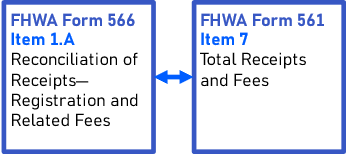 The reconciliation of fees reported on FHWA Form 566, item 1.A (Registration and Related Fees), which is the total value of receipts during the reporting year, including registration fees, title fees, dealer licenses, and other receipts, should be equal to the receipts entered for FHWA Form 561, item 7 (Total Receipts and Fees).
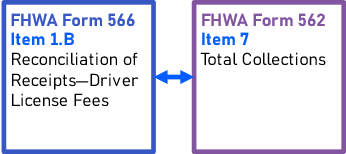 The reconciliation of fees reported on FHWA Form 566, item 1.B (Driver License Fees), which is the total funds collected from issuing drivers licenses during the reporting period, should be equal to the value entered for FHWA Form 562, item 7 (Total Collections).
 The reconciliation of fees reported on FHWA Form 566, item 1.C (Motor Carrier Taxes), which is the total funds collected from motor carrier taxes during the reporting year, should be equal to the value entered for FHWA Form 571, item 9 (Total Motor Carrier Taxes Paid for Total Carriers).
 The amount in FHWA Form 566, item 6, should be equal to the value entered for prior year FHWA Form 566, item 9 (Balance Undistributed at End of Year). If these values do not agree, provide a note explaining why.
The table summarizes these relationships.
FHWA Form 566 is completed after FHWA Form 561, FHWA Form 562, and FHWA Form 571. Fuels and FASH flags values entered in FHWA Form 566 that differ from values entered in FHWA Form 561, FHWA Form 562, and FHWA Form 571.
Fuels and FASH conducts certain validation tests when a State submits a form. Then it generates a report showing the total percentage change over the past 3-year period and a line graph for the 3-year period. The report highlights data that shows questionable trends from one year to the next. Fuels and FASH prompts the State to view the graphs and reports and to return to the form for editing if data variances are outside of normal trends.
Using the 3-year data reports generated by Fuels and FASH, compare data with the previous year’s data, and if there is a significant increase, decrease, or other anomaly, investigate to identify the reason. If there is a legitimate reason for a large difference from the previous year’s data, add a note. Otherwise, return to the data sources to rectify the data.
After a State submits a form, an FHWA analyst reviews the form, examining the data quality report and reading all notes, justifications, and comments. The analyst may ask for more information. After this review, the analyst may accept or reject a form. The following reasons could lead to a form being rejected:
The FHWA analyst also performs an in-depth review of all State forms for quality control. The FHWA staff may request additional information or corrections if their review finds erroneous data. States can go back to edit the form to explain the figures.
The FHWA analyzes all State-reported data for consistency and for adherence to reporting guidelines. The analysis is accomplished in close consultation with the State supplying the data.
| << Prev | Contents | Next >> |





