U.S. Department of Transportation
Federal Highway Administration
1200 New Jersey Avenue, SE
Washington, DC 20590
202-366-4000
This chapter provides instructions for preparing FHWA Form 571, Receipts from the State Taxation of Motor Vehicles Operated for Rent (for Hire) and Other Motor Carriers. Vehicles operated for rent and certain other vehicles that, because of the specific nature of their operations, are subject to taxation not imposed on motor vehicles in general, are known as motor carriers. Motor carriers can be cars, buses, or trucks.
States use FHWA Form 571 to report the motor carrier taxes collected throughout the year, by vehicle type. Gross receipt taxes, distance taxes, weight and capacity taxes, flat rate fees, certificate and permit fees, and miscellaneous fees are reported on this form.
FHWA uses State-reported data to support the annual processing, compilation, development, and certification of national datasets, which are used to perform analysis of highway system investment needs and levels of investment, highway system user activities and revenue sources, and HTF transactions, including Federal-aid Highway Program funding apportionments to States.
The FHWA also uses data from FHWA Form 571 to compile tables for the annual publication Highway Statistics publication. The FHWA analysts and other analysts at the national and State levels use the data in forecasting tax revenue, highway deterioration, and fuel consumption, and in transportation planning for determining conformance with air quality standards, multimodal design analysis, and roadway safety analysis.
State DOTs are ultimately responsible for the submission of FHWA Form 571 to FHWA. Different States have different organizational structures, and if the State DOT relies on other offices and agencies such as department of revenue or department of motor vehicles for the data required for FHWA Form 571, it should ensure that their processes for data collection meet FHWA’s reporting requirements. Coordination among agencies to establish processes for the translation or transformation of data may be necessary to meet reporting requirements.
The FHWA division office should coordinate with State agencies to identify the agencies, offices, and personnel responsible for data collection, preparation, and quality control. Some division offices form user groups to encourage coordination among agencies for the preparation of data for FHWA.
Absence of coordination among State agencies may affect data quality and timeliness; staff turnover and retirement can disrupt established processes and affect data quality and timeliness. State agencies should document their procedures for data collection, analysis, and reporting to ensure the transfer of this essential knowledge when staff leave an agency. Proper documentation and knowledge transfer flatten the learning curve for new staff and reduce knowledge gaps that could lead to the reporting of erroneous data.
The State DOT should notify FHWA Office of Highway Policy Information of the contact information of the staff responsible for data preparation, including the person’s name, position title, office or agency name, email address, and phone number.
This section summarizes the recent changes in requirements for completing FHWA Form 571. The FHWA conducted a reassessment of the motor carrier program, including a review of the historic data, to determine the extent to which the data collected is used for publication. The FHWA also sought and received information from States about their reporting systems and limitations for data collection. The FHWA also other Federal agencies about how they use the data in FHWA Form 571 and which data they would like FHWA to continue collecting. With this information, FHWA made the following changes to the reporting requirements for FHWA Form 571.
States may have to give special consideration to certain uncommon issues in compiling data, or they may have unique circumstances in the collection and reporting of data on motor carrier taxation. The following gives States more information about how to handle some of these circumstances.
FHWA Form 571 is designed to provide a record of special State taxes—those in addition to registration fees—paid by each type of motor carrier. Report all State-imposed motor carrier taxes regardless of the collecting agency.
Taxes imposed by county or municipal governments on motor vehicles operated for hire and on other motor carriers are not reported on FHWA Form 571.
In some States, special motor-carrier taxes imposed by the State are collected by county or local government officers, who deduct amounts for collection expenses (or for other purposes) and forward the net collections to the State collecting agency. Report the amounts deducted in FHWA Form 566. If your State does not track the amount of such deductions, estimate the amounts for FHWA Form 566.
FHWA Form 571 is designed to provide a record of special State taxes, in addition to registration fees, paid by each type of motor carrier.
Report all State-imposed motor carrier taxes, regardless of the collecting agency. But do not report taxes imposed by county or municipal governments on motor vehicles operated for hire and other motor carriers.
Explanations of each item in the form are provided in the following section.
This section should include the sum of different types of motor carrier taxes collected. Examples of what to include and exclude in FHWA Form 571 are shown below.
This column is for the total sum of all taxes levied on motor carriers for the reporting period. Include taxes levied on motor carriers, but do not include receipts from general taxes, such as sales tax or gross receipt taxes applied to general business operations.
In this column, enter the sum of all taxes based on distance that were collected during the reporting period. This includes all distance, weight-distance, and passenger-distance taxes.
This column is for the sum of all taxes collected during the reporting period from special-license taxes based on weight or capacity. Do not include registration fees for weight or capacity of motor vehicles.
Enter the sum of all flat business fees and occupation licenses fees collected during the reporting period.
This column is for the sum of all fees imposed for the issuance of certificates of convenience and necessity during the reporting period.
This column is for miscellaneous fees related to motor carriers that are not reported in the other categories. Add a note detailing specific information about the fees.
This column is for the total of all motor-carrier taxes paid. Fuels and FASH calculates this item automatically from the totals of columns 1 to 6.
This section is for tax information by vehicle type.
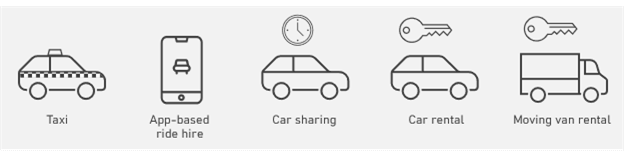
This item is for all taxes collected for passenger cars for hire during the reporting period. Include all taxicabs, delivery cars, app-based ride hire, car rentals, car sharing, and other automobiles operated for hire including moving van rentals.
Figure 7‑1. Examples of Passenger Cars for Hire
This item is for taxes collected for motor carrier buses during the reporting period. Include motor vehicles that seat more than 11 passengers that are operated for hire or are otherwise subject to taxation as motor carriers. Exclude school buses unless they are subject to special motor carrier taxes. If school buses are subject to special motor carrier taxes, add a note to that effect.
This item is for taxes collected for passenger motor carriers during the reporting period. Fuels and FASH calculates this item automatically from items 1 and 2.
This item is for taxes collected for single-unit trucks during the reporting period. A truck of 10,000 pounds or more GVW, with a single frame supporting both the power and cargo-carrying portions of the vehicle, is considered a single-unit truck. This category includes garbage collection trucks, neighborhood delivery trucks, camping and recreational vehicles, and motor homes.
This item is for taxes on tractor trucks, road tractors, and similar trucks—trucks that are equipped as power units for combination vehicles—during the reporting period. If your State does not segregate tractor trucks and road tractors from other trucks or if it registers tractor-semitrailer combinations as trucks, add a note to that effect.
If your State does not report tractor-semitrailer combinations separately but as single entities, report the fees paid by such combinations here and add a note of explanation. Report extra trailer units in Item 7, Trailers and Semitrailers.
This item is for taxes collected for motor trucks and tractor trucks, road tractors, and similar trucks. Fuels and FASH calculates the total automatically from items 4 and 5.
This item is optional. It is for reporting separate taxes imposed on trailers and semitrailers, if any. If your State taxes trailers and semitrailers as separate vehicles, enter the amount collected here. Enter zero if your State does not wish to provide the data.
But if the State tax on a trailer or semitrailer is part of the tax imposed on the hauling vehicle, report that amount in Item 4, Motor Trucks or Item 5, Tractor Trucks, Road Tractors, as appropriate, and add a note here about where the tax is reported.
This item is for taxes collected for freight motor carriers and trailers and semitrailers. Fuels and FASH calculates this item automatically from items 6 and 7. (Item 6 is already the subtotal of items 4 and 5.) If trailers and semitrailers are not reported, this item has the same value as item 6.
= FHWA Form 566, Item. 1.C, Reconciliation of Receipts—Motor Carrier Taxes
This item is for taxes collected from total passenger motor carriers and total freight carriers. Fuels and FASH calculates the total from data in items 3 and 8.
 Form 571 has a relationship with one other FHWA 500-Series form. Item 9(7) on FHWA Form 571 (Total Motor Carrier Taxes Paid for Total Carriers) should be equal to the receipts reported in FHWA Form 566, column C, item 1.C. Motor Carrier Taxes.
Fuels and FASH conducts certain validation tests when a State submits a form. Then it generates a report showing the total percentage change over the past 3-year period and a line graph for the 3-year period. The report highlights data that shows questionable trends from one year to the next. Fuels and FASH prompts the State to view the graphs and reports and to return to the form for editing if data variances are outside of normal trends.
Using the 3-year data reports generated by Fuels and FASH, compare data with the previous year’s data, and if there is a significant increase, decrease, or other anomaly, investigate to identify the reason. If there is a legitimate reason for a large difference from the previous year’s data, add a justification for the item. Otherwise, return to the data sources to rectify the data.
After a State submits a form, an FHWA analyst reviews it, examining the data quality report and reading all justifications and submission comments. The analyst may ask for more information. After this review, the analyst may accept or reject a form. The following reasons could lead to a form being rejected:
The FHWA analyst performs an in-depth review of all State forms for quality control. The FHWA staff may request additional information or corrections if the review finds erroneous data. States can go back to edit the form to explain the figures.
The FHWA analyzes all State-reported data for consistency and for adherence to reporting guidelines. The analysis is accomplished in close consultation with the State supplying the data.
| << Prev | Contents | Next >> |





